

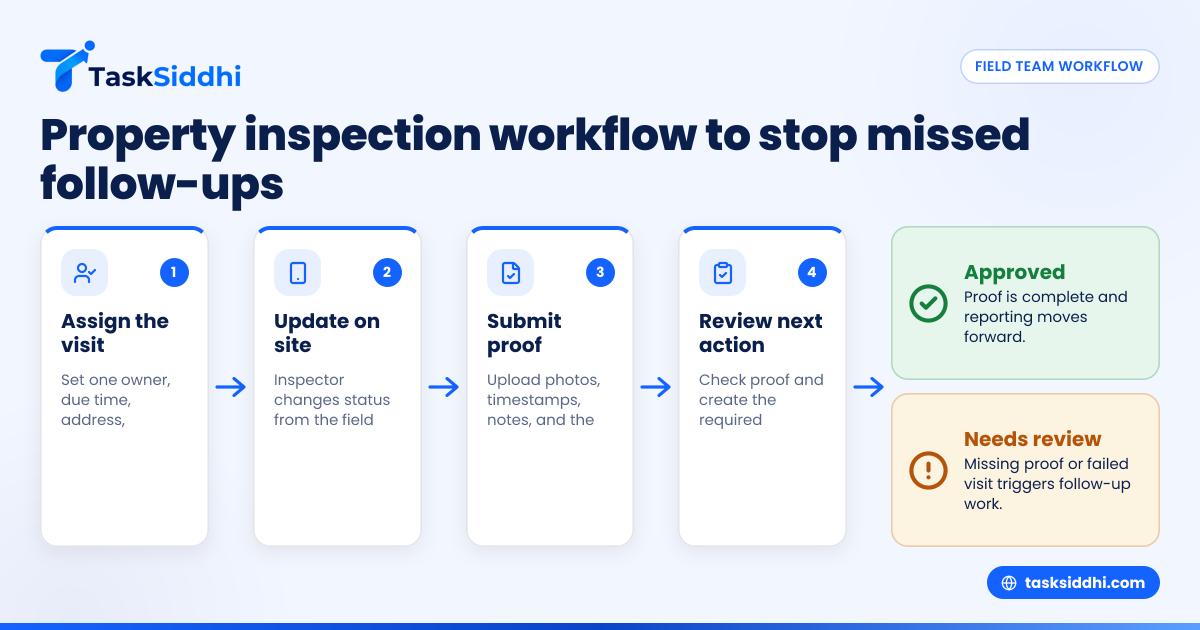
Field team task management in the United States for property inspection companies means giving every inspection a clear owner, due time, checklist, and proof requirement from the moment it is booked. The goal is simple: fewer missed visits, faster reports, and no follow-ups slipping through email threads, paper notes, or text messages.
Key takeaways
- Property inspection teams need one system for assignments, status, proof, and follow-up tasks.
- Missed follow-ups usually come from unclear ownership, weak proof standards, and no deadline tracking.
- A good process uses job cards, mobile updates, photo proof, timestamps, and simple reporting.
- Managers should track visit completion, report turnaround, open follow-ups, and overdue work every day.
- Field teams in cities like Houston, Chicago, and Detroit benefit from mobile-first workflows because staff are rarely at desks.
- TaskSiddhi can help inspection teams organize work with boards and views, field visits, time tracking, and reporting.
Why property inspection companies struggle with field team task management in the United States
Property inspection companies in the United States often start with tools that feel easy. A manager sends addresses by text. An inspector replies with photos by email. A coordinator updates an Excel file later. That works for a small team, until volume grows.
Then problems stack up fast. One inspector thinks a follow-up is optional. Another forgets to upload all photos. A client asks for proof of a site visit from last week, and the team spends 30 minutes searching phones and inboxes. A reinspection request gets buried in a shared mailbox. A property in Chicago is marked “done,” but the tenant access issue was never recorded.
This is where field team task management matters. It is not just a digital to-do list. It is the operating system for how your inspection business runs day to day.
For property inspection companies, a task management process must answer five basic questions every time:
- What property needs inspection?
- Who owns the visit?
- What proof is required?
- What happens next after the visit?
- Who checks that the follow-up actually happened?
If your team cannot answer those quickly, missed work becomes normal. Clients see delays. Office staff chase updates all day. Inspectors lose time to duplicate calls and messages.
In the United States, many inspection businesses also deal with strict client expectations. Property managers, insurers, lenders, and vendors expect clear records. They may want timestamps, photos, notes, and a reliable trail of communication. They may also expect quick turnaround before the next business day. If your team is still running on spreadsheets and phone calls, consistency becomes hard.
What does a good property inspection workflow look like?
A good workflow gives each inspection one clear record, one owner, one deadline, and one next step. The inspector updates status from the field, uploads proof on site, and triggers follow-up work before the visit is forgotten.
That sounds basic, but most missed follow-ups happen because one of those pieces is missing. The visit may be assigned, but no proof standard exists. Or the proof exists, but nobody creates the repair estimate follow-up. Or the follow-up is discussed, but not assigned with a due date.
The core stages every inspection company should define
Most property inspection teams can simplify operations by using a standard set of stages. The exact names can vary, but the logic should stay consistent.
A common flow looks like this:
- New request received
- Visit scheduled
- Inspector assigned
- On site
- Proof submitted
- Review pending
- Follow-up needed
- Follow-up assigned
- Client sent report
- Closed
These stages help the office and the field stay aligned. Everyone knows what “done” means at each point. That is much better than vague updates like “handled,” “checked,” or “sent over.”
Why proof standards matter more than status labels
A status alone is not enough. “Completed” means very little if each inspector uses a different standard.
For a property inspection company, proof usually includes some mix of:
- Exterior photos
- Interior photos
- Arrival time
- Departure time
- Notes on access
- Occupancy details
- Damage observations
- Safety concerns
- Signature or acknowledgment, where required by the client
- Next-step recommendation
Without this structure, the office must ask for missing details later. That slows billing, reporting, and client response. It also increases risk when clients dispute whether a visit happened or what the inspector found.
This is why mobile job records matter. A field team should be able to update the job while on site, not hours later from memory. With a tool built for field visits, teams can keep proof attached to the work item itself instead of scattering it across phones and inboxes.
How do you assign property inspection visits without confusion?
Assign each visit to one person, one date, and one time window. Add the address, access notes, required proof, and the exact next action if the visit cannot be completed.
That short answer solves most confusion, but it only works when assignment rules are consistent across the business.
Set assignment rules before the day starts
Many companies assign work reactively. A request comes in, and whoever is available gets a text. That creates uneven workloads and unclear accountability.
Instead, build a simple assignment policy around these factors:
- Geography
- Property type
- Priority
- Inspector skill
- Client deadline
- Access window
For example, if you have three inspectors in Houston, split work by zone or route. If one inspector handles commercial properties better, route those jobs intentionally. If a lender client needs same-day reporting, flag those jobs early.
The assignment should include everything the inspector needs before leaving:
- Full property address
- Contact name and phone number
- Appointment window
- Special access instructions
- Required checklist
- Photo requirements
- Notes from prior visits
- Target submission time
Use one owner per visit
Shared ownership creates dropped work. If two people think they are responsible, no one is truly responsible.
Every job card should have one primary owner. Other people can support, review, or approve. But one person must be accountable for completing the visit or escalating a problem.
This matters most when something goes wrong. If a tenant is not available or a lockbox code fails, the assigned inspector should know exactly what to do next. That next step should already be part of the task.
Standardize failed-visit outcomes
Not every inspection can be completed on the first trip. That is normal. What causes chaos is when each inspector handles failed visits differently.
Create standard outcomes such as:
- No access
- Customer not available
- Unsafe conditions
- Reschedule required
- Wrong address
- Additional approval needed
Each outcome should trigger a required action. For example, “No access” might require one exterior photo, one note, and a same-day reschedule task. That is how you stop missed follow-ups.
How can an ai field team process reduce missed follow-ups?
An ai field team process helps by turning visit updates into clear next actions. When notes, proof, and status live in one workflow, managers spot missing follow-ups faster and can standardize what happens after each inspection result.
The phrase matters because many owners are looking for ways to reduce manual checking. But the real benefit is not magic. It is structure. Better task management makes it easier to see what still needs action.
Build follow-up rules into the workflow
A follow-up should never depend on memory. It should depend on the inspection outcome.
For example:
- Inspector marks “damage found.”
- The system requires photos and notes.
- A repair estimate task is created.
- The office reviewer gets notified.
- A due date is set for client reporting.
This is where automation becomes useful. The purpose is not to make your process complex. The purpose is to remove manual handoffs that break under pressure.
Separate field completion from office completion
Many inspection businesses mark a job “done” when the inspector leaves the property. But from the client’s point of view, the work may not be done until the report is reviewed and sent.
That is why you need two completion points:
- Field complete
- Admin complete
This helps managers see whether the bottleneck is in the field or in the office. It also prevents unfinished follow-up tasks from disappearing behind a “completed” label.
What proof should inspectors collect on every visit?
At minimum, collect timestamped photos, arrival and departure updates, property notes, and a clear outcome. If a visit fails, collect proof of the reason and create the next task before the inspector leaves the site.
That is the short version. The exact proof standard depends on your client type and service line, but consistency matters more than complexity.
Create a proof checklist by inspection type
Different jobs need different proof. A single-family exterior inspection does not need the same checklist as a multifamily occupied-unit visit.
Start with three to five common inspection types. Then define the proof needed for each.
For example:
Exterior property inspection
- Front elevation photo
- Street view photo
- Address confirmation photo if possible
- Notes on occupancy signs
- Damage or maintenance notes
- Arrival and completion time
Interior inspection
- Entry confirmation
- Photos by room
- Safety issues
- Utility status notes
- Damage details
- Occupancy observations
- Completion time
Failed access attempt
- Arrival update
- Exterior proof photo
- Reason for failure
- Contact attempt note
- Reschedule or escalation task
This level of standardization reduces rework. It also helps new inspectors perform more consistently.
Collect proof in the field, not at the end of the day
When proof is uploaded later, details get lost. Photos stay on phones. Timestamps become less useful. Notes become vague.
A mobile workflow is better. Inspectors should complete the job card from the property itself. A mobile app supports that habit because the task, checklist, and proof live in one place.
The best setup for a team of 5 to 30 inspectors
For most small and midsize inspection companies, the best setup is simple: one board for active work, standard job cards, clear due dates, mobile proof capture, and a daily review of overdue follow-ups. Complexity usually hurts adoption.
Keep the board structure simple
Many teams overbuild their systems. They create too many statuses, too many exceptions, and too many custom fields. Then no one updates the board properly.
A practical board for property inspections might include:
- New
- Scheduled
- Assigned
- On site
- Proof submitted
- Review
- Follow-up
- Report sent
- Closed
That is enough for most teams. If you need deeper sorting, use filters or views rather than adding more stages. Tools with boards and views help managers separate same-day visits, overdue jobs, and client-specific work without cluttering the main process.
Use job templates
Templates save time and improve quality. They are useful for:
- Vacant property inspections
- Occupied property visits
- Insurance-related inspections
- Commercial site checks
- Reinspections
Each template can include the standard checklist, proof rules, and instructions. That keeps office staff from rewriting the same directions over and over.
Track inspector time where it helps operations
Time tracking is not only for payroll. It helps reveal routing problems, overloaded staff, and jobs that always take longer than planned.
If one Detroit route consistently causes late completions, the issue may be travel time, property density, or access delays. Structured time tracking can show patterns that text-message updates cannot.
The metrics that show whether your process is working
If you cannot measure the workflow, you cannot improve it. Property inspection teams do not need dozens of dashboards. They need a handful of numbers reviewed consistently.
Start with these metrics:
- Visits assigned today
- Visits completed today
- Proof submitted same day
- Open follow-ups
- Overdue follow-ups
- Average report turnaround time
- Failed access rate
- Revisit rate
These numbers tell you where work breaks down. If completed visits are high but proof-submitted rates are low, your field process is weak. If proof is on time but report turnaround drifts, your office review process needs attention.
Review by client and by inspector
Do not only look at totals. Split your reporting by client and by inspector.
A client may have higher failed-access rates because scheduling is poor. One inspector may have more missing proof because expectations were never made clear. Once you see patterns, you can fix the cause instead of chasing symptoms.
A tool with built-in reporting can make these reviews easier, especially when your team is spread across multiple routes and properties.
A practical rollout plan for inspection companies
The fastest way to improve field team task management in the United States is not a full rebuild. It is a phased rollout.
Step 1: Document your current workflow
Write down how a job moves today from request to closure. Include all handoffs. Include every point where a manager must remind someone manually.
This will show you where follow-ups get lost.
Step 2: Standardize visit types and proof
Pick your top three inspection types. Create one checklist and one proof standard for each.
Do not start with edge cases.
Step 3: Define statuses and owners
Decide what each status means. Decide who owns the task at each stage.
This removes ambiguity.
Step 4: Pilot with one team or one client
Test the process on a small portion of work for one to two weeks. Watch where inspectors hesitate. Watch where office staff still rely on side messages.
Step 5: Add automations for repeated follow-ups
Once the manual process is clear, automate repeatable steps like review reminders, failed-visit escalations, and follow-up task creation.
Step 6: Review metrics weekly
Use a short weekly review. Focus on overdue follow-ups, revisit causes, and report delays.
The goal is consistency, not perfection.
Common mistakes property inspection companies should avoid
Even good teams make the same avoidable mistakes.
Mistake 1: Treating messages as the system of record
Text messages and email are useful for communication. They are not a reliable job record.
Mistake 2: Closing jobs before follow-ups are assigned
If the inspector finds damage and no follow-up task exists, the job is not truly finished.
Mistake 3: Letting each inspector define “complete”
Completion should be based on a standard checklist, not personal judgment.
Mistake 4: Tracking everything in one spreadsheet
Spreadsheets are fine for summaries. They are weak for live field execution, proof tracking, and status visibility.
Mistake 5: Making the process too hard to use on the road
If updating a job takes too many taps or too much typing, inspectors will delay updates until later.
A practical work management system should support the real work of service jobs and client work, not create extra admin for people in the field.
If you want a simpler way to assign visits, capture proof, and keep follow-ups from slipping, see the product tour or compare plans on pricing.