














Improving service job tracking in US businesses means organizing work details clearly, tracking time and materials accurately, and using real-time updates to speed billing and boost customer satisfaction. Effective tracking cuts delays and errors, helping managers and teams stay on the same page.
Key takeaways
- Service job tracking helps document job progress, materials used, and technician time for quick, accurate billing.
- Using the right system reduces job completion errors and customer complaints.
- Real-time updates improve communication between field teams and office staff.
- Automating workflows frees managers to focus on customer relationships, not paperwork.
- Accurate tracking supports compliance with US tax rules and 1099 reporting when using subcontractors.
- AI service job features can assist in scheduling, estimating, and monitoring jobs for efficiency.
why is service job tracking important for US service businesses?
Service job tracking gives businesses a clear record of what was done, when, and by whom. This documentation speeds up billing as invoices are generated from accurate, updated job data rather than guesswork. When all team members have real-time visibility of job status, they avoid double work or missed follow-ups.
For US businesses, keeping detailed job records is vital for tax reporting and ensuring compliance. If subcontractors or freelancers are involved, reliable tracking simplifies 1099 preparation. It also helps in managing state sales tax requirements since job details impact what charges apply.
Improving tracking also directly lifts the customer experience. Clients appreciate prompt, correct bills and timely updates on service progress. That builds trust, leading to a better reputation and repeat business.
what are common challenges with service job tracking?
Many US service businesses still rely heavily on WhatsApp groups, Excel sheets, and paper job cards to manage service jobs. These outdated methods cause several problems:
- Data inaccuracy: Manual entry often leads to mistakes in job details, time, or materials recorded.
- Delayed updates: Field staff might not report status changes quickly, causing lag in office workflows.
- Difficulty in tracking multiple jobs: When teams juggle several jobs daily, paper and chat can be confusing.
- Billing delays: Poor recordkeeping leads to billing errors and slow invoice generation.
- Lack of visibility: Managers lack real-time insight into job progress or potential issues.
- Challenges in compliance: Without organized data, preparing 1099 forms or managing state tax charges becomes tedious.
These problems hurt cash flow and reduce customer satisfaction. Businesses need better tools to solve them.
how can technology improve service job tracking?
Modern work-management tools specifically designed for service jobs offer several benefits:
- Job boards and views: Digital boards give a clear overview of pending, in-progress, and completed jobs. Managers can assign tasks easily.
- Time tracking: Field employees clock their start and end times in the app, ensuring accurate labor records.
- Proof and reports: Photos and notes can be attached to job cards on-site.
- Automated notifications: Clients and managers get instant updates about job status changes.
- Mobile app access: Teams in the field can update job details and upload evidence from their phones.
- Reporting: Managers get data to analyze job completion rates, time, and costs for future planning.
Using these features cuts delays, errors, and disputes, enabling faster billing cycles and happier customers.
what is an ai service job, and how does it help?
An ai service job uses artificial intelligence to enhance the management of service tasks. AI can predict scheduling conflicts, suggest optimal routes for technicians, and even estimate job costs based on past data.
AI-driven automation in job tracking simplifies decision-making and boosts efficiency. For example, AI can flag jobs that risk running over time or alert managers if client approvals are pending. This proactive approach prevents delays and unexpected costs, improving service quality.
how do i start improving service job tracking in my business?
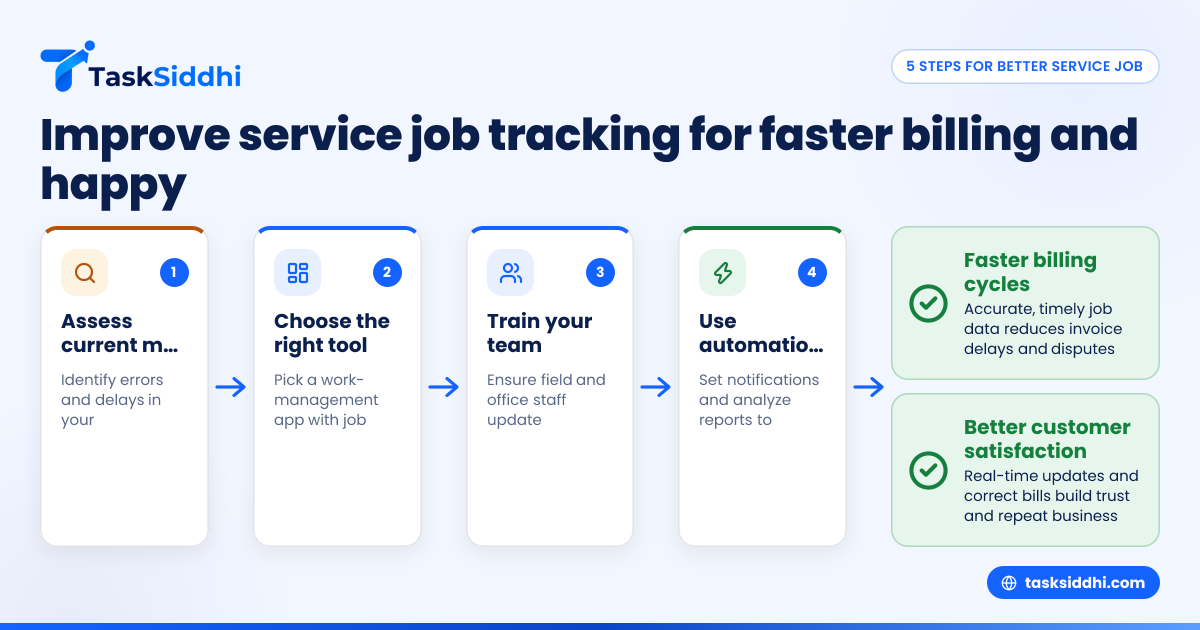
Here are five steps US service businesses can follow to get better at tracking jobs:
- Assess current methods: Identify where errors or delays happen in your current system, whether paper, WhatsApp, or spreadsheets.
- Choose a work-management tool: Look for apps focused on service jobs that offer job boards, time tracking, proof collection, and mobile access.
- Train your team: Make sure field workers and office staff understand how to update job status promptly and accurately.
- Use automation and reporting: Set up notifications and generate reports regularly to catch bottlenecks quickly.
- Review and improve regularly: Monitor billing speed and customer feedback to refine your tracking processes.
If you want an integrated solution, consider TaskSiddhi’s service jobs features, which streamline tracking from field visits to invoice-ready job cards.
how much does service job tracking software cost?
Basic service job tracking tools often have free tiers with essential features, while more complex needs require paid plans. Costs typically depend on the number of users and additional capabilities like automation or advanced reporting.
Free tools can suffice for very small teams but may lack critical functions like time tracking or mobile access. Paid services offer full-featured work-management with job boards, proof upload, and integrations. Check pricing options carefully to fit your business size.
how does AI in service job tracking affect billing and customer satisfaction?
AI assists by keeping job data accurate and timely, which minimizes billing errors. It speeds data entry through automated suggestions and highlights discrepancies early. Accurate job records allow invoices to be sent faster and with fewer disputes.
Customers appreciate knowing the status of their service and receiving correct bills. AI features can also personalize communication by predicting potential delays and automatically notifying clients, which enhances satisfaction and trust.
what compliance concerns should US service businesses keep in mind?
Service job tracking must support US-specific compliance needs:
- 1099 reporting: Track subcontractors’ labor hours and payments accurately for tax forms.
- Sales tax: Capture location-specific sales tax for billing in the correct states.
- Privacy: Ensure customer data stored in tracking software follows privacy requirements.
- Communication laws: If the software has automated messaging, compliance with TCPA and CAN-SPAM rules is essential.
Using a compliant tool reduces audit risk and simplifies tax season.
can service job tracking improve team productivity?
Yes. Clear visibility into job assignments reduces confusion and wasted effort. Employees spend less time on paperwork and more on actual service delivery if the tracking system is easy to use. Real-time updates mean that managers can quickly reassign jobs if delays occur.
Furthermore, time tracking tied directly to job cards helps with accurate payroll and performance measurement, motivating better productivity.
how can mobile apps help with service job tracking?
Mobile apps allow field employees to update job status, upload photos, and log times directly from the worksite. This real-time input eliminates delays from returning paperwork to the office or sending messages via WhatsApp.
A mobile app also provides GPS data and proof of visit, boosting transparency for clients and managers. This immediate communication streamlines workflows and speeds up billing processes.
summary
Service job tracking is essential for US service businesses to speed billing, improve customer satisfaction, and stay compliant. Moving from manual methods to digital work-management tools can eliminate errors, simplify communication, and provide real-time job insights. AI-powered features add efficiency by automating scheduling, notifications, and problem detection.
If you want to see how this works in practice, take a product tour of TaskSiddhi or compare plans on our pricing page to find the right fit for your team.
Frequently asked questions
What is service job tracking, and why is it important?
Service job tracking records each step of a service task, including timing, materials, and employee notes. It’s important because accurate tracking speeds up billing, reduces errors, and improves customer communication, leading to higher satisfaction and better cash flow.
Can AI help with service job tracking?
Yes, AI helps by automating scheduling, monitoring job progress, and predicting potential issues. It can suggest efficiencies and send alerts to managers, making service delivery smoother and faster.
How does service job tracking software improve billing?
Tracking software consolidates time and materials data into job cards that can be converted directly into invoices. This reduces billing errors and speeds up sending bills to customers, accelerating payments.
Do I need a mobile app for better job tracking?
A mobile app is very useful because it allows field technicians to enter job updates instantly, upload proof of work, and keep everyone informed in real time, reducing delays caused by manual reporting.
How can service job tracking support tax compliance?
Detailed records support IRS requirements, especially when working with subcontractors who need 1099 forms. Software that tracks labor hours and payments helps prepare accurate tax documents and manage sales tax charges properly.
What should I look for when choosing job tracking software?
Look for easy job assignment and updates, time tracking, mobile access, automated notifications, and reporting features. Make sure the software meets US tax and communication compliance and fits your team size and budget.