

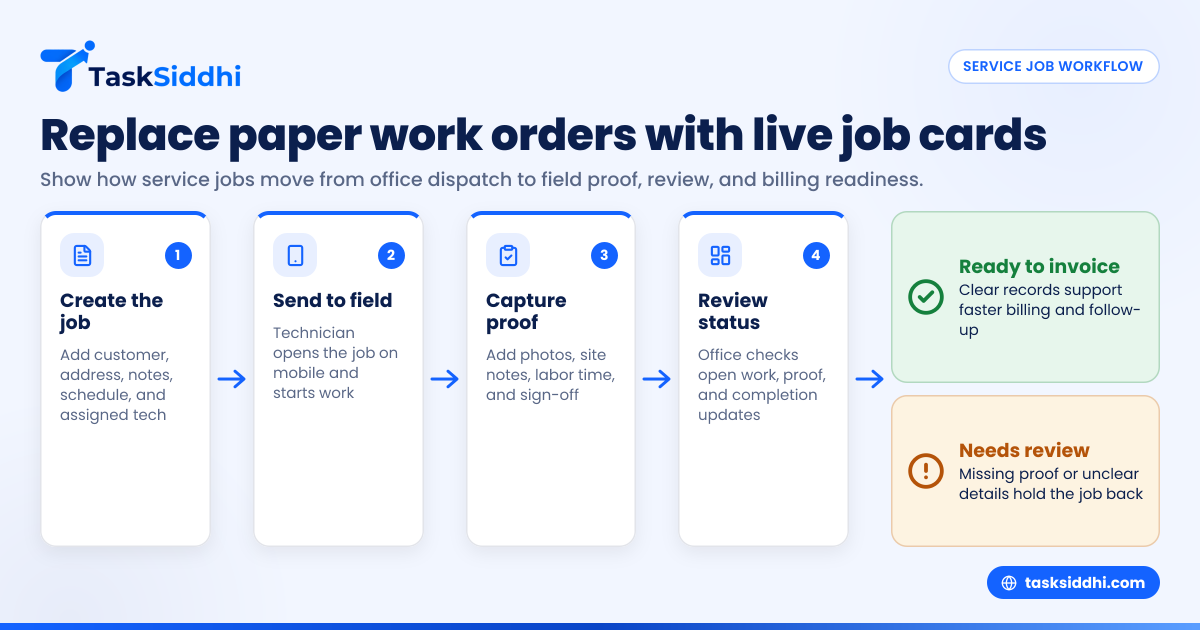
Job card software helps a Delaware small-business owner replace paper work orders with one system for scheduling, job details, photos, signatures, labor time, and status updates. In the United States, that means fewer missed jobs, faster invoicing, clearer records, and better control over field work from Wilmington to Dover.
Key takeaways
- Paper job cards slow down dispatch, billing, and follow-up for Delaware service businesses.
- Good job card software keeps customer details, work notes, photos, and labor time in one place.
- Delaware owners should look for mobile use, proof of work, clear reporting, and easy staff adoption.
- A simple rollout works best: start with one job type, one team, and one weekly review.
- The right setup reduces phone chasing, lost paperwork, and end-of-day data entry.
- For field and service teams, digital job cards work best when tied to service jobs, time tracking, and reporting.
Why Delaware small-business owners are moving away from paper job cards
If you run a service company in Delaware, paper work orders probably still feel familiar. A tech grabs a clipboard. A dispatcher sends an address by phone. Notes get written in a rush. Then someone has to read the handwriting, match the hours, and figure out whether the job is complete.
That system breaks fast as your team grows past five people.
A plumbing company in Wilmington, an HVAC contractor in Newark, or an electrical service business covering Dover and Middletown all face the same problem. Jobs move in real time. Paper does not. If a tech needs a part, if a customer asks for a change, or if your office needs proof the work was done, a paper card leaves too much room for delay.
Job card software solves that by turning each work order into a live record. The office and the field team both see the same job. Notes update in one place. Photos are attached to the job. Time gets recorded against the visit. You can check status without calling every technician.
For many Delaware owners, the real issue is not technology. It is control. You want to know:
- Which jobs are still open
- Which technician is on-site
- What was done
- How long it took
- Whether the customer signed off
- Whether the office can invoice today
That is what digital job cards are for.
What is job card software Delaware United States businesses actually need?
Job card software in Delaware, United States should help a small service business run daily field work without extra admin. It should let your office create jobs fast, send them to technicians, collect proof from the field, and close work orders cleanly for billing.
The keyword here is practical.
A lot of software sounds impressive but does not match how a small-business owner works day to day. You do not need a complicated setup built for a giant enterprise team. You need something your dispatcher, technician, and office manager can use this week.
At a basic level, each digital job card should hold:
- Customer name and address
- Contact details
- Job type
- Scheduled date and time
- Technician assigned
- Work instructions
- Checklists or required steps
- Parts or materials used
- Photos from site
- Customer sign-off
- Job status
- Labor time
That is the working record of the service job. When it is digital, the office is no longer waiting for a stack of papers at 5:30 PM.
What a digital job card replaces
Paper work orders usually sit inside a messy process:
- A customer calls or emails.
- The office writes details in a notebook or spreadsheet.
- A dispatcher texts the technician.
- The technician writes notes on paper.
- Photos stay on a phone.
- Hours get remembered later.
- The office retypes everything into QuickBooks or another system.
Each handoff creates delay and risk. Details get lost. Job cards go missing. Billing waits. Customers call asking for updates, and no one has the full picture.
Job card software replaces that chain with one shared workflow.
How does job card software help a Delaware owner day to day?
It gives you one live record for every job, so your office, dispatcher, and technician stop working from different notes. That means fewer missed details, faster updates, and less end-of-day paperwork before you invoice or schedule the next visit.
In practice, the daily benefits are simple.
Faster dispatch and fewer phone calls
When jobs are stored in a digital board, you can see open work at a glance. Instead of flipping through papers or scrolling old messages, you assign work and move it by status. That is especially helpful when your team covers multiple Delaware stops in one day.
A business owner in New Castle County may have technicians crossing Wilmington, Newark, and Bear. A company in Kent County may cover Dover, Smyrna, and Milford. You need a clear view of who is free, which jobs are urgent, and which work still needs customer approval.
Using boards and views helps make that visible without building a complex system.
Better proof of work
Customers often want confirmation that the work is complete. On paper, that usually means a signature and some handwritten notes. But many service jobs need more than that. You may need before-and-after photos, site notes, arrival and completion times, or a checklist showing required steps were followed.
For Delaware owners, this matters in both residential and commercial work. A property manager in Wilmington may want photo proof. A retail location in Dover may want a signed service record. A contractor may want a job history before approving the next phase.
Digital job cards make that proof easier to collect and easier to find later.
Cleaner payroll and billing support
Paper job cards are often the weak point between field work and billing. If hours are unclear, invoices are delayed. If the technician forgets details, the office has to call back. If parts used are not captured, revenue leaks out.
With built-in time tracking, labor time can be tied to the actual service work. That makes review easier before payroll and invoicing. It also gives you better records if a customer questions billed hours later.
What should Delaware small-business owners look for in job card software?
Choose software that your field team will actually use on the first week. For a Delaware small business, that usually means mobile access, simple job status updates, photos, notes, signatures, and reporting that helps the owner spot delays, rework, and outstanding jobs.
Here are the features that matter most.
Mobile-first use for field technicians
If your technicians are on the road, desktop-first software will fail. They need to open a job, read instructions, upload photos, and mark status from a phone. That is where a mobile app becomes essential.
The app should support the real flow of a service visit:
- Open assigned job
- View address and customer details
- Read work notes
- Start job
- Add updates from site
- Upload proof
- Capture sign-off
- Mark complete
If those steps are hard, your team will go back to text messages and memory.
Field proof and site updates
For businesses doing inspections, repairs, installation, maintenance, or follow-up visits, proof from the site matters. That is why field visits and digital records work together well. Photos, notes, and completion status should all stay attached to the job card.
Simple automation for repeat admin
Many small owners spend too much time moving jobs from one stage to another or reminding staff to update records. Basic automation can help reduce those repetitive steps.
For example, once a job is marked complete, you may want it moved into a review stage. If a job remains open too long, you may want your office to notice quickly. You do not need a complex setup. You need routine visibility.
Reporting you can use in Delaware
A good owner dashboard should answer simple questions:
- How many jobs are open?
- Which technicians completed the most work this week?
- Which jobs are waiting for customer sign-off?
- How long does each job type usually take?
- Which clients create repeat visits?
That is where reporting matters. Good reporting is not about pretty charts. It is about making the next decision faster.
Can I replace paper work orders without upsetting my team?
Yes. Start with one job type, one small crew, and one simple workflow. Keep the first version short, train on real jobs, and review usage every week. Most resistance drops once technicians see fewer calls, less duplicate writing, and faster job closeout.
The biggest rollout mistake is trying to digitize every process at once.
If you run a Delaware service company with 5 to 30 people, your team already has habits. Dispatchers use phone calls. Techs text updates. Office staff rely on memory and folders. If you launch software with ten new rules on day one, adoption will stall.
A better plan is to phase it in.
A simple 30-day rollout for a Delaware service business
Week 1: choose one service workflow
Pick one job type with repeat volume. Good examples include:
- HVAC maintenance visits
- Plumbing service calls
- Electrical repair visits
- Property maintenance jobs
- Appliance service calls
Do not start with your most complex jobs.
Week 2: build a short digital job card
Only include the fields you truly need:
- Customer
- Address
- Assigned tech
- Scheduled date
- Job notes
- Photos
- Time spent
- Completion status
- Sign-off
That is enough to prove the system works.
Week 3: train one crew
Show the team how to open, update, and close jobs on mobile. Use real jobs, not fake practice records. Keep the training short. A 20-minute walkthrough is often enough when the workflow is simple.
Week 4: review and tighten
Meet with the dispatcher, one technician, and your office lead. Ask:
- What slowed you down?
- Which field was unclear?
- What still happened outside the system?
- Which jobs took too long to close?
Then adjust the setup. This is where software becomes your process, not just another app.
Should you use an ai job card setup in a small service business?
Yes, if it saves time on routine admin and keeps records clearer. An ai job card approach only helps when it reduces typing, speeds up updates, or makes job history easier to find. If it adds confusion, skip it and keep the workflow simple.
For a Delaware small-business owner, the goal is not to chase trends. It is to cut friction.
When people talk about an ai job card workflow, they usually mean one of two practical needs. First, they want job details organized faster. Second, they want less manual follow-up after a technician finishes work. Those are valid goals, but only if the basics are already in place.
If your team still struggles to mark jobs complete, upload photos, or track time consistently, focus there first. Digital discipline matters more than advanced tools.
Once your process is stable, look for software that helps your office stay consistent. The best use of AI-style support in service work is usually behind the scenes: cleaner records, easier search, and less repetitive admin. It should not make the field team learn a whole new way of working.
Common mistakes Delaware owners make when switching from paper
Most failures come from overbuilding the system or undertraining the team. Owners often add too many fields, skip weekly reviews, or expect technicians to change habits without showing how the new process makes their day easier.
Here are the most common mistakes.
Copying the paper form exactly
A paper form often contains old habits, not useful data. If you digitize every box, you create a bloated job card no one wants to fill out. Keep only what helps scheduling, proof, payroll, billing, or future service.
Making the office responsible for all updates
If the field team does not update the job, the software becomes another back-office task. Technicians need to own status, photos, and completion notes. Otherwise the office keeps chasing answers.
Skipping weekly management review
Even a good system drifts if no one checks it. Set one weekly review for open jobs, overdue work, and missing proof. A Delaware owner with a small team does not need a long meeting. Fifteen minutes is enough if the data is visible.
Treating software as the solution by itself
Software supports process. It does not replace management. You still need clear job stages, clear ownership, and simple expectations.
A practical checklist before you choose job card software in Delaware
Before you commit, test the software against your actual workday. A tool is only useful if it fits how your Delaware team schedules, performs, documents, and closes service jobs from the field to the office.
Use this checklist.
Workflow fit
- Can you create and assign jobs quickly?
- Can technicians update jobs from the field?
- Can you capture photos and notes on-site?
- Can jobs move through clear stages?
- Can you review open and completed work easily?
Staff adoption fit
- Will your least technical technician use it?
- Can a dispatcher learn it without formal training?
- Does it reduce calls and texts instead of adding more?
Business control fit
- Can you see what is still open today?
- Can you review labor time by job?
- Can you check proof before billing?
- Can you spot slow or stuck jobs?
Growth fit
If you add more technicians or more service areas across Delaware, the system should still stay simple. That is why many owners prefer a work board approach with clear features, instead of disconnected spreadsheets and paper folders.
If you are comparing options, it also helps to review free vs paid choices based on actual daily use, not just monthly cost.
How TaskSiddhi fits field and service job work
TaskSiddhi is built for teams that need clear job tracking, mobile updates, proof from the field, and simple work visibility. For a Delaware small-business owner, that means less chasing, fewer lost work orders, and a better way to run service jobs without paper.
The platform is most useful when you want one place to manage service flow from assignment to completion. You can organize work with boards, track labor time, collect field updates, and review job progress without piecing together texts, spreadsheets, and paper forms.
That matters for small service businesses because growth usually creates admin before it creates process. A system built around client work and service execution can help you standardize before the chaos gets expensive.