

If you run a property maintenance business in Delaware, a site visit proof checklist is a simple, repeatable list of evidence your crew collects at every stop. It helps you confirm the work happened, reduce customer disputes, support billing, and keep your office out of the “he said, she said” mess that often starts in texts, paper notes, and camera rolls.
Key takeaways
- A strong site visit proof checklist should capture who, where, when, what, and condition.
- Delaware property maintenance owners need proof that is easy for field crews to collect and easy for the office to review.
- Photos alone are not enough. Add timestamps, job status, notes, and customer sign-off when needed.
- The best checklist changes by job type, such as lawn care, common-area cleaning, handyman work, or vacancy checks.
- A mobile process is faster than paper and reduces missing proof at the end of the day.
- Standardizing proof across every visit makes billing, callbacks, and customer communication easier.
Why site visit proof matters for Delaware property maintenance owners
If you manage crews across Wilmington, Newark, Dover, or beach-area rentals, you already know the problem. A tech says the work is done. The customer says nobody came. The property manager wants before-and-after photos. Your office asks for the exact arrival time. Nobody can find the right text thread.
That is why a site visit proof checklist matters.
For a Delaware small-business owner, site visit proof is not just about trust. It is about running the business with less friction. Good proof helps you:
- confirm the crew reached the right address
- show the visit happened on the right date
- document site conditions before work starts
- prove the work completed at the property
- support invoices sent through QuickBooks or Stripe workflows
- reduce avoidable callbacks
- train newer crew members on what “complete” means
It also helps when you manage recurring work for HOAs, landlords, retail sites, and small commercial buildings. These customers often want consistency. They do not want ten different styles of documentation from ten different employees.
A checklist solves that.
What should a site visit proof checklist include?
A site visit proof checklist should include the basics first: property address, date, arrival time, crew member name, photos, work completed, site condition, and departure time. Then add job-specific proof such as meter readings, gate access notes, locked-door issues, customer sign-off, or parts used.
That short list covers the core. The rest depends on your service mix.
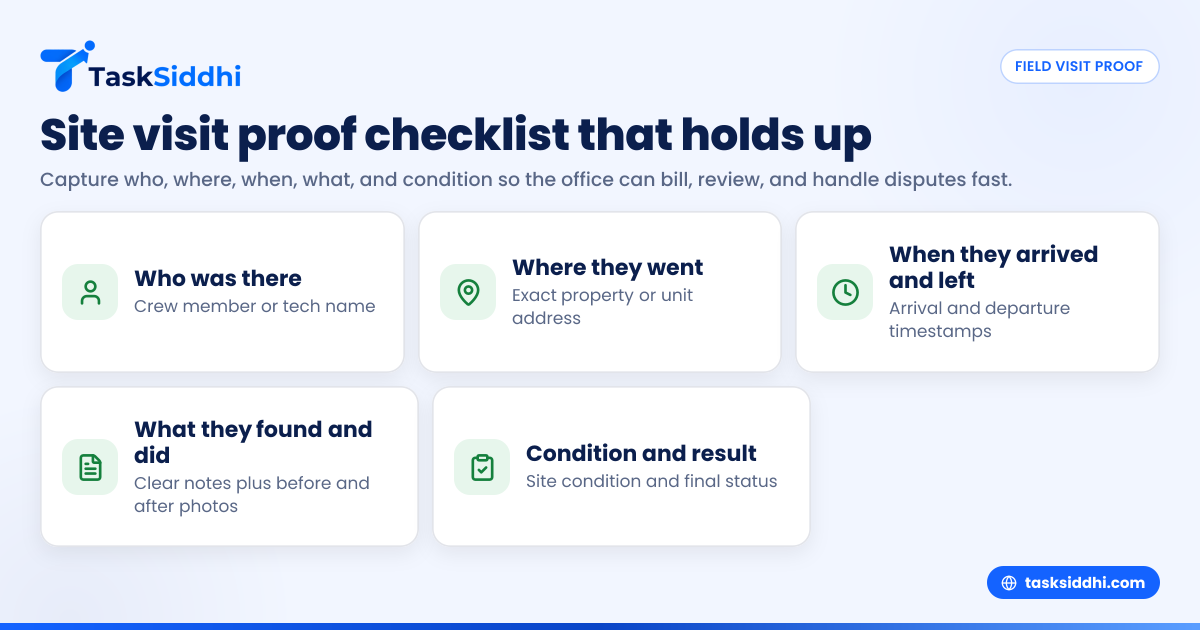
If you own a Delaware property maintenance company, your checklist should answer five questions every time:
- Who was there? Record the crew member or tech name.
- Where did they go? Capture the exact property or unit address.
- When did they arrive and leave? Note start and end times.
- What did they find and do? Add clear notes and photos.
- What is the result? Mark complete, partial, blocked, or needs follow-up.
Without those basics, proof breaks down fast. A single photo with no context rarely settles a dispute. A text saying “done” is even weaker. Your team needs a routine that creates complete records every time.
The core fields every checklist should have
Start with the same core fields on every job card or work order:
- customer name
- property address
- unit or area serviced
- crew member assigned
- arrival timestamp
- departure timestamp
- job type
- work status
- notes
- before photos
- after photos
- issues found
- customer or tenant interaction notes
- follow-up needed
- signature, if required
These fields are useful whether your team handles trash-outs, landscaping touch-ups, seasonal maintenance, light repairs, or inspection visits.
Why “proof” means more than photos
Many owners think proof starts and ends with before-and-after images. Photos matter, but they are only one part of the record.
For example, a Delaware landlord may ask why a cleanup bill is higher than expected. Photos show volume and condition. But a complete record also shows arrival time, extra debris found on site, access delays, and the exact work done. That context is what helps your office defend the invoice without a long back-and-forth.
How do I build a simple site visit proof checklist?
Start with your top 10 job types and list the exact proof you need to invoice, answer disputes, and manage callbacks. Keep one standard checklist for every visit, then add a few job-specific items for services like cleanups, repairs, inspections, and recurring maintenance.
That is the fast way to build it without overcomplicating the process.
Step 1: List your most common service calls
Write down the jobs your crews perform every week. For many Delaware property maintenance owners, that includes:
- turnover cleanups
- exterior checks
- common-area cleaning
- small repairs
- seasonal property checks
- lawn and grounds touch-ups
- vendor coordination visits
- vacant property inspections
Your checklist should fit real work, not an ideal version of your business.
Step 2: Identify the proof you need for each one
For each job type, ask:
- What proof does the customer usually ask for?
- What proof does my office need to invoice?
- What proof helps if the customer disputes the work?
- What proof helps if a crew member forgets a task?
- What proof helps us quote follow-up work?
This step matters because not every visit needs the same detail. A quick lock check is different from a full turnover inspection.
Step 3: Keep the standard part short
Your standard checklist should be easy enough for a crew member to complete from a phone in less than two minutes, not counting photos.
If it takes too long, people skip steps.
A good standard section includes:
- confirm property
- record arrival
- take required before photos
- complete work
- take required after photos
- add notes
- mark status
- record departure
Step 4: Add job-specific sections
Then create add-on sections for jobs that need more proof.
Examples:
For vacant property checks
- front door condition
- utility status
- visible leaks
- signs of entry
- thermostat reading
- window condition
For common-area cleaning
- lobby photo
- hallway photo
- trash removal note
- restroom supplies checked
- damage reported
For small repairs
- issue before photo
- repair completed photo
- materials used
- access issue note
- follow-up required
Step 5: Train to the checklist, not to memory
Do not assume your crew will “just know.” Walk through real examples. Show them what a good record looks like and what a weak one looks like. The more specific you are, the more reliable the proof becomes.
A practical site visit proof checklist for Delaware property maintenance
Here is a working checklist you can adapt for your business.
Before arriving
- confirm address and job scope
- confirm tenant, owner, or manager contact if needed
- review special access instructions
- check if signature is required
- confirm tools and supplies are loaded
On arrival
- mark arrival time
- verify the property address
- note weather if it affects the job
- document access issues
- take exterior arrival photo if needed
Before work starts
- take before photos of the area serviced
- note pre-existing damage
- note safety issues
- confirm site condition
- record anything outside original scope
During the visit
- complete the assigned tasks
- record extra work approved on site
- document blocked access or customer delays
- note parts, materials, or supplies used
- capture issue photos if new problems are found
Before leaving
- take after photos from clear angles
- mark work complete, partial, or blocked
- write a short summary of work done
- note follow-up actions needed
- capture customer sign-off if your process requires it
- mark departure time
Back at the office or end of day
- review records for missing photos
- flag jobs with follow-up needs
- send customer proof if your service level includes it
- match proof to invoice or work order
- store records where the office can retrieve them fast
This checklist works well for many Delaware property maintenance teams because it stays practical. It does not try to turn every visit into a long inspection report.
What proof should Delaware property maintenance owners collect on every visit?
Collect proof of location, timing, condition, work completed, and exceptions on every visit. In practice, that means a verified address, timestamps, before-and-after photos, short notes, and a clear final status so your office can bill, answer questions, and schedule follow-up work without guessing.
That is the baseline. Then adjust by property type and customer expectation.
For residential rental properties in Delaware
Residential rental work often creates the most disagreements. Tenants, landlords, and property managers may all see the same job differently.
Your proof should usually include:
- building exterior photo
- unit number if applicable
- before-and-after photos of problem areas
- access notes
- occupied or vacant status
- issue summary
- completion status
This is especially useful for turnovers, small repairs, and recurring common-area work.
For commercial sites
Commercial customers often care more about consistency and response times than long notes. Keep proof simple and repeatable.
Use:
- arrival and departure times
- area serviced
- task checklist
- before-and-after photos where relevant
- issue escalation notes
- manager interaction notes if needed
For HOA and community work
HOAs often need visual confirmation. They also like records they can forward to board members or managers.
Your checklist should emphasize:
- exact area completed
- photos from the same angle each visit
- visible issues found nearby
- items deferred for approval
- repeat problem tracking
Common mistakes that make site visit proof useless
A checklist only helps if the proof is usable later. Many records fail because they are incomplete or too vague.
Too few photos
One photo from too far away does not prove much. The image should show the actual work area and enough detail to understand the condition.
No clear timestamps
If your crew forgets to log arrival or completion, your office loses important context. Time matters for billing, routing, and dispute handling.
Weak notes
“Done” is not a useful note. “Removed debris from rear entry, cleared walkway, found broken handrail, follow-up needed” is better.
Mixing personal phones and scattered messages
When proof lives across text threads, camera rolls, and handwritten notes, your office wastes time hunting for records. That is when jobs fall through the cracks.
No standard status labels
Use simple status choices such as:
- complete
- partial
- blocked
- reschedule
- follow-up required
If every employee uses different wording, your office has to interpret too much.
Using mobile tools to make proof easier
For most field teams, the checklist works best on a phone. Crews can update jobs on site, attach photos, and avoid re-entering notes later. That saves time and reduces end-of-day paperwork.
A digital workflow also makes it easier to review jobs by customer, address, crew member, or date. For Delaware owners handling multiple sites each day, that is a big step up from paper job cards.
If you want a more organized process, TaskSiddhi can help teams manage field visits with a simple mobile workflow. You can also use the mobile app to keep job updates and proof tied to the work itself instead of scattered in chats.
Where AI can help without overcomplicating the job
Some owners are starting to ask about an ai site visit workflow. In simple terms, that usually means using software to organize visit data faster, spot missing proof, or summarize job notes.
The important part is not the label. It is whether the process helps your crew move faster and helps your office find complete records quickly. For a small Delaware property maintenance business, simple beats flashy every time.
How Delaware owners can roll this out without pushback
The biggest risk is making the checklist feel like extra work. Your crew already has full days. If the new process feels heavy, adoption will be weak.
Start with one team for two weeks
Pick one route or one supervisor. Test the checklist on real jobs. Watch where people get stuck.
Ask:
- which fields are unclear
- which photos are hard to collect
- which notes are repeated too often
- what the office still cannot tell from the proof
Then tighten the checklist.
Use examples from your own jobs
Show one good completed record and one poor one. Real examples train faster than policy documents.
Review missing proof weekly
Do not wait for a customer complaint. Review a sample of records every week. Look for patterns. Maybe one tech skips arrival times. Maybe another forgets after photos. Fix the habit early.
Build it into your board, not into memory
Your checklist should live where the work is assigned and tracked. If your team uses digital task management, put proof fields directly into the workflow. TaskSiddhi’s boards and views, time tracking, and reporting can help owners see what happened in the field without chasing updates.
A Delaware-specific way to think about proof
Delaware is small enough that many owners cover a wide service area in one day, but large enough that scattered jobs can still create confusion. A morning stop in Wilmington, an afternoon job in Dover, and an urgent issue near the coast can turn into a messy day fast.
That makes standardized proof even more valuable.
You may not need a long report for every visit. But you do need enough evidence that someone in the office can answer basic questions fast:
- Did we go?
- When were we there?
- What condition was the site in?
- What exactly did we do?
- What still needs action?
If your current answer is buried in group texts, paper notes, or unlabeled photos, this checklist will help.
Building a repeatable process for growth in Delaware
Most small property maintenance owners start with hustle. They remember details in their heads. They answer customer questions from memory. That works until the team grows.
Once you have multiple crews, recurring sites, and a busy office, memory stops scaling.
A site visit proof checklist creates one simple standard. It protects your business when customers question the work. It helps newer employees perform more consistently. It gives your office a cleaner path from field work to invoice.
Most of all, it saves time.
Instead of asking three people what happened at a property, your office can open the record and see the answer.
If you want to make that process easier, especially for recurring service work, you can explore TaskSiddhi’s features, see the free vs paid options, and decide what level of structure fits your team.
See how it works in the product tour or compare plans at pricing.
Frequently asked questions
How many photos should a site visit proof checklist require?
Use the fewest photos that still prove condition and completion clearly. For many property maintenance jobs, that means one or two before photos and one or two after photos of each work area.