

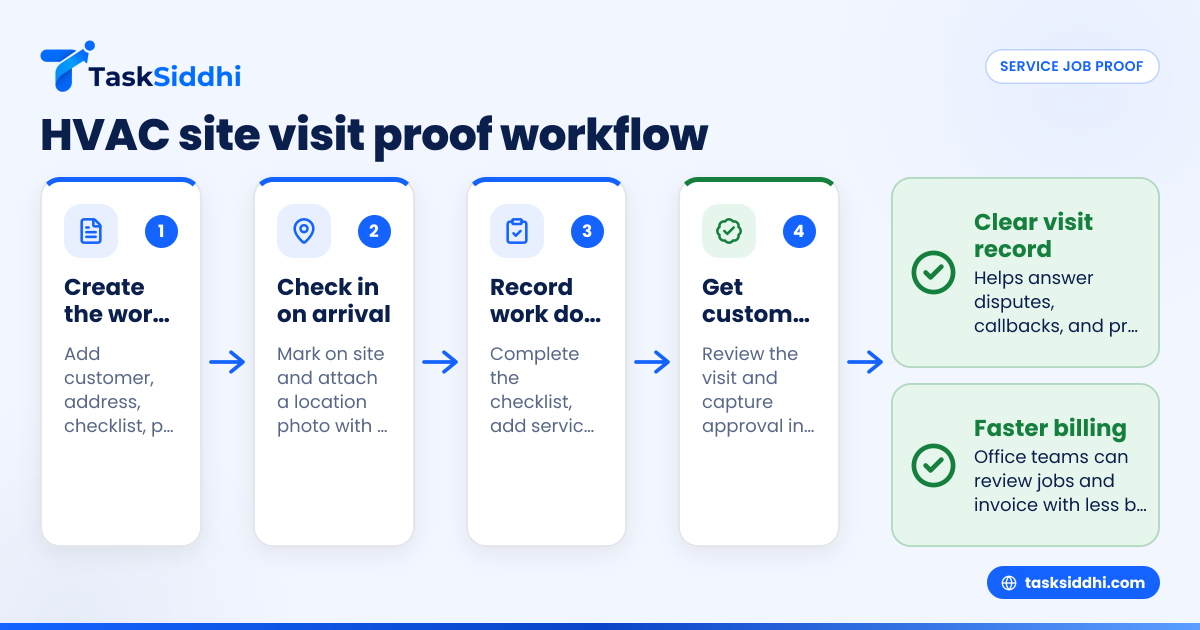
Site visit proof for HVAC maintenance companies in the United States means keeping a clear record that your technician arrived at the right location, did the scheduled work, and got the customer’s approval before leaving. In practice, that proof usually includes a timestamp, job address, photos, service notes, checklist results, and a customer signature tied to one job record.
Key takeaways
- Good site visit proof protects HVAC companies from billing disputes, callbacks, and “your tech never came” complaints.
- The best proof combines arrival time, location, photos, work notes, and customer sign-off in one record.
- Paper forms and text threads slow down office teams and make it harder to invoice quickly.
- A standard proof process helps managers in busy seasons when technicians are running many jobs per day.
- Customers trust documentation that is simple, professional, and easy to share after the visit.
- A field workflow works best when dispatch, technicians, and office staff all update the same system, often through a mobile app.
Why site visit proof matters for HVAC maintenance companies in the United States
HVAC maintenance work often looks routine until a customer questions the visit. A property manager says no one showed up. A homeowner says the filter was not changed. A commercial client asks why they were billed for a rooftop unit inspection when their staff never saw the technician.
Without solid proof, your office team has to search phone photos, call the tech, and piece together the story from memory. That takes time. It also delays billing and creates tension with customers.
For HVAC maintenance companies in the United States, site visit proof is not just about blame. It is also about speed and consistency. When every maintenance job has the same documentation, your team can close work orders faster, answer customer questions faster, and train new technicians more easily.
This matters even more when you manage recurring service agreements. Preventive maintenance jobs may happen monthly, quarterly, or seasonally. If your documentation is weak, you can lose track of what was done at each visit. If your documentation is strong, you build a service history that helps with renewals, upsells, and future repairs.
In cities like Chicago, Houston, and Detroit, HVAC companies often handle a mix of residential calls, retail stores, offices, warehouses, and multi-site commercial accounts. Each customer type expects proof in a slightly different format. The core requirement stays the same: show arrival, show work completed, and show approval.
What should site visit proof include?
At minimum, site visit proof for HVAC maintenance companies should answer five basic questions:
- Who went to the job?
- When did they arrive and finish?
- Where did the visit happen?
- What work was completed?
- Did the customer review and accept the visit?
A strong job record usually includes these items:
Technician identity
The record should show which technician handled the visit. This sounds obvious, but it matters when customers manage multiple vendors or multiple properties. If there is a question later, you want one clear owner for the work.
Date and time stamps
Arrival and completion times should be recorded as part of the job flow. This helps with customer questions and internal payroll reviews. It also supports accurate time tracking when technicians move between multiple maintenance stops in one day.
Service location
The exact address or site name should be attached to the job. This is especially important for multi-building campuses, retail chains, and property management accounts. One wrong suite number can create a dispute even if the tech was nearby.
Photos
Photos are one of the most useful forms of proof. They can show the unit tag, thermostat reading, dirty filter, replaced filter, condenser condition, drain line, electrical panel, or completed work area. The point is not to take random pictures. The point is to show useful evidence tied to the visit.
Work performed
A simple note saying “maintenance completed” is weak. Better notes say what was inspected, cleaned, adjusted, or replaced. If the tech found issues, those should be logged clearly.
Checklist results
Preventive maintenance jobs are easier to verify when the tech follows a standard checklist. This is helpful for internal quality control and for customers who want proof that your process was followed the same way each time.
Customer sign-off
A signature or approval at the end of the visit closes the loop. It confirms the customer or site contact was present, reviewed the work, or at least acknowledged completion.
How do you prove a technician arrived at the job site?
Use a job record with a timestamp, service address, technician check-in, and arrival photo tied to the work order. That gives your office a clean record of who arrived, when they arrived, and where the visit started.
Arrival proof should be simple enough that technicians can do it every time. If the process is too slow, people skip steps. For most HVAC maintenance teams, the best arrival proof has four parts:
- The technician opens the assigned job on their phone.
- They mark themselves on site.
- They add a photo that shows something identifiable at the location.
- The system stores the timestamp with the job record.
That photo does not need to be dramatic. It might show the front of the building, the unit number, the roof access point, or the mechanical room label. The goal is to show that the technician reached the right place.
For recurring customers, this matters because many visits look similar. One rooftop package unit can look like another. Good arrival proof reduces confusion between locations.
Some teams also use an ai site visit workflow to prompt technicians for required proof at each step. The useful part is not the label. The useful part is the consistency. If the system reminds the tech to capture arrival proof before starting service, office staff do not need to chase missing details later.
How do you document work completed without slowing technicians down?
Use short checklists, required photos, and clear service notes inside one job flow. Keep the form tight so techs can finish it in minutes, not write a long report in the parking lot.
The trick is to document the work without turning every maintenance stop into office work. HVAC technicians are there to inspect equipment, perform maintenance, and flag issues. They should not spend extra time retyping the same information into several places.
A practical approach is to standardize maintenance documentation by job type. For example:
- Residential seasonal tune-up
- Light commercial rooftop maintenance
- Split system maintenance
- Multi-unit property maintenance
- Filter replacement visit
- Preventive maintenance under contract
Each template can have its own checklist and photo requirements. That keeps documentation relevant.
Use short service notes
Technicians do better with prompts than blank boxes. Instead of “notes,” ask for specific inputs such as:
- Filter condition
- Coil condition
- Drain line status
- Thermostat operation
- Refrigerant concerns observed
- Parts recommended
- Follow-up needed
This produces notes that office teams can actually use.
Require before-and-after photos where useful
Photos are strongest when they show change. For example:
- Dirty filter and new filter
- Blocked drain and cleared drain
- Thermostat before adjustment and after
- Condenser area before cleaning and after
This helps customers understand the value of preventive maintenance. It also helps your company justify recommendations.
Capture deficiencies clearly
Maintenance visits often uncover repair needs. If the technician finds a worn belt, weak capacitor, damaged contactor, or airflow issue, the record should separate “maintenance completed” from “repair recommended.” That prevents later confusion about what was included in the visit.
For companies handling many service jobs, this separation is important. It creates a clean handoff from maintenance visit to quoted repair.
Build a repeatable proof process for every HVAC visit
A repeatable process is more important than a perfect form. If everyone on your team follows the same steps, your records become reliable.
Here is a simple workflow that works for many HVAC maintenance companies.
1. Create the job before dispatch
The office should create one clear work order with:
- Customer name
- Service address
- Site contact
- Scheduled date
- Equipment details if known
- Maintenance type
- Required checklist
- Required photos
- Sign-off requirement
This gives technicians a clear starting point.
2. Dispatch the right technician
Assign the job to the technician who will actually do the work. If the assignment changes during the day, update the job record. This avoids confusion later when the invoice and proof need to match.
Shared boards and views help managers see what is scheduled, in progress, and done without relying on phone calls for every update.
3. Check in on arrival
When the technician reaches the site, they should mark arrival and upload the first proof item. This could be a location photo, unit tag photo, or building entrance photo.
4. Complete the checklist during the visit
Technicians should record maintenance actions as they work, not from memory at the end of the day. This improves accuracy.
5. Add photos and notes before leaving
The easiest time to finish documentation is while the tech is still on site. Once they drive away, missing details often stay missing.
6. Get customer sign-off
If the customer or site contact is present, review the completed work and collect a signature. If no one is present, note that clearly and document who was notified.
7. Mark the job complete
The office should only treat the job as complete when the required proof is attached. This one rule can dramatically improve record quality.
What should customer sign-off include?
Customer sign-off should confirm the site contact reviewed the visit details, saw the work summary, and acknowledged completion. It should be tied to the same job record as the photos, notes, and timestamps.
Many HVAC companies treat the signature as the whole proof package. It is not. A signature is useful, but it is stronger when it sits beside the rest of the visit record.
A good sign-off process includes:
- Name of the person signing
- Date of the visit
- Time or completion status
- Brief work summary
- Space for customer comments
- Signature or approval capture
For commercial customers, the person signing may be a front desk manager, maintenance contact, store manager, or property representative. That is fine. What matters is that your record shows who acknowledged the visit.
If no one is available, your team can still complete the maintenance job, but the proof record should show that no site contact was present. In that case, clear photos and detailed service notes matter even more.
This is also where digital records help. If proof is spread across a clipboard, text messages, and a technician’s camera roll, the office has to rebuild the file before invoicing. A single job record is easier to review and easier to send to the customer if questions come up later.
Common mistakes HVAC companies make with visit documentation
Even good teams lose proof when the process is informal. Here are the most common issues.
Relying on memory at the end of the day
When technicians enter notes hours later, details get lost. Unit numbers, filter sizes, and customer comments are easy to forget.
Storing photos outside the job record
If photos stay on personal phones, they are hard to find and easy to lose. Proof should live with the work order.
Using vague notes
“PM done” does not help your office, your customer, or your future service technician. Notes should describe what was checked and what was found.
Skipping sign-off when the day gets busy
Busy days are exactly when documentation matters most. If your process depends on perfect conditions, it will fail in peak season.
Mixing maintenance and repair work in one unclear summary
Customers need to know what was included in the maintenance visit and what needs separate approval later.
How better proof speeds billing and reporting
Site visit proof is not just an operations issue. It affects cash flow.
When your office has complete records, invoices go out faster. The job can be reviewed quickly. Any service agreement billing is easier to support. If a commercial account asks for proof before paying, your team is ready.
This also improves internal visibility. Over time, maintenance records can show:
- Jobs completed per technician
- Visit duration by maintenance type
- Repeat issues by site
- Missed checklist items
- Follow-up repair opportunities
That kind of visibility is easier with built-in reporting. Managers can spot where documentation is strong, where it breaks down, and which jobs generate the most follow-up work.
For some teams, automation can also help by reminding technicians to upload required proof before a job can be closed. That reduces the office back-and-forth that happens when records are incomplete.
A simple system for HVAC maintenance companies
If your team still manages maintenance visits through calls, texts, and paper forms, start small. You do not need a complex rollout.
A practical setup looks like this:
- Pick your top two maintenance job types.
- Create one checklist for each.
- Define required arrival proof.
- Define two to four required photos.
- Add a short note format.
- Make customer sign-off part of the closeout step.
- Review completed jobs weekly for missing proof.
This kind of process fits field teams that need structure without heavy admin work. It is especially useful for companies that want one place for work records, field visits, technician updates, and customer-ready job history.
TaskSiddhi can help by keeping dispatch, proof, notes, and completion updates together in one workflow. If your HVAC company wants fewer missing job details and faster job closeout, that kind of shared system is easier to manage than scattered spreadsheets and chat threads.
See how it works in the product tour or compare options on the pricing page.
Frequently asked questions
Is a customer signature enough as proof of an HVAC maintenance visit?
No. A signature is helpful, but it is much stronger when combined with timestamps, address details, photos, and service notes. If a dispute comes up, the full record tells a clearer story than a signature alone.
What photos should an HVAC technician take during a maintenance visit?
Start with one arrival photo that identifies the site or equipment. Then capture photos that show key service evidence, such as filter condition, cleaned components, thermostat readings, unit tags, or issues that need repair approval.
Should residential and commercial HVAC maintenance jobs use the same proof process?
The core process can be the same, but the forms should differ. Commercial jobs often need site contact details, equipment lists, and more formal documentation, while residential visits usually need a simpler summary and sign-off.