

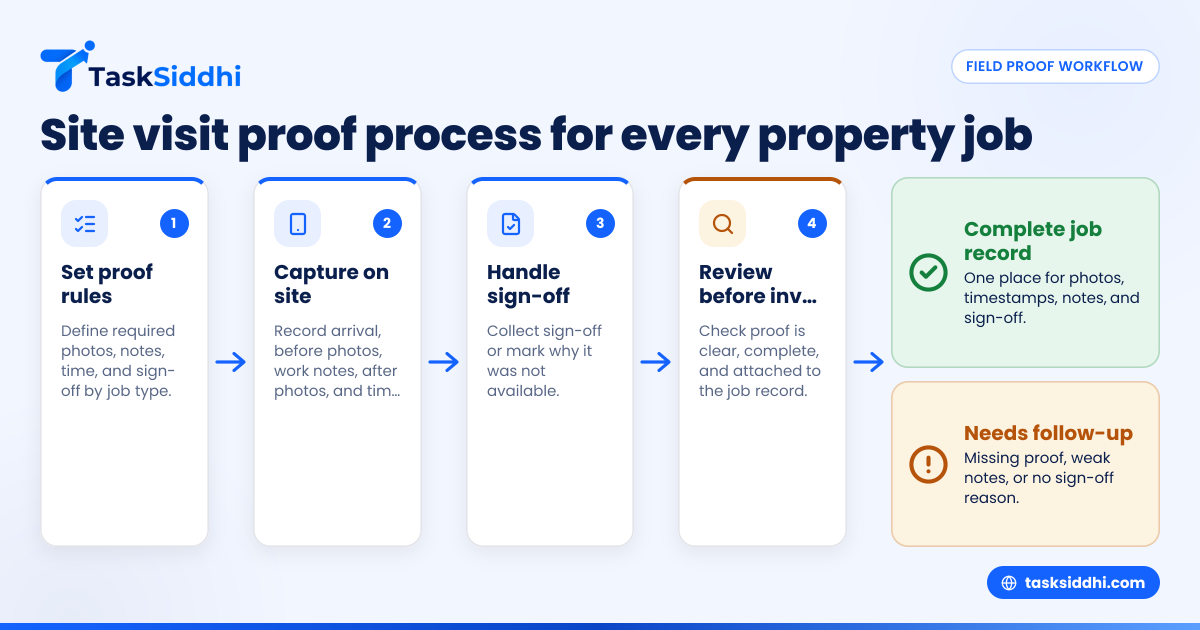
If you run a property service business in Delaware, a clear site visit proof process protects you from billing disputes, missed jobs, and “we were never there” complaints. The goal is simple: for every visit, capture who went, when they arrived, what they did, proof on site, and client sign-off in one place.
Key takeaways
- A strong site visit proof process in Delaware should capture photos, timestamps, worker name, location, work notes, and sign-off for every job.
- Standard proof reduces disputes with property managers, landlords, HOAs, and commercial clients in Wilmington, Dover, and Newark.
- The best process starts before the truck leaves and ends only after proof is reviewed and attached to the job record.
- Mobile-first workflows help small teams avoid lost paper job cards and messy WhatsApp photo threads.
- Clear proof also improves payroll checks, invoicing speed, and customer trust.
- For growing teams, a shared system with field visits, time tracking, and reporting makes follow-up easier.
Why site visit proof matters for Delaware property service owners
If you own a small property service company in Delaware, you probably deal with rushed schedules, weather delays, tenant access issues, and constant phone calls. On a busy day, your team might handle lawn work in Newark, unit turns in Wilmington, and maintenance checks near Dover. When proof is weak, every one of those jobs can turn into a question mark.
Clients do not just want the work done. They want proof that the visit happened. They want to know when your technician arrived, what was found, what was completed, and whether anything blocked the job. If you bill without proof, payment slows down. If a tenant disputes access, your office scrambles. If a property manager changes staff, your team may need to explain an old visit months later.
A site visit proof process Delaware United States business owners can rely on should do three things well:
- Protect revenue.
- Reduce rework and back-and-forth.
- Create a clean job history for every property.
This matters even more for small businesses. You may not have a dispatcher, office admin, and operations manager all handling records. Often, the owner is doing all three jobs. That means your process must be simple enough that a five-person team follows it every day.
What should a complete site visit proof record include?
A complete record should show who visited, when they arrived, where they were, what they saw, what they did, and whether the client accepted it. If one of those pieces is missing, disputes get harder to resolve.
For Delaware property service owners, a complete proof record usually includes:
- Job number or work order number
- Property address and unit number if needed
- Technician name
- Arrival and departure time
- Date of service in MM/DD/YYYY format
- Photos taken before, during, and after work
- Short work notes
- Any issue found on site
- Materials used, if relevant
- Customer, tenant, or manager sign-off
- Reason sign-off was not available, if nobody was present
Think of this as a chain of proof. Each part supports the next. A timestamp without photos is weak. Photos without notes can be unclear. Notes without sign-off leave room for argument. Together, they create a record that is easy to defend.
Photos should answer simple questions
Every photo should help answer one question:
- What did the crew find?
- What did they fix, clean, inspect, or install?
- What does the finished result look like?
Blurry or random photos do not help. Train your team to take wide shots for context and close shots for detail. If they serviced a common area, include a shot that clearly identifies the area. If they worked in a unit, avoid capturing unnecessary personal details.
Timestamps should be automatic where possible
Manual time entry causes mistakes. People forget. They round. They fill it in later from memory. That creates weak records. A better process uses mobile time capture tied to the job itself. This is especially helpful when your crews move between several Delaware properties in one day.
Sign-off should be simple, not perfect
Some visits happen with a property manager on site. Some happen at empty units. Some happen after hours. Your process should support all three. The point is not to force a signature every time. The point is to record what happened and why sign-off was or was not collected.
How do I set up a site visit proof process in Delaware?
Start with one standard checklist for every property visit: arrival, before photos, work notes, after photos, sign-off, and job close. Keep it short enough that your team will actually follow it on every Delaware job.
Then build that checklist into your daily workflow. Do not keep it as a document nobody opens. If the process lives only in the owner's head, it will fail when the day gets busy.
Step 1: Define proof rules by job type
Not all property service jobs need the same proof. A trash-out, lawn service, HVAC maintenance visit, leak inspection, and common-area cleaning job all need different records.
Create simple proof requirements for each service type. For example:
Lawn or exterior work
- Arrival time
- Wide photo of property front
- Before and after photos of target area
- Notes on blocked access or weather issues
- Completion time
Unit turn or cleaning
- Unit number
- Before photos by room
- Notes on damage or missing items
- After photos by room
- Manager sign-off if present
Maintenance or repair visit
- Problem reported
- Photo of issue found
- Notes on work completed
- Photo after repair
- Parts used, if relevant
- Tenant or manager sign-off if present
These proof standards make expectations clear. Your team should never have to guess what to capture.
Step 2: Make one person accountable for record quality
In a small Delaware business, accountability matters more than software. Someone must review whether proof is complete before invoices go out or jobs are marked done.
That person may be you, your office manager, or your lead tech. The rule should be simple: no complete proof, no complete job close. This one habit catches missing photos, weak notes, and unsigned records before they become billing problems.
Step 3: Use a mobile workflow in the field
Paper job cards get wet, lost, or filled in later. Texting photos to the office creates messy records. A mobile workflow is better because the tech can complete the job record while standing at the site.
For Delaware owners managing crews across multiple towns, a mobile app is useful because it keeps the proof attached to the job rather than buried in someone's camera roll. That matters when a client calls two months later asking for the photos from a service visit.
Step 4: Review proof before invoicing
Do not wait for a client complaint to discover missing proof. Review job records daily. Check:
- Are photos clear?
- Are timestamps present?
- Are notes specific?
- Is sign-off included or explained?
- Does the record support the invoice amount?
This keeps billing cleaner and reduces awkward customer calls.
What photos, timestamps, and notes should my crew capture?
Your crew should capture enough detail to prove the visit happened and show the work result, but not so much that the process slows down. Three to six useful photos and clear notes usually beat twenty random images.
Use a before-during-after pattern
This is the easiest rule for crews to remember.
- Before: show the condition at arrival
- During: show the issue or work in progress if useful
- After: show the finished result
For example, if your team clears a drainage issue behind a small commercial building in Wilmington, the record should show the blocked area before work, the work in progress if needed, and the cleared result after completion.
Write notes like a client will read them
Bad note: “Done.”
Better note: “Arrived at 9:12 AM. Cleared debris from rear drain, removed standing water, and tested flow. No further blockage visible. Property contact not on site.”
This kind of note saves time later. It is specific. It explains the work. It also explains why there was no signature.
Capture exceptions every time
The best proof process does not just document completed work. It also documents exceptions:
- No access to unit
- Tenant refused entry
- Weather blocked exterior work
- Unsafe condition found
- Additional approval needed
- Return visit required
These notes protect your team when a client asks why the job was not completed.
What if the client is not on site to sign?
If the client is not on site, record that clearly, capture strong photo proof, and close the job with notes explaining who was unavailable. A missing signature is manageable if the rest of the proof is complete and easy to review.
Many Delaware property service jobs happen without a decision-maker present. That is normal. The mistake is leaving the record half-finished because nobody was there to sign.
Use a “sign-off not available” rule
Train your team to choose one clear reason:
- Manager not on site
- Tenant unavailable
- Vacant unit
- After-hours service
- Emergency visit
This keeps records consistent. It also stops your office from chasing crews later for an explanation.
Send proof quickly after the visit
When sign-off is missing, speed matters. If you send the proof summary soon after the job, the client can review it while the visit is still fresh. That often reduces friction.
This is one reason many owners move away from photos in text threads and toward a shared job system with boards and views. It is easier to see which visits are complete, which need review, and which still need client confirmation.
Build a repeatable proof process for Delaware property jobs
A process works only if your team can repeat it every day. That means it must be short, visible, and tied to how jobs are assigned and closed.
Create one standard job close checklist
Use the same close checklist for all field staff:
- Arrive and start time
- Confirm address and unit
- Capture before photos
- Complete work or inspection
- Add notes
- Capture after photos
- Collect sign-off or mark reason unavailable
- Stop time
- Submit record before leaving site
This reduces skipped steps. It also helps new hires learn faster.
Keep job records in one place
When photos sit in one phone, times in a spreadsheet, notes in a notebook, and approvals in email, the office wastes time rebuilding the story. A single job record is easier to manage.
For owners juggling recurring jobs and one-off visits, structured features can help centralize the record without adding a lot of admin work.
Use simple automation for follow-up
You do not need a complex system. Even small automations help. For example:
- Flag jobs with missing sign-off
- Alert the office if photos are missing
- Move completed visits into review
- Track return visits separately
This is where automation can reduce manual follow-up and help a small Delaware team stay organized.
Where does AI fit into a site visit proof process?
AI can help summarize visit notes, spot missing proof fields, and organize records faster, but it should support your process, not replace clear field habits. A strong ai site visit workflow still depends on accurate photos, timestamps, and technician notes.
For a small business owner, the practical use of AI is not magic. It is cleanup. It can help you review records faster, identify incomplete submissions, and create clearer summaries for customers or office staff.
Helpful uses of AI for field proof
Here are realistic ways AI can help:
- Flag jobs missing before or after photos
- Turn rough tech notes into cleaner summaries
- Help group repeat issues by property
- Surface patterns in missed sign-offs
- Make reporting easier at the end of the week
But AI cannot fix weak source data. If your crew forgets photos or writes vague notes, no tool can fully rescue that record.
Keep human review in the loop
Owners should still review exceptions, customer complaints, and unusual records. If a technician marks a repair complete but the photos look incomplete, a person should catch that before invoicing.
That is especially true for higher-value property service work where one disputed invoice can affect cash flow.
Common mistakes Delaware owners should avoid
Even good teams fall into habits that weaken proof.
Taking photos that lack context
A close-up of a repaired pipe is useful. But if nobody can tell which unit or area it belongs to, it loses value. Add one wider shot.
Writing notes after the crew leaves
Late notes are less accurate. Require notes to be entered on site before the job is closed.
Treating proof as optional on small jobs
Small jobs create disputes too. In fact, they are often easier for clients to question because the invoice amount is low and the work is less visible.
Not reviewing records weekly
A weak process can look fine for weeks until a client dispute exposes the gaps. Review random jobs each week to spot patterns.
Letting each technician use their own method
One tech sends texts. Another uses paper. Another calls the office. This creates chaos. Standardize the process across the team.
A simple weekly audit for Delaware small-business owners
You do not need a long compliance program. You just need a short weekly audit.
Every Friday, review five completed jobs and ask:
- Is the address correct?
- Are before and after photos present?
- Are timestamps complete?
- Do notes explain the work clearly?
- Is sign-off included or explained?
- Would this record support the invoice in a dispute?
If the answer is no on any item, fix the process immediately. Small corrections each week prevent bigger billing and customer problems later.
For teams that want cleaner oversight, reporting helps owners see completion trends and missing records without opening every job one by one.
Turning proof into a better customer experience
A solid site visit proof process is not just about defense. It also improves the customer experience. Property managers want less back-and-forth. Owners want faster approvals. Tenants want clear communication.
When your business can quickly send a clean visit record, you look more organized. That builds trust. It can also help you win repeat work because clients know your team documents jobs properly.
This matters in Delaware’s relationship-driven service market. Small-business owners often grow by reputation. A clean proof process supports that reputation every day.
If you want to see a practical way to organize job proof, visits, and follow-up for field teams, take a look at the product tour or compare plans at pricing.