

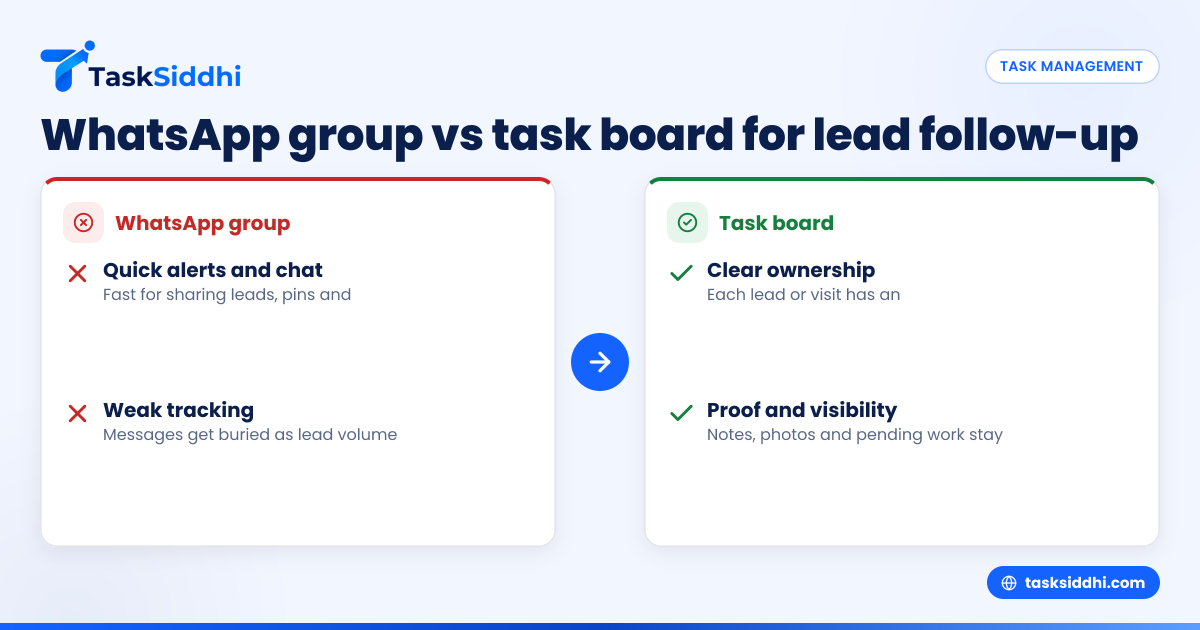
If your IndiaMART leads, site visit requests and follow-ups are running inside WhatsApp groups, things move fast at first but break as volume grows. A task board gives each lead and visit a clear owner, due date, status and proof trail, so your team can follow up on time and managers can see what is actually pending.
For Indian teams handling site visits across cities, the real question is not WhatsApp or software. It is whether your process can survive missed messages, staff changes, delayed callbacks and scattered proof from the field.
Key takeaways
- WhatsApp groups are quick for alerts, but weak for ownership, tracking and reporting.
- A task board works better when your team handles many IndiaMART leads and scheduled site visits.
- For site visit follow up in India, the biggest gains come from clear statuses, reminders and proof from the field.
- You do not need a complex setup. A simple pipeline and job card process is enough to start.
- Keep WhatsApp for communication, but move work tracking to a shared board.
- Teams in Mumbai, Pune, Bengaluru and tier-2 cities benefit when follow-ups stop depending on memory.
Why this comparison matters for IndiaMART lead follow-up in India
Many Indian SMEs get enquiries from IndiaMART, JustDial, referrals and direct WhatsApp messages. A salesperson or coordinator drops the lead into a group. Someone replies, someone calls, someone plans a site visit. For a few leads a day, this feels manageable.
The problem starts when your team handles 20, 50 or 100 open leads and active site visits at the same time. Messages get buried. A customer asks for a callback after two days. The site engineer shares a photo in one group and a voice note in another. A manager asks, “What is pending from yesterday?” and nobody has a clean answer.
This is why the search phrase “whatsapp group vs task board for site visit follow up India” matters so much. It is not about replacing one app with another for the sake of it. It is about preventing lost revenue, delayed visits and poor customer experience.
In many Indian businesses, the current process looks like this:
- Lead comes from IndiaMART.
- Admin posts it in a WhatsApp group.
- Salesperson calls and updates the group.
- Site visit is planned informally.
- Technician or sales executive visits the site.
- Photos, notes and customer feedback come on WhatsApp.
- Quotation follow-up happens manually.
- Manager asks for status in the evening.
This process depends heavily on people remembering to update the group. It also depends on everyone reading the same messages at the right time. That is risky when your team is busy, on the road or handling multiple customers.
WhatsApp group vs task board: the basic difference
A WhatsApp group is a conversation tool. A task board is a work tracking tool. That sounds simple, but it changes how your team operates.
In a WhatsApp group, information is arranged by time. Newer messages push older ones upward. In a task board, work is arranged by status, owner, due date and priority. That means managers can see pending follow-ups and planned visits without scrolling through chat history.
A WhatsApp group is useful for speed. You can quickly share a lead, location pin or customer number. But it does not naturally answer questions such as:
- Which IndiaMART leads are waiting for first call?
- Which site visits are scheduled for today?
- Which visits are completed but quotation is pending?
- Which technician has not uploaded proof?
- Which old leads have had no follow-up in three days?
A board answers those questions directly. With boards and views, teams can move each lead or visit through clear stages instead of relying on message threads.
What usually goes wrong in WhatsApp-based follow-up
The most common problem is not communication. It is lack of structure.
Here is what Indian teams often face:
- One lead is discussed in several groups.
- The same customer is called twice by different people.
- A promised callback is forgotten.
- A site visit is done, but no proof is stored in one place.
- Follow-up after quotation gets delayed.
- The owner or manager has no daily dashboard.
- Old leads stay in the group forever with no clear closure.
This is why even an ai whatsapp group summary will not solve the root issue. Summaries may help you read faster, but they do not create ownership, deadlines or accountability.
Which is better for site visit follow-up in India?
For most teams doing regular site visits, a task board is better for tracking work, and WhatsApp is better for communication. Use WhatsApp to alert people quickly. Use a board to manage the actual lead, visit and follow-up lifecycle.
That hybrid approach fits how Indian businesses already operate. Your staff can still message customers on WhatsApp. Your field team can still coordinate location, timing and access. But the official record of the job should sit on a board.
Why site visits need stronger tracking
Site visits create more moving parts than a simple phone follow-up. You may need:
- Customer name and address
- Contact person and phone number
- Source of lead, such as IndiaMART
- Product or service requirement
- Preferred visit time
- Assigned salesperson or technician
- Visit notes
- Photos or proof
- Next action
- Quotation deadline
- Payment or approval stage
Trying to manage all that in chat is difficult. A dedicated workflow for field visits makes it easier to track each step without losing context.
A task board creates visible ownership
In a group, everyone sees the lead, so nobody fully owns it. On a board, one person owns the card. The due date is visible. The next step is clear. If the task slips, the manager can see it immediately.
That matters a lot when your team is spread across locations. A business with staff in Mumbai and Pune, or in a district HQ and nearby towns, needs one shared view of work. A board gives that view without making managers chase updates manually.
What does a simple task board setup look like?
Start with one board for lead follow-up and one board for scheduled visits, or combine both into one pipeline if your volume is still small. Keep it simple so the team actually uses it.
A basic pipeline can look like this:
- New IndiaMART lead
- First call pending
- Contacted
- Site visit scheduled
- Visit done
- Quotation sent
- Follow-up pending
- Won
- Lost
- No response
Each lead becomes one card. The card should include the customer number, city, requirement, source, assigned person, due date and next action. If a site visit happens, the card should capture notes and proof.
If your team does technical jobs after the visit, you can add a separate flow for service jobs. If your work is more account-based and relationship-driven, a client work setup may fit better.
What should every lead or site visit card include?
To make the board useful, capture only the details your team actually needs every day:
- Lead source: IndiaMART, JustDial, referral, website, walk-in
- Customer name and mobile number
- Area, city and full visit address
- Requirement summary
- Assigned executive
- Next follow-up date
- Site visit date and time
- Visit outcome
- Quotation status
- Expected value in ₹
- Remarks and proof
This becomes far more reliable than searching old chats for a photo or voice note.
Can I keep using WhatsApp and still move to a task board?
Yes. Most Indian teams should keep using WhatsApp for quick communication. The change is that WhatsApp becomes the alert layer, not the system of record.
For example, when a new IndiaMART lead comes in, your coordinator can still notify the assigned executive on WhatsApp. But the lead itself should be created on a board, assigned with a due date, and moved through stages until closure.
This reduces friction because you are not asking the team to stop using familiar tools overnight. You are simply moving the tracking part to a better place.
A practical split that works for small Indian teams
Use WhatsApp for:
- Fast internal alerts
- Customer chat
- Live coordination on the day of a visit
- Sharing urgent updates
Use a task board for:
- Ownership
- Due dates
- Status tracking
- Visit proof
- Manager visibility
- Reporting
- Follow-up history
That split keeps daily work realistic. It also avoids the mistake of forcing every conversation into a formal system.
How do you stop leads from getting missed?
Set one owner, one next action and one due date for every lead. If a lead has no owner or no due date, assume it will be missed.
Under that rule, managers can quickly review all cards due today, overdue follow-ups and visits pending proof. That is much easier than asking for updates in a group at 7 pm and getting mixed replies.
To make this work, use a simple daily routine:
- Capture every new lead on the board.
- Assign it immediately.
- Add the next follow-up date.
- Move it to the correct stage after every call or visit.
- Close won, lost or no-response leads clearly.
- Review overdue items once a day.
A board with automation can also help reduce manual chasing by nudging people when due dates are nearing or tasks stay stuck too long.
Why reminders matter more than perfect data entry
Many owners worry that staff will not fill every field correctly. That concern is fair. But in practice, reminders and visible pending work matter more than perfect data entry on day one.
If your board captures the lead, owner, due date and stage properly, you will already improve follow-up discipline. Additional details can become more consistent over time.
What about proof from site visits and field staff updates?
This is one of the biggest weaknesses of WhatsApp-only operations. Visit photos, notes, customer signatures or completion messages often sit inside personal chats or mixed groups. Later, nobody can find them when a customer disputes something or when billing is delayed.
A proper field workflow should let your team update jobs from the road. A mobile app matters here because field staff should not need a laptop. They should be able to open the card, add notes, mark status, and attach proof before leaving the customer site.
If your team also needs timing discipline, time tracking helps you understand how much effort goes into visits, repeat visits and after-visit work.
Why proof matters for billing and customer trust
For many Indian businesses, site visits lead to quotations, approvals, service jobs and then invoicing. If site details are unclear, billing gets delayed. If customer data is spread across phones and chats, your office team wastes time reconfirming basic details.
Proof also matters for internal control. If one manager asks why a visit was marked complete, there should be one record with notes and evidence, not scattered media in several chats.
If customer contact details and visit records include personal data, teams should also handle them carefully and keep access limited as appropriate under the DPDP Act, 2023. A board with role-based work access is generally safer than forwarding customer information endlessly through groups.
How can a manager review performance without reading chats?
A manager should be able to see open leads, overdue follow-ups, completed visits and conversion progress in one place. If the only way to know status is to read 500 messages, the process is already failing.
That is where reporting becomes useful. Even basic reports can answer practical questions:
- How many IndiaMART leads came this week?
- How many got a first call within the same day?
- How many site visits were completed?
- How many quotations are pending follow-up?
- Which executive has the highest overdue count?
- What is the likely value of open opportunities in ₹?
This is much better than end-of-day updates based on memory.
A simple review routine for owners
If you run a 5 to 30 person team, do not overcomplicate reviews. A daily 15-minute check is enough:
- New leads not assigned
- Overdue calls
- Today’s site visits
- Visits done but quotation pending
- High-value opportunities above your threshold in ₹
- Stuck cards older than seven days
That one routine can improve response speed more than adding more chat groups.
When is WhatsApp group still enough?
If your business gets very few leads, has one owner doing most follow-up, and site visits are rare, WhatsApp may still be enough for now. The same is true if every job closes within one day and there is little need for reporting.
But the tipping point comes quickly. Once multiple people touch the same lead, once visits span locations, or once the owner is no longer personally tracking every enquiry, chat-based follow-up becomes fragile.
Signs you have outgrown WhatsApp-only operations
You have likely outgrown pure group-based follow-up if:
- Leads are missed or called late
- Staff ask again for the same customer details
- Managers cannot see what is pending
- Site visit proof is hard to find
- Quotation follow-up slips
- One staff member leaving causes confusion
- You still depend on Excel to rebuild status every evening
At that point, moving to a task system is less about software and more about protecting revenue.
Is a task board difficult for field teams to adopt?
No, if you start with a very small process. Keep the board stages simple, use clear names, and train the team on only the actions they need daily: open card, update status, add note, upload proof.
Do not start with a complicated CRM-style setup. Start with practical work tracking. That is why many Indian service and field teams prefer a board over a heavy system with too many mandatory fields.
A low-friction rollout plan
Here is a practical way to switch over in two weeks:
- Pick one team or one city.
- Create a simple lead-to-visit board.
- Add only active leads first.
- Make one person responsible for board hygiene.
- Review usage daily for one week.
- Fix stage names and missing fields.
- Roll out to the rest of the team.
You can also show staff the specific features they will use instead of training them on every option at once.
Final recommendation for Indian SMEs
If you rely on IndiaMART leads and physical site visits, WhatsApp alone is not enough once the business reaches regular daily volume. Keep WhatsApp for fast communication, but move lead ownership, follow-up dates, visit status and proof to a task board.