














How US small service businesses can benefit from job card software to streamline field task management
Job card software is a digital tool that helps small US service businesses organize and track their field jobs efficiently. It replaces paper job cards with easy-to-use digital boards, enabling managers and teams to stay aligned, capture proof of work, and speed up billing and reporting.
Key takeaways
- Job card software streamlines field job management by digitizing task assignment, updates, and proof.
- It enhances communication across teams, reducing errors from WhatsApp and paper-based workflows.
- Mobile apps enable technicians to capture photos, notes, and signatures on site for accountability.
- Integration with time tracking and reporting tools improves payroll and client billing accuracy.
- Features like automated reminders and status updates help managers keep jobs on schedule.
- AI-driven job card software can optimize task allocation and identify workflow bottlenecks.
What is job card software and how does it work?
Job card software is a digital solution that replaces traditional paper job cards used to document field work details. It allows managers to create job cards for tasks such as service visits, repairs, installations, or inspections. Each job card captures key job info like location, assigned team member, task description, materials used, and customer details.
The software organizes job cards on boards or lists that reflect the workflow stages, for example: scheduled, in progress, completed, and invoiced. When field workers visit a site, they update the job card with time spent, photos of the work, notes, and customer signatures using a mobile app. This real-time documentation helps managers monitor progress, maintain quality control, and facilitate timely billing.
In US small service businesses, this can dramatically reduce miscommunication caused by relying on WhatsApp groups, paper forms, or Excel sheets, where details can get lost or misread. Digital job cards ensure accurate, up-to-date information is always accessible to supervisors and clients.
why do US small service businesses need job card software?
Small service businesses in the United States often struggle with managing field tasks efficiently due to manual or fragmented workflows. Paper job cards, phone calls, and WhatsApp updates can lead to:
- Lost or incomplete job information
- Delays in approval and billing cycles
- Difficulty tracking employee hours and materials
- Poor visibility on job status and team workload
- Errors affecting customer satisfaction and payments
Job card software addresses these pain points by centralizing job data, providing transparency, and streamlining communication across teams. US service businesses benefit from faster invoicing, reduced paperwork, and improved accuracy for payroll and taxes. This also supports compliance with US labor laws and business recordkeeping requirements.
Using such software means managers can focus on growing business rather than chasing paper trails or clarifying task details. This is crucial in cities like Chicago, Houston, and Detroit where competition and customer expectations are high.
how does ai job card software improve field task management?
AI job card software uses artificial intelligence to optimize the creation, assignment, and monitoring of job cards. It analyzes historical field data and current job demands to recommend the most efficient allocation of technicians and resources. AI can predict delays, identify bottlenecks in workflows, and automate routine reminders or escalations.
This saves managers time and reduces human error in scheduling and follow-up. In a fast pace service environment, AI-enhanced job card tools help businesses respond quickly to customer needs while maintaining cost control. Machine learning algorithms can also analyze job completion patterns to suggest process improvements, helping small US service firms increase operational efficiency.
By harnessing AI alongside core job card features, companies can deliver better service quality with fewer delays or disputes, a competitive edge in markets with high customer expectations.
what features should us service businesses look for in job card software?
US small service businesses must pick software aligned with their workflows and compliance needs. Key features to consider:
- Mobile app support for technicians to update job cards on-site with photos and signatures
- Boards or visual workflows for team transparency on job status and priorities
- Time tracking integration for payroll and billing accuracy
- Automated notifications and task assignments to avoid delays
- Customizable job fields to capture relevant task data
- Reporting tools for invoicing, tax compliance, and performance analysis
- Cloud access for managers and clients to view job progress remotely
- Data security standards relevant to US business norms
Functions like field visits, service jobs, and client work can be managed in specialized task boards. Automation can simplify repetitive tasks while maintaining oversight.
how can us service businesses implement job card software easily?
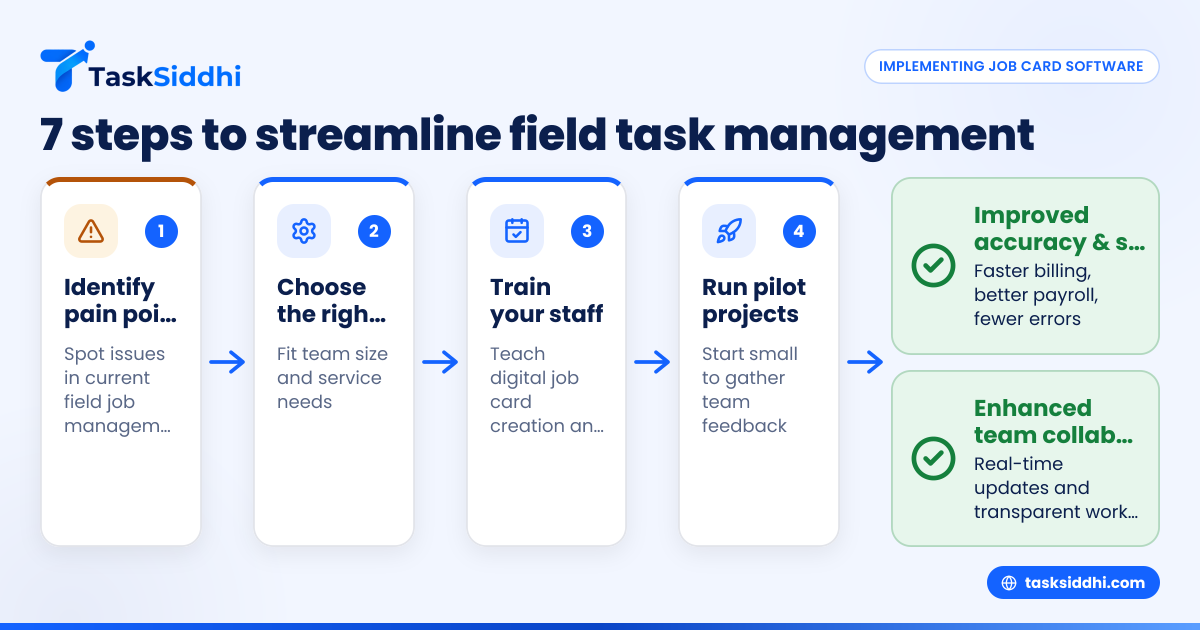
Implementing job card software does not require major overhauls or technical expertise. Follow these steps:
- Identify your current field job management pain points
- Choose software that fits team size and service complexity, like TaskSiddhi with boards and views and mobile app support
- Train staff on creating and updating job cards digitally
- Start with a pilot team or limited project to gather feedback
- Develop routines around digital job cards for task assignment, completion proof, and billing
- Use reporting and time tracking features to monitor efficiency
- Scale software use as comfort and results improve
Smooth onboarding reduces resistance from field teams used to paper or WhatsApp. Digital job cards improve accuracy, transparency, and speed with measurable ROI.
Is job card software expensive for small businesses?
Job card software pricing varies by features and user count. Many providers, including those focused on US small businesses, offer tiered plans starting from free or low-cost options. Core task management combined with automation and mobile access can fit modest budgets without heavy upfront investment.
Compared to labor and administrative costs of manual job tracking, digital job card systems can save money by reducing errors, speeding billing, and improving customer satisfaction. Evaluate software based on value rather than just upfront price, considering productivity gains in cities with competitive markets such as Detroit or Houston.
For a detailed comparison, visit TaskSiddhi’s free vs paid page and explore plans on the pricing page.
how do digital job cards impact customer satisfaction?
Real-time job card updates improve communication between field technicians, managers, and customers. Providing on-site proof of work like photos and customer signatures helps build trust and reduces disputes. Customers appreciate timely updates on job progress and precise billing, enhancing repeat business potential.
Digital job cards also enable faster turnaround times from job completion to invoicing and payment collection. This efficiency not only boosts cash flow but enhances the professional image for small US service businesses competing in crowded local markets.
conclusion
Job card software is a practical tool for US small service businesses to transform field task management. It digitizes and centralizes job details, improves team coordination, and accelerates billing and reporting. With mobile apps and AI features, companies can boost operational efficiency and customer satisfaction. Explore how TaskSiddhi’s job card software features can help your team by taking the product tour or comparing plans on the pricing page.
Frequently asked questions
What is an ai job card, and how does it help service teams?
An AI job card is a digital job card enhanced with artificial intelligence to optimize task assignments and predict workflow issues. It helps service teams work more efficiently by automating scheduling and suggesting resource allocation based on historical data.
Can job card software integrate with accounting tools like QuickBooks?
Yes, many job card software solutions designed for US businesses offer integration or export options compatible with QuickBooks and other popular accounting tools like Stripe. This simplifies billing and tax compliance.
How does job card software improve time tracking accuracy?
Job card software with integrated time tracking lets field workers log hours directly on job cards via mobile devices. Real-time data capture reduces rounding errors and supports compliant payroll processing under US labor laws.
Is job card software secure for client information?
Reputable job card software providers implement data security measures like encryption and restricted access controls, adhering to US business data privacy practices to protect client and company information.
How quickly can my team start using job card software?
Most modern job card software offers intuitive interfaces and mobile apps, enabling teams to start within days. Minimal training is needed, especially when onboarding is done in phases.
Do job card digital records satisfy IRS requirements for business expenses?
Yes, digital job card records with detailed job descriptions, times, and client approvals can support business expense documentation required by the IRS during audits or tax filings.