














Job card software helps manufacturers in Maharashtra track field jobs, assign tasks, collect job proof, and manage service teams efficiently. It replaces WhatsApp groups and paper job cards, simplifying job visibility and timely completion.
Key takeaways
- Job card software streamlines scheduling, job tracking, and proof collection for manufacturers in Maharashtra.
- It improves communication, reduces errors, and provides real-time updates to field and office teams.
- Features like time tracking and photo proof help ensure accountability and job quality.
- AI job card functionalities can automate task assignments and optimize workflows.
- Using digital job cards supports compliance with the DPDP Act 2023 by securely handling personal data.
- Mobile apps enable teams in tier-2 and tier-3 cities to update jobs on the go without losing connectivity.
What is job card software and why do manufacturers in Maharashtra need it?
A job card software is a digital tool that creates job cards—detailed records of work orders—for dispatch, progress tracking, and completion verification. For Indian manufacturers, especially in Maharashtra’s industrial hubs like Pune and Aurangabad, managing field service jobs on WhatsApp or Excel leads to lost data and delays.
Manufacturers typically coordinate site visits, equipment maintenance, or client delivery with field teams. Without a proper system, it is hard to track who did what, when, and where. Job card software brings all this data into one platform, enabling managers to assign jobs quickly, get status updates, track time spent on tasks, and collect proofs such as photos or customer signatures.
This reduces disputes, improves service quality, and helps comply with documentation standards required under GST audits or internal quality checks. Using software built for Indian teams also means better handling of Indian addresses, GST invoices, and local languages.
How does AI job card technology help Indian manufacturers?
AI job card technology automates task allocation, detects delays, and suggests optimal schedules based on past data. It analyses job complexity and employee availability in real time, reducing manual planning effort.
For example, an AI-powered job card system can automatically assign a maintenance task to a technician near the factory in Nashik, who is free at the required time. AI can predict if a delay is likely and alert managers to adjust assignments proactively. This boosts productivity and customer satisfaction.
Manufacturers get faster turnaround on service calls and better resource usage. The AI also helps in generating reports quickly, identifying frequent failure points in equipment, or flagging bottlenecks in site visits.
How do I start using job card software in my manufacturing unit in Maharashtra?
Short answer: Select software that fits your team size and job complexity, onboard your employees, and migrate existing job cards digitally.
Begin by evaluating your current workflow and pain points. Are your team updates delayed? Are job completion proofs missing or scattered? Use this to choose features like mobile app access, photo proof, and time tracking.
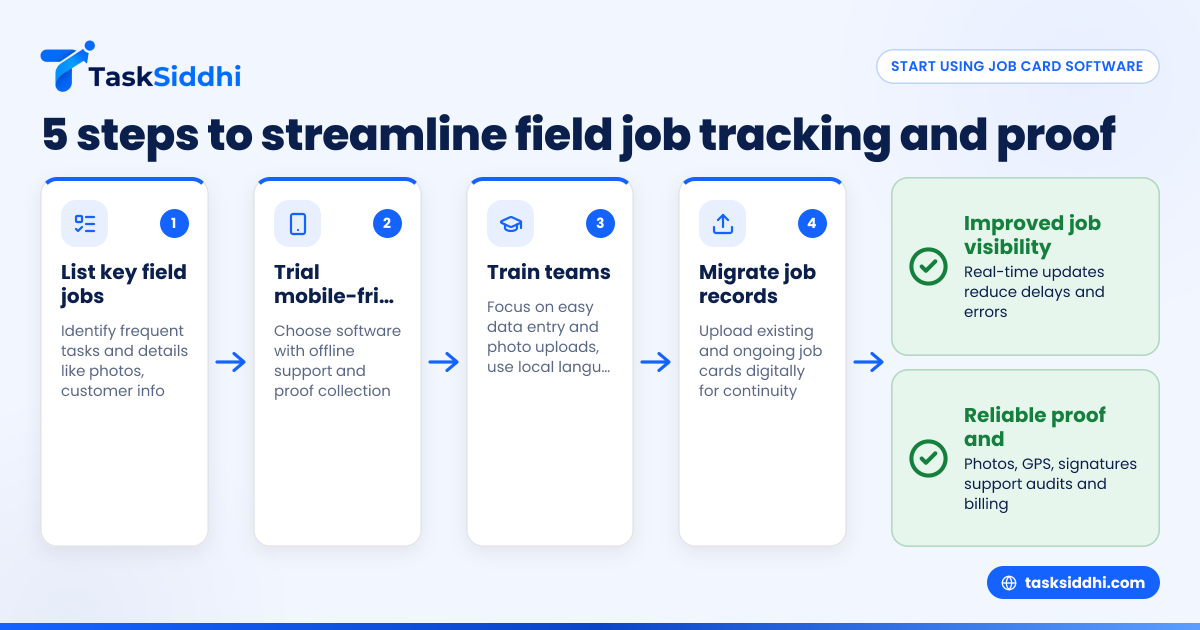
Follow these steps:
- List your frequent field jobs and required details to capture (customer info, job type, photos).
- Trial a job card software app that supports mobile updates and works offline.
- Train your field and office teams on the app, focusing on easy data entry and photo uploads.
- Migrate your job history or ongoing tasks into the system for continuity.
- Establish a routine to review daily job card reports and timesheets.
Moving away from WhatsApp and paper saves management time and cuts errors. You also gain digital records for GST and client billing, compatible with tools like Tally.
What are the essential features of job card software for Maharashtra manufacturers?
A good job card software for manufacturers in Maharashtra should have:
- Task assignment and tracking: Create, assign, and monitor jobs with deadlines and priority.
- Mobile app support: Field teams can update job status and upload proof from anywhere, even tier-3 towns.
- Photo and signature proof: Attach photos or client signatures as onsite evidence.
- Time tracking: Log time spent per job for billing and efficiency analysis.
- Custom templates: Design job card formats to capture relevant data such as GST invoice numbers or machine serials.
- Real-time status notifications: Alerts for pending or delayed jobs.
- Reporting: Generate reports on job completion, worker productivity, and service quality.
- Data privacy compliance: Ensure secure handling of worker and client data per DPDP Act 2023.
Features like time tracking and reporting help manufacturers maintain transparency and audit-readiness. Integration with payment solutions like UPI or Razorpay for client invoicing enhances workflow.
How does job card software help with field visits and proof in tier-2 and tier-3 cities of Maharashtra?
Job card software improves the reliability of field visits by providing location and time stamps and capturing on-site proof such as photos or signatures. In cities like Nashik or Solapur, field conditions can vary, and connectivity may be spotty.
Mobile apps work offline and sync automatically when the device gets a signal. This helps teams update job progress immediately after completing tasks, reducing lost data or double entries.
Managers at the home office in Mumbai or Pune can track jobs as they happen, assign new work, or respond to issues faster. This leads to better service quality and timely client billing.
Proof collected digitally also supports compliance with documentation rules and reduces disputes over completed work.
Can job card software integrate with GST and Tally accounting for manufacturers?
Yes, modern job card software designed for Indian manufacturers often supports export or integration with GST e-invoicing and accounting software like Tally. This allows job data, including invoice numbers and GST details, to be transferred easily without manual entry.
Proper job documentation aids GST compliance, as audits may require proof of service delivery or client acceptance. Automated data flow reduces errors and saves time during filing monthly returns.
Manufacturers in Maharashtra benefit from simplified billing, accurate cost tracking, and easier reconciliation between service jobs and financial accounts.
How much does job card software cost for small manufacturing teams in Maharashtra?
Short answer: Costs vary depending on features, number of users, and support, but manufacturers can start with affordable monthly plans tailored for teams of 5 to 30.
Most job card software providers offer tiered pricing based on team size and feature sets. Essential plans with mobile access, time tracking, and reporting start at budgets suitable for SMEs. Manufacturers can scale up as their operations grow.
Evaluate return on investment by factoring in time saved, error reduction, and improved billing accuracy. Free trials and demo plans help decide if the software meets your needs before paying.
See detailed comparisons in the free vs paid guide.
How to ensure data privacy and compliance while using job card software?
With the DPDP Act 2023 in effect, manufacturers must safely handle personal data of employees and clients. Choose job card software that stores data securely on Indian servers, offers role-based access, and complies with data handling norms.
Regularly review permissions, audit job card data for sensitive information, and ensure data retention policies align with legal requirements.
Train field and office teams about responsible data handling, especially when collecting photos or signatures.
Conclusion
For Maharashtra manufacturers, adopting job card software transforms field job management. It digitises job tracking, proof collection, and reporting, trimming operational delays and errors. Features like AI job card automation and mobile app support make it effective across tier-2 and tier-3 cities. Explore how TaskSiddhi’s platform helps your team improve service quality and control costs with ease at our product tour or see plan options on pricing.
Frequently asked questions
What is the difference between a paper job card and job card software?
Paper job cards are physical sheets that are hard to track, prone to loss, and require manual entry for reporting. Job card software digitises this process, providing real-time updates, proof collection, and easier reporting for manufacturers in Maharashtra.
Can job card software work offline in locations with poor internet in Maharashtra?
Yes, many job card apps support offline data entry. They sync automatically once the device reconnects. This helps field teams in Nashik, Aurangabad, and other areas keep updating tasks without disruption.
How do I train my field staff to use job card software effectively?
Start with simple app training focusing on entering essential job details and uploading photos. Use local language guides if needed. Regular follow-ups and sharing success stories motivate adoption.
Is TaskSiddhi’s job card software suitable for small manufacturing teams?
Yes, TaskSiddhi is designed for Indian teams of 5 to 30, especially manufacturers managing field and client jobs. Its features fit typical workflows and provide a mobile app for easy updates.
What proof can I collect on job cards to avoid payment disputes?
You can collect photos of completed work, client signatures, GPS stamping, and time logs. This digital proof provides clear evidence, reducing misunderstandings in billing or service completion.
How can AI improve my job card management?
AI helps by automating task assignments, predicting delays, and streamlining workflows. This allows manufacturers to optimise resource use and improve service turnaround without manual oversight.