














Service job tracking is the process of organizing, monitoring, and recording tasks for HVAC teams to ensure timely and quality service delivery. For Delaware’s small HVAC businesses, efficient service job tracking reduces errors, improves customer satisfaction, and streamlines operations.
Key takeaways
- Service job tracking organizes HVAC tasks, speeds up workflows, and avoids missed appointments.
- Mobile apps let field technicians update job status and share proof on the spot.
- Tracking time and materials helps with accurate invoicing, vital for Delaware small businesses managing cash flow.
- Automation reduces repetitive data entry and customer communication delays.
- Using detailed reports reveals team performance trends and improves service quality.
- AI service job tools can analyze data for smarter scheduling and resource allocation.
why is effective service job tracking important for Delaware HVAC businesses?
Delaware small HVAC businesses juggle many clients with varying schedules. Effective service job tracking ensures that service requests don’t get lost in Excel sheets or WhatsApp messages. It helps managers see what jobs are pending, in progress, or completed, so they can allocate resources properly.
Tracking also aids compliance with local Delaware business requirements. For example, timely documentation and proof of service support accurate 1099 filing for independent contractors. It reduces chances of payment disputes and simplifies bookkeeping with popular US finance tools like QuickBooks and Stripe.
Since HVAC companies in Wilmington or Dover handle emergency calls alongside routine maintenance, clear visibility over jobs helps prioritize urgent requests. It also supports tracking state sales tax charges properly on service invoices.
what does ai service job tracking mean for a small HVAC business?
AI service job tracking refers to using artificial intelligence to analyze HVAC job data, automate scheduling, or predict resource needs. AI can optimize routes for technicians in the busy corridors of Newark, DE, ensuring faster response times while reducing fuel costs.
AI-driven systems can identify patterns from past jobs, such as common maintenance issues or frequent parts replacements in specific neighborhoods. This insight helps businesses stock the right inventory and prepare technicians better.
Integrating AI with traditional service job tracking software saves time on manual data input and provides actionable insights, giving Delaware HVAC businesses a competitive edge against larger companies.
how can mobile apps improve service job tracking for HVAC teams?
Using mobile apps, technicians update job statuses, log time spent, and upload photos directly from job sites. This eliminates the typical delays from waiting to return to the office to fill out paper job cards.
For example, a technician in Newark can capture a photo of a repaired HVAC unit or a faulty component and attach it to the job card instantly. This real-time proof benefits both managers and clients, verifying that work was completed satisfactorily.
Mobile apps reduce miscommunication within small teams of 5 to 30 members, which is common for Delaware businesses. They coordinate schedules and changes smoothly without endless calls or WhatsApp messages.
what are best practices for tracking time and materials on service jobs?
Accurately tracking the time technicians spend on each service job in Delaware is crucial for billing and payroll. Use digital time tracking software that integrates directly with your HVAC job board and invoicing system.
For materials, record parts used with prices, including Delaware state sales tax, as this affects the final invoice. Keep this documentation linked to the appropriate job card so it’s easy to review or correct if needed.
Best practices include:
- Logging start and finish times precisely through mobile devices.
- Notating any unexpected delays or additional labor.
- Verifying parts used match the inventory or purchase orders.
- Regularly reviewing and reconciling job data to catch errors early.
Accurate records speed up payments and improve trust with customers in Delaware’s competitive market landscape.
how to use automation for service job tracking without losing personal touch?
Automation streamlines routine tasks such as sending appointment reminders or follow-up satisfaction surveys. You can set triggers within your job tracking system to email customers when a technician is en route or notify them if a part is backordered.
However, avoid over-automating communication that should be personal, like discussions of cost changes or job complications. Maintaining warmth and responsiveness helps your Delaware HVAC clients feel valued.
Automation should free your team to focus on quality service and problem-solving rather than drowning in paperwork or manual updates.
what role do reports play in enhancing service job tracking?
Service job tracking reports provide detailed insights on job completion times, technician productivity, and customer feedback. Delaware small business owners use reports to identify bottlenecks, frequent complaints, or seasonal demand spikes.
For example, a detailed report may reveal that HVAC units in Rehoboth Beach require more frequent repairs during humid summer months. Such insights can drive proactive service offers or better technician training.
Reports also help when applying for loans or investor pitches by showcasing your operational efficiency and growth potential.
how can small Delaware HVAC businesses start service job tracking with minimal disruption?
Transitioning from paper or WhatsApp groups to a structured service job tracking system can seem daunting. Here are steps to start smoothly:
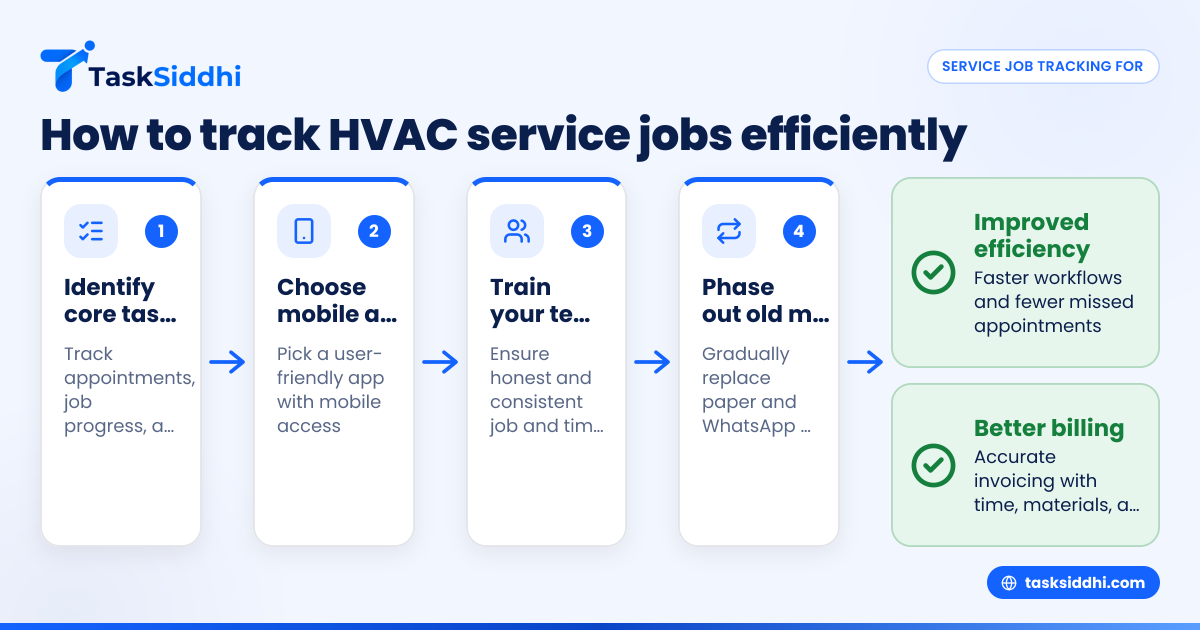
- Identify the core tasks that need tracking: appointments, job completion, parts usage.
- Choose an easy-to-use app or platform with mobile access.
- Train your team on logging jobs and time honestly and consistently.
- Gradually phase out old methods while keeping them as a backup for a short period.
- Regularly review job data with your team to reinforce accountability.
This approach reduces resistance and improves uptake across your field staff.
conclusion
Service job tracking is essential for Delaware small HVAC businesses to maintain efficiency, billing accuracy, and customer satisfaction. Embracing mobile apps, automation, and AI capabilities can transform your daily operations and support sustainable growth. Discover how a dedicated service job management tool can help your business by taking a product tour or see which plan matches your needs on the pricing page.
frequently asked questions
what is the easiest way to track HVAC service jobs?
The easiest way is to use a mobile app designed for service job tracking. It lets technicians update job progress from the field, log time and materials, and sends automatic notifications to clients. This method increases accuracy and speed versus manual paper-based processes.
how does ai service job tracking improve HVAC business scheduling?
AI analyzes past job data and technician locations to create optimal daily routes and schedules. This reduces travel time, increases the number of completed jobs, and lowers fuel costs, improving profitability for small HVAC companies in Delaware.
can service job tracking software integrate with QuickBooks or Stripe?
Yes, many service job tracking platforms offer integrations with financial tools like QuickBooks and Stripe. This helps automate invoicing and payment processing based on accurate job data, streamlining cash flow management for small Delaware businesses.
what features should a service job tracking app have for small HVAC businesses?
Look for features like mobile job updates, time and material tracking, photo attachments, automation for communication, and reporting capabilities. These functions address typical challenges faced by small teams managing multiple jobs across Delaware locations.
is manual service job tracking still viable for small teams?
Manual tracking can work for very small teams with limited jobs, but it is prone to errors and can slow growth. Using digital tracking improves efficiency, transparency, and customer satisfaction, which are crucial for scaling a Delaware HVAC business.
how often should I review service job reports?
Review reports weekly or monthly to monitor performance trends and identify bottlenecks. Regular reviews help you make informed decisions about staffing, training, and customer communications in your Delaware HVAC operation.