














Service job tracking helps Delaware HVAC businesses manage fieldwork efficiently by organizing service requests, dispatching technicians quickly, and collecting proof of work on site. It boosts customer satisfaction and reduces paperwork and scheduling errors, saving time and cutting costs.
Key takeaways
- Service job tracking digitizes job scheduling and technician dispatch, critical for busy Delaware HVAC businesses.
- Real-time updates and proof of work reduce disputes and improve customer trust.
- Mobile apps let field technicians capture photos, notes, and signatures on site for immediate reporting.
- Integrating time tracking with job boards helps optimize technician productivity.
- Automation can streamline repeat tasks like notifications, approvals, and invoicing.
- Leveraging AI service job features can provide smart scheduling and workload balancing.
Why service job tracking is essential for Delaware HVAC businesses
HVAC businesses in Delaware face unique challenges such as unpredictable weather, seasonal demand spikes, and urgent repair requests. Coordinating multiple field technicians across Wilmington, Dover, and Newark while maintaining detailed records onsite is critical.
Without efficient service job tracking, business owners often rely on phone calls, texts, or WhatsApp groups, which lead to miscommunication, missed jobs, or duplicate visits. Paper job cards are hard to manage and delay billing.
A dedicated service job tracking system centralizes your job info with digital boards and job cards. Dispatchers and technicians see live updates, reducing missed jobs and improving job completion times. You can attach client communications, photos, and work reports directly to each job for clear proof. This eliminates reliance on paper and long email threads.
How does AI service job tracking work for HVAC businesses?
AI service job tracking uses intelligent software to analyze workloads, predict delays, and optimize schedules by assigning jobs based on technician skills, locations, and availability.
For Delaware HVAC companies, this means your dispatcher gets instant suggestions for the best technician for each job, factoring in traffic conditions or urgent requests. It reduces human error in scheduling and helps balance workloads so no technician is overbooked.
AI-driven tracking also aids in saving costs by minimizing technician travel times and ensuring jobs don’t fall through the cracks during peak seasons like winter or summer.
How do AI service job features optimize scheduling?
AI features analyze job details and technician availability, providing smart scheduling recommendations. This ensures efficient routes and balanced workload, reducing delays and travel costs.
What are the benefits of proof on the go for your HVAC service jobs in Delaware?
Proof on the go means your technicians capture job evidence live from the field, like photos of work completed, customer signatures, and notes.
This is a huge benefit in Delaware where customers expect timely and trustworthy service. When your tech snaps before-and-after photos, and gathers approval signatures during site visits, you get clear proof in your reports. This prevents billing disputes and supports faster invoicing.
Digital proof also makes your business look professional and reliable, improving customer satisfaction and the odds of repeat business in competitive markets like Philadelphia and Baltimore areas nearby.
Why is mobile proof collection critical for HVAC businesses in Delaware?
Mobile proof collection provides instant, verifiable documentation directly from the job site. It reduces billing disputes and boosts customer confidence in your service quality.
How can I improve dispatch in my Delaware HVAC business?
Effective dispatch relies on clear job status visibility and mobile connectivity for your techs.
Set up a centralized job board so your back office or dispatch team can see all jobs in progress and upcoming. Organize jobs by priority, location, or technician to plan routes efficiently.
Equip your techs with a mobile app to receive job updates and report status changes immediately. This reduces phone tag and manual status notes.
With TaskSiddhi’s boards and views and mobile app, you streamline dispatch and communication seamlessly between office staff and field teams, ensuring no jobs get missed.
How do I track time and expenses accurately on site?
Accurate time and expense tracking safeguards profitability for your HVAC business.
Have your technicians use a mobile time tracking feature to clock in and out at job sites. This automates payroll and flags overtime to keep labor costs in check.
Allow your field techs to capture expenses like parts used or travel fees with photo receipts attached to jobs. This integrates job costing into your billing flows.
Good tracking makes it easier to sync with QuickBooks or other accounting tools common among Delaware small businesses.
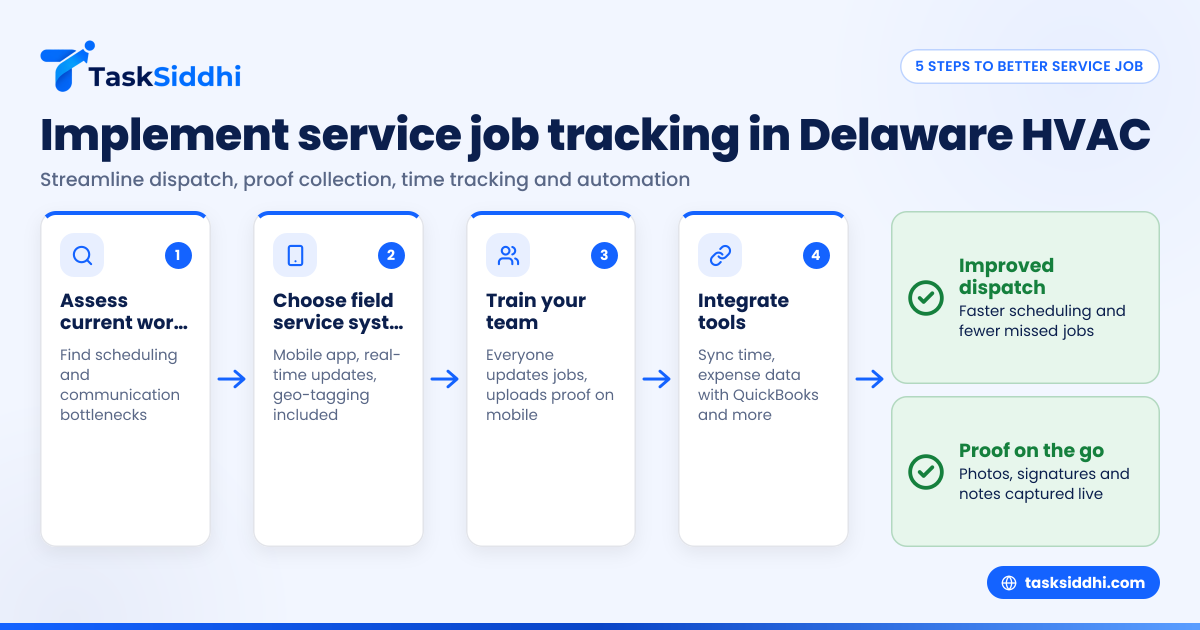
How to implement service job tracking in your Delaware HVAC business: 5 simple steps
Implementing service job tracking starts with understanding your current processes, then adopting tools and training your team. Here are five clear steps to get started:
- Assess your current workflow: Identify bottlenecks in scheduling, communication, or reporting.
- Choose a system designed for field service: Look for features like mobile apps, real-time updates, geo-tagging, and reporting dashboards.
- Train your staff and technicians: Make sure everyone understands how to use the job boards, update statuses, and upload job evidence.
- Integrate with your existing tools: Sync time and expense data with accounting like QuickBooks or invoicing apps.
- Leverage automation: Use notifications, approvals, and job reminders to reduce manual follow-up.
Following these steps helps Delaware HVAC owners make their service teams more productive and improve customer experience significantly.
What should I look for in a service job tracking app for Delaware HVAC?
When selecting a service job tracking app, prioritize:
- Easy mobile access so technicians can update jobs from any site.
- A visual job board for dispatch to see all jobs and team availability.
- Time tracking and expense capture integrated in one place.
- Reporting features that summarize jobs completed, technician productivity, and customer feedback.
- Support for urgent dispatch and proof of work such as customer signatures and photos.
- Customizable alerts and automated workflows to reduce manual admin.
TaskSiddhi covers all these with service jobs features tailored to field businesses in Delaware and beyond.
How can automation help my Delaware HVAC service job tracking?
Automation can handle routine tasks like reminders for technicians to update jobs, notifying customers when a tech is en route, or triggering billing workflows once a job is marked complete.
This cuts down on back-office workload and delays.
For busy Delaware businesses managing multiple locations or requests, automation scales your operations smoothly.
Can automated job proof and reporting improve customer retention?
Yes, many HVAC businesses see better retention when they provide transparent and timely reports with proof of service. Customers feel confident about billing accuracy and appreciate quick follow-up.
Digital reports with photos and signatures reassure clients and reduce disputes.
Your team benefits from easier audits and compliance, important when working with property managers or commercial clients in Delaware.
Conclusion
Delaware HVAC business owners can improve dispatch and manage service jobs more efficiently with service job tracking. Tools that provide real-time updates, proof of work on site, and automated workflows reduce errors, speed up billing, and improve customer trust. Consider integrating mobile time tracking and AI-driven scheduling to maximize your team’s productivity.
See how it works in practice on our product tour or compare plans at pricing.
Frequently asked questions
What is service job tracking for HVAC businesses?
Service job tracking is software that helps organize, dispatch, and monitor repair or maintenance jobs. It allows real-time updates and collects proof of work right from the field.
How does AI service job scheduling improve efficiency?
AI analyzes technician skills and locations to assign jobs optimally. It avoids overload and reduces travel time, speeding up job completion.
Can service job tracking integrate with QuickBooks?
Yes, many tracking tools sync job time and expenses with QuickBooks to streamline billing and accounting.
What proof of work should technicians capture on site?
Photos before and after work, customer signatures, and notes on issues or parts used provide reliable documentation.
Does automation help reduce missed jobs?
Absolutely. Automation sends reminders and customer alerts, cutting down on forgotten or delayed service visits.