














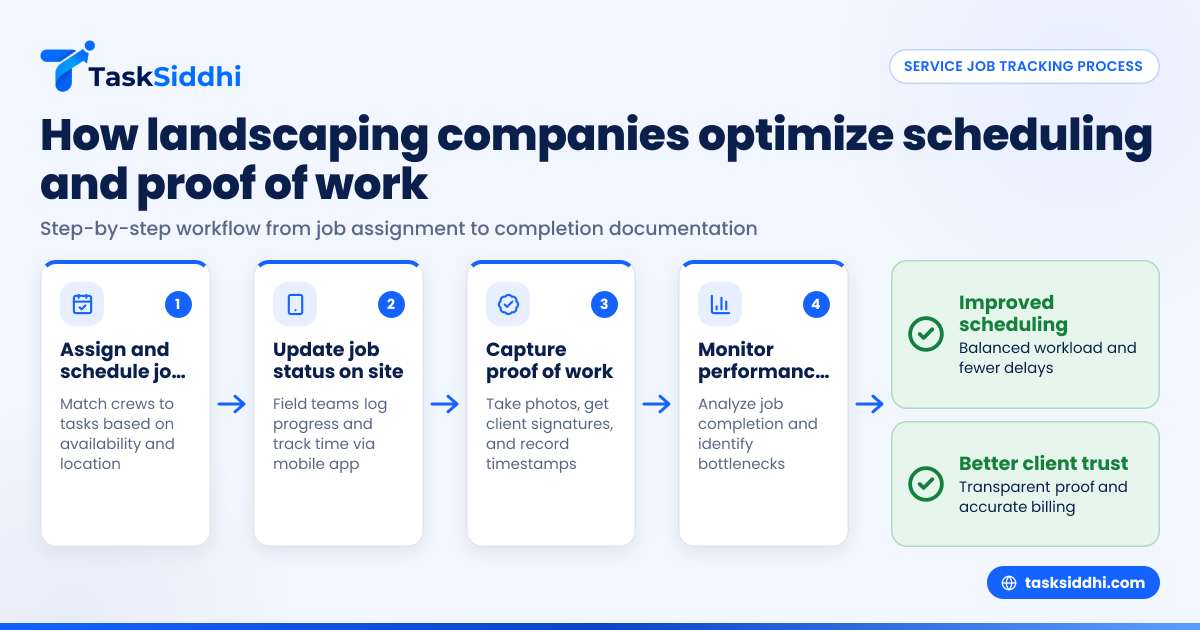
Service job tracking helps landscaping companies schedule tasks, monitor field work, and collect proof of completed jobs. It streamlines daily operations, improves communication within teams, and provides accurate records for clients and billing.
Key takeaways
- Service job tracking optimizes scheduling, reduces delays, and balances workload among landscaping crews.
- Real-time updates and proof-of-work photos improve transparency and client trust.
- Mobile apps enable field teams to log visits, track time, and update job status instantly.
- Reporting helps identify bottlenecks and refine processes for better service delivery.
- AI service job capabilities can automate scheduling and prioritize urgent tasks.
- Using a dedicated tool reduces reliance on spreadsheets, paper forms, and WhatsApp groups.
What is service job tracking for landscaping companies?
Service job tracking involves using tools and processes to monitor landscaping tasks from dispatch to completion. For small landscaping companies in cities like Houston or Detroit, it means assigning crews to specific jobs, scheduling jobs efficiently, and collecting proof of work such as photos or customer sign-offs.
Tracking helps managers avoid double bookings and last-minute reschedules. It reduces missed appointments and ensures teams spend less time on administrative work. When jobs are logged digitally, it’s easier to maintain accurate client records for invoicing and future contracts.
How does service job tracking improve scheduling in landscaping?
Service job tracking improves scheduling by providing a clear overview of upcoming and ongoing jobs. Managers can view all tasks in one place and assign crews based on availability and skill sets. This reduces conflicts and gaps between jobs.
Digital boards show job priority and location, which helps route teams efficiently—important in sprawling metro areas like Chicago. Automated reminders alert teams and clients about upcoming visits. AI service job features can analyze past job durations and traffic patterns to suggest the best schedule, balancing workloads and minimizing late arrivals.
By reducing manual scheduling and last-minute changes, landscaping companies increase on-time completions and customer satisfaction.
What tools help with service job tracking for small landscaping businesses?
Several tools help track service jobs, including spreadsheets, paper logs, and messaging apps. However, these methods can be error-prone and inefficient for companies with 5 to 30 workers.
Dedicated work management apps offer:
- Boards and views for visualizing jobs by status and location
- Mobile app access for field workers to update job progress on site
- Time tracking to log hours spent on each job
- Photo capture and document upload for proof of service
- Reporting to analyze job completion rates and team performance
TaskSiddhi is one such app designed for US businesses to manage field service jobs efficiently. Its mobile app and automation features help managers monitor multiple teams and client sites without constant calls or texts.
What does "ai service job" mean and how can it help?
AI service job means using artificial intelligence to automate and optimize how service jobs are scheduled and managed. It analyzes data like team availability, past job times, and priorities to recommend the best assignments and orders.
This helps landscaping companies save time, balance workloads, and handle urgent jobs faster. AI predicts how long tasks might take and alerts managers to potential delays, making operations smoother and more efficient.
How to prove service work was completed on field jobs?
Proof of work is vital for client trust and billing transparency. For landscaping, this includes photos of finished lawns, signatures from clients, and timestamps from job site visits.
Mobile apps allow field teams to capture photos right from their phones and attach them to job cards. GPS tagging verifies the location, and time tracking confirms when the job was done.
Keeping this evidence digitally organized simplifies invoicing and protects your business against disputes. It also provides documentation for warranty claims or follow-up visits.
How do I set up service job tracking for my landscaping company?
Start by choosing a work management app that offers mobile access for your field teams. Next, create boards that match your workflow stages like scheduled, in progress, and completed.
Add your landscaping jobs as cards with client and address details. Assign crews and set start times with notifications for upcoming visits. Train your field workers to update job status and upload proof such as photos via the mobile app.
Use reporting tools to monitor job completion rates and team performance. Begin with a small group to refine the process before rolling it out company-wide. This step-by-step approach helps you adopt service job tracking smoothly.
Can service job tracking integrate with my existing systems?
Yes, many job tracking tools integrate with common business apps like QuickBooks for accounting, Stripe for payments, and email platforms for client communication. Integration reduces manual data entry and errors.
Some apps also connect with ERP systems used in larger operations, making data flow seamless across departments. Check if your chosen tool offers APIs or built-in connectors to fit your workflow.
Integrated systems help your teams focus on service delivery rather than juggling multiple tools.
What costs should I expect for service job tracking solutions?
Prices vary by features, number of users, and contract terms. Entry-level plans often include core tracking and mobile app use.
Advanced options may add AI scheduling, automation, and detailed reporting. Most vendors charge per user monthly, with discounts for annual billing.
Consider your current admin time and errors saved when evaluating ROI. Efficient service job tracking usually pays for itself by improving field productivity and client satisfaction.
How to make your landscaping service job tracking mobile friendly?
Since landscaping crews work in the field, mobile-friendly tools are essential. Look for apps that let workers view assigned jobs, update progress, log hours, and capture photos or signatures onsite.
Real-time communication via mobile reduces paperwork and duplicate effort. It speeds feedback and helps managers respond quickly to issues.
Mobile access keeps field teams connected and operations running smoothly.
Conclusion
Optimizing service job tracking transforms how small landscaping companies in the US manage daily operations. Scheduling gets smarter, teams stay connected, and clients receive timely proof of quality work. Mobile apps and AI capabilities provide extra efficiency gains. Explore how TaskSiddhi streamlines job tracking on the product tour or compare plans on the pricing page.
Frequently asked questions
What is service job tracking?
Service job tracking is a digital process that monitors service tasks from assignment to completion. It helps landscaping companies schedule, manage crews, and document completed jobs for client transparency and billing.
How does AI improve service job scheduling?
AI analyzes historical job data and team availability to optimize schedules. It forecasts job durations and prioritizes urgent tasks, reducing delays and improving resource use.
Can I use my phone for job tracking?
Yes, modern tools offer mobile apps for field workers to update job status, upload photos, track time, and communicate with managers in real time.
Is proof of work necessary for landscaping services?
Proof ensures client trust and protects against disputes. Photos, timestamps, and client sign-offs document completed work and assist with billing accuracy.
Does service job tracking help with billing?
Definitely. By logging job details, hours, and materials used, tracking software supports precise invoicing and integrates with payment or accounting systems.
How do I start with service job tracking?
Choose a work management app, set up boards with your workflow, add jobs, assign teams, and encourage field staff to update progress via mobile. Use reporting tools to monitor and improve operations.