














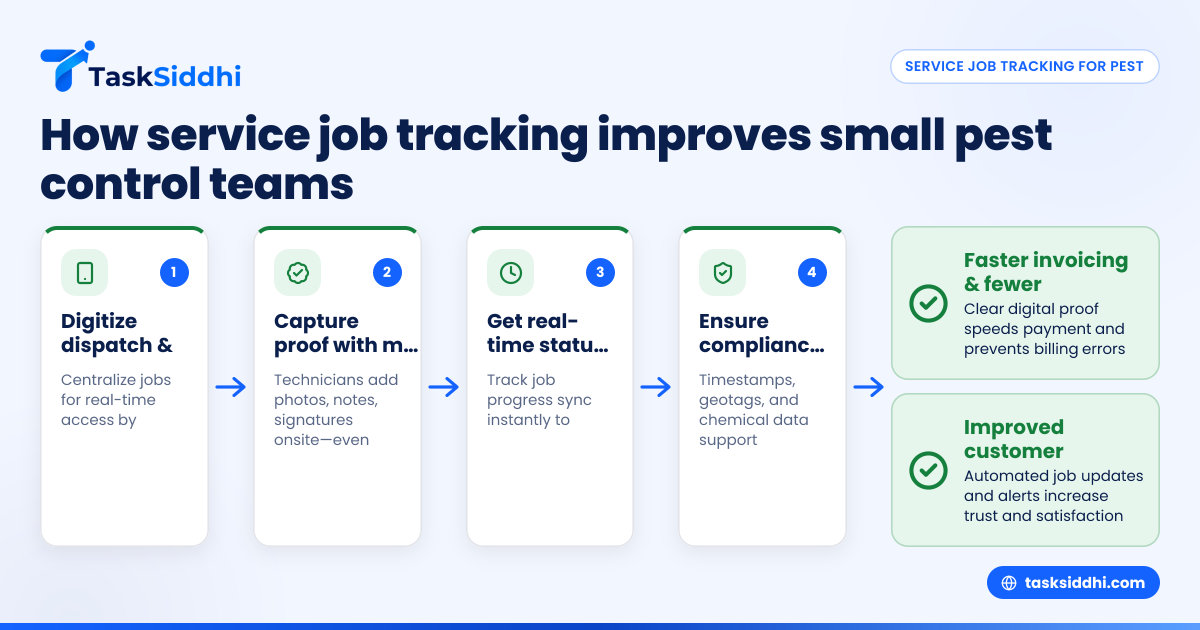
Service job tracking helps small pest control teams stay organized by digitizing dispatch, job progress, and proof of work with mobile job cards. It speeds up scheduling, improves communication, and ensures accurate records for billing and compliance.
Key takeaways
- Service job tracking improves field team dispatch and real-time job monitoring.
- Mobile job cards allow pest control workers to capture proof with photos and notes onsite.
- Real-time status updates reduce time wasted on coordination and follow-ups.
- Tracking boosts accuracy for billing, tax reporting, and compliance with US regulations.
- AI service job tools can suggest scheduling optimizations and flag delays early.
- Integrating tracking with your work management app simplifies daily operations.
Why service job tracking matters for small pest control teams
Service job tracking centralizes job assignments and real-time progress updates, reducing delays and miscommunication common in phone or paper-based methods. By digitizing dispatch and documentation, small pest control teams stay efficient and prepared for accurate billing and compliance.
Small pest control businesses in cities like Houston or Detroit often rely on phone calls, WhatsApp groups, or paper cards to coordinate service jobs. These methods lead to missed updates, duplicate efforts, and delays in billing. Service job tracking solves these problems by centralizing job assignments and progress updates on a digital platform accessible to managers and field technicians in real time.
The pitfalls of traditional tracking
Using WhatsApp for job coordination can quickly become overwhelming as team size grows. Important job messages can get buried in group chats, leading to confusion about what tasks are pending or completed. Paper job cards, meanwhile, are prone to getting lost or damaged, causing disputes over work done and payment delays. Mistakes in transcribing handwritten notes can also affect billing accuracy and compliance documentation.
A field example from Chicago
Consider a pest control operator managing a team of 12 technicians across Chicago. The dispatcher has to juggle phone calls while updating an Excel sheet that doesn’t sync in real time. One technician arrives onsite, but without access to the latest instructions. They complete the job but forget to capture proof photos. Back at the office, billing is delayed because of missing paperwork. The dispatcher wastes hours coordinating callbacks and chasing missing information.
Service job tracking replaces all these headaches. When the technician arrives, they open a mobile app displaying their job card with all relevant details, including client information, safety notes, and special requests. They take photos of traps set or sprayed areas and add remarks—all timestamped and synced immediately. Dispatchers see progress in real time and can reschedule jobs if delays occur.
Benefits beyond the field
This visibility translates into faster invoicing and reduces disputes. It also improves compliance with EPA pesticide record-keeping rules, as every job has documented proof. Business owners gain confidence knowing their documentation is secure and audit-ready, avoiding potential liabilities.
How does AI service job technology enhance pest control operations?
AI service job tools analyze past job data to optimize schedules, predict delays, and suggest resource allocation. They identify patterns like peak job times or repeat visits, helping managers plan routes and hours, cut fuel costs, and improve customer satisfaction.
Scheduling optimization with AI
AI-powered tools detect trends—for example, afternoon storms in Detroit that delay jobs—and recommend shifting appointments to mornings for better completion rates. It can also group jobs geographically, suggesting efficient technician routes to reduce drive time.
Example: AI flags three appointments on Detroit’s west side and recommends assigning one technician to all, minimizing travel. It identifies overbooked technicians and prompts reassignments to balance workload.
How does AI service job technology predict delays?
AI monitors job progress and sends early alerts when a job runs behind schedule. In busy Houston teams, such warnings help managers adjust assignments or notify customers proactively, reducing frustration and preventing a backlog.
AI’s delay prediction increases responsiveness and customer satisfaction by enabling timely intervention before problems escalate.
Resource and inventory forecasting
AI analyzes pesticide consumption trends to predict when to reorder supplies based on upcoming job demands. This prevents last-minute procurement challenges and reduces excess inventory costs.
Preparing for business growth
By automating scheduling and data analysis, AI service job technology frees managers from manual tasks, allowing focus on customer acquisition and team expansion.
How can mobile job cards improve proof of service and compliance?
Mobile job cards digitize job logs with timestamps, geotags, photos, and client signatures right at the site using smartphones or tablets. This detailed documentation supports accurate billing and dispute resolution.
Ensuring compliance with EPA pesticide regulations
The EPA requires pest control businesses to keep detailed pesticide usage records, including product data and client acknowledgments. Mobile job cards let technicians input this information onsite, reducing incomplete paperwork risks.
For example, a Houston technician treating a home can select pesticide types, enter used quantities, attach photos, while the system records date, time, and GPS data automatically. This digital trail simplifies audits and inquiries.
Protecting your business during IRS audits and insurance claims
Accurate job records validate tax deductions and prove work done for billing. They also serve as evidence in insurance claims related to property or injury disputes.
Eliminating errors and lost paperwork
Unlike paper job cards, mobile versions are centralized, searchable, and cloud-backed, improving accuracy and speeding up payment processes.
What features should small pest control teams look for in service job tracking software?
Effective software should support pest control workflows with essential, user-friendly tools.
1. Mobile app support
Technicians need offline-capable apps to update jobs and capture proof onsite without delays. Syncing occurs once connected to the internet.
2. Dispatch board and scheduling
Managers benefit from visual calendars or maps for quick job assignments and adjustments, reducing conflicts and optimizing resources.
3. Real-time updates
Automatic notifications on job acceptance, start, and completion minimize phone traffic and keep everyone informed.
4. Photo and signature capture
Built-in options to add photos and collect client signatures create strong proof of services rendered.
5. Time tracking integration
Logging hours per job allows accurate payroll and invoicing, especially for hourly work.
6. Reporting and analytics
Insight dashboards show job durations, technician productivity, and revenue trends to guide operational decisions.
7. Automation
Automated reminders for follow-ups, recurring visits, and license expirations help maintain compliance and customer satisfaction.
Avoiding feature overload
Choose solutions focused on pest control needs, avoiding unnecessary complexity. Pick platforms that scale with your business growth.
How can service job tracking improve customer communication and satisfaction?
Tracking apps enhance communication by automating updates and sharing digital proof, building trust that drives repeat business.
Sharing real-time updates
Automatic texts or emails confirm appointments, technician arrival, and job completion, reducing manual calls and keeping customers informed.
Delivering digital proof and reports
Clients receive photos and job summaries promptly, reassuring them of thorough service, such as traps placed or areas treated.
Handling delays professionally
Automated alerts notify customers early about delays, helping manage expectations and maintain a positive reputation.
Minimizing disputes
Clear, timestamped documentation prevents misunderstandings over services or charges, supporting positive reviews and referrals.
How do small businesses integrate service job tracking with their existing tools?
Service job tracking should seamlessly connect with tools like QuickBooks and Stripe to avoid manual data entry and errors.
Syncing financial data
Top platforms export job and time data compatible with QuickBooks or integrate via APIs, streamlining invoicing and payment reconciliation.
CRM and email marketing connections
Integration with CRM systems automates customer reminders and marketing, ensuring compliance with CAN-SPAM and TCPA rules while boosting retention.
Avoiding workflow interruptions
Choose tracking software designed to enhance your current stack, enabling quick adoption with minimal training.
If you want to see how service job tracking can transform your pest control team's dispatch and onsite work, explore a product tour or review the pricing to find a plan that fits your needs.
Frequently asked questions
What is the main benefit of service job tracking for pest control teams?
Service job tracking digitizes job dispatch and progress updates, providing transparency and organization. It reduces delays, paperwork errors, and billing disputes, allowing teams to complete more jobs efficiently and improve customer service.
Can mobile job cards be used without internet access?
Yes, most modern service job tracking apps allow offline data entry. Technicians can capture notes and photos onsite without connectivity. Once reconnected, updates automatically sync to the system, ensuring records remain complete.
How does service job tracking help with compliance?
By capturing detailed job data such as timestamps, geolocations, chemical usage, and client signatures, service job tracking supports compliance with EPA requirements and IRS audits. This documentation helps demonstrate adherence to regulations and protects your business.
Are AI features necessary for small teams?
AI features are optional but beneficial. They automate routine scheduling, highlight potential issues early, and optimize resource allocation. As your business grows, AI saves time and reduces manual mistakes.
How secure is the data stored in service job tracking apps?
Reputable service job tracking platforms implement data encryption and strong security protocols. This protects sensitive client and operational information against unauthorized access or breaches.
Can my pest control team track time worked on individual jobs?
Yes, integrating time tracking allows technicians to log hours spent per job accurately. This supports fair payroll practices and correct billing based on actual work performed.