














Service job tracking helps small plumbing teams in the US manage dispatch, job progress, and real-time proof of work. It increases efficiency, reduces errors, and improves customer satisfaction with mobile tools that keep teams connected on-site and in the office.
Key takeaways
- Service job tracking centralizes job information and streamlines dispatch for plumbing teams.
- Mobile apps enable on-the-go updates and proof like photos and signatures directly from service visits.
- AI service job tools can improve scheduling and automate routine tasks for faster responses.
- Accurate tracking supports billing, client communication, and compliance with US regulations.
- Integration with QuickBooks and payment tools simplifies invoicing after job completion.
- Real-time reporting helps managers monitor team performance and optimize routes.
Why is service job tracking critical for small plumbing teams in the US?
Service job tracking ensures every plumbing job is accounted for, from dispatch to completion. Small teams in cities like Chicago or Houston often juggle multiple service calls daily. Without proper tracking, jobs might get delayed, details lost, or proof of work missing, resulting in unhappy customers or billing disputes.
A cloud-based job tracking system shares updates instantly between dispatchers and plumbers in the field. This means quicker responses to emergency calls and accurate arrival times communicated to customers. Job cards, service notes, and photos can be attached on the spot, avoiding paperwork or lost data.
Additionally, well-documented service jobs help with accurate billing and tax reporting, essential for US businesses managing sales tax and 1099 contractors. Automated reminders and tracking also keep jobs from falling through the cracks.
How does AI service job tracking improve efficiency?
AI service job tracking uses machine learning to help schedule jobs, assign the best technician, and predict delays. It can analyze past job durations and traffic patterns in cities like Detroit to optimize daily routes.
For small teams, AI tools reduce manual work while improving response times. These systems can automatically prioritize urgent jobs and suggest rescheduling when conflicts arise. This leads to fewer missed appointments and better utilization of resources.
By automating data entry and alerts, AI also frees up managers to focus on higher-value tasks instead of chasing updates. Overall, smart service job tracking boosts customer satisfaction and profitability.
What features should plumbing teams look for in a service job tracking app?
An effective service job tracking app for small plumbing businesses in the US should have:
- Mobile app support for on-the-go updates and job proof with photos and customer signatures.
- Real-time dispatch boards that show job status and technician locations.
- Time tracking integrated with job cards for accurate labor cost calculations.
- Automated reminders and notifications to reduce missed appointments.
- Integration with finance tools such as QuickBooks or Stripe for seamless invoicing.
- Reporting dashboards highlighting team performance, job completion rates, and revenue metrics.
- Compliance features for US regulations including 1099 contractor tracking and audit trails.
- Automation options to create recurring jobs or follow-ups without manual input.
For example, TaskSiddhi offers many of these features bridging field and office teams. Real-time job boards combined with the mobile app enable faster service delivery and better proof on site.
How can small plumbing teams start using service job tracking effectively?
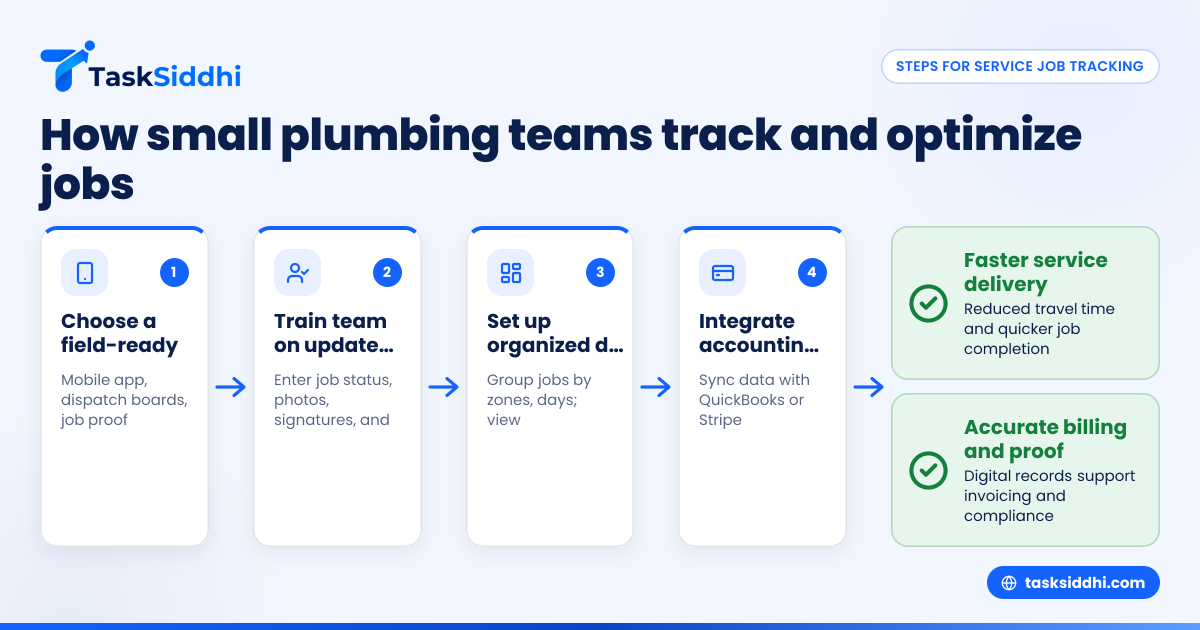
Small plumbing teams can start using service job tracking effectively by choosing the right tool, training staff, and integrating workflows.
- Choose a tool designed for field and service work with mobile apps.
- Train your team on entering job updates, capturing proof, and time tracking.
- Set up dispatch boards organized by zones or days.
- Integrate with your accounting software for faster invoicing.
- Review reports weekly to spot bottlenecks and improve scheduling.
- Use automation to handle recurring jobs and alerts.
Taking these steps helps small US plumbing businesses gain quick control over service jobs. Clear processes and a unified app reduce mistakes and speed up service delivery.
TaskSiddhi supports these workflows with its mobile app and boards and views, combining proof capture, dispatch, and reporting in one system.
How can mobile proof of service improve transparency and customer trust?
Mobile proof of service involves capturing evidence like photos, signatures, and visit timestamps right from the technician's smartphone during a job. This instant documentation confirms the job was done as agreed.
In plumbing, proof might include before-and-after images of installations, replaced parts, or repairs. Customers in US cities appreciate this transparency especially for higher-cost jobs or emergency fixes.
Real-time proof reduces disputes over job completion or quality. It also complements invoices with detailed records, shortening payment cycles and lowering the chance of chargebacks.
With a mobile app, techs can upload proof immediately without carrying paper forms or returning to the office. This streamlines workflows and builds customer confidence through visible accountability.
What is the best way to optimize dispatch routes for small plumbing teams?
Optimizing dispatch involves assigning jobs logically so plumbers spend less time traveling and more time working. Best practices include:
- Grouping jobs by proximity to reduce mileage and fuel costs.
- Prioritizing urgent or same-day service calls.
- Using apps that display live traffic and job statuses.
- Scheduling jobs to balance workload evenly across the team.
- Factoring in technician skillset and certifications for specific tasks.
Incorporating an AI service job scheduler enhances these steps by analyzing historical data and current conditions to suggest efficient routes and job orders automatically.
Smaller teams can use digital boards displaying job cards and technician locations on a map to visualize assignments. This reduces rescheduling and missed appointments.
How does service job tracking impact billing and compliance in the US?
Accurate service job tracking creates reliable documentation needed for billing clients. It ensures labor hours, parts used, and job details are recorded before invoicing in QuickBooks or Stripe.
For US plumbing companies, proper job records support compliance with tax laws. Tracking contractor hours simplifies 1099 reporting and verifies payments are correct. Detailed reports also help during audits.
Additionally, capturing proof of service and customer approval on site meets contractual obligations and reduces disputes. Timely updates speed up invoice generation, improving cash flow.
Digital tracking replaces manual logs and paper job cards, lowering errors and administration costs while strengthening compliance readiness.
See how it works on the product tour or compare plans on the pricing page.
Frequently asked questions
What exactly is service job tracking?
Service job tracking is a system or app used to plan, monitor, and record service tasks completed by field technicians. It provides real-time updates, proof of job progress, and helps manage scheduling and billing.
Can AI service job tools work for small plumbing businesses?
Yes. AI tools can automate scheduling, optimize routes, and prioritize jobs to boost efficiency. Small teams benefit by reducing manual rescheduling and speeding up customer response times.
How does mobile proof of service help reduce disputes?
It captures timestamped photos, signatures, and notes directly from the field. This digital evidence confirms the job details, preventing misunderstandings over what was done and when.
Are there compliance concerns related to service job tracking in the US?
Proper tracking supports compliance with tax reporting, contractor payments, and audit requirements. Accurate records help with 1099 filings and verify sales tax on completed jobs.
How do service tracking apps integrate with finance tools?
Many apps connect with QuickBooks or Stripe to sync labor, parts, and customer billing details. This integration speeds up invoice creation and reduces manual data entry errors.
Can service job tracking improve customer satisfaction?
Absolutely. Providing accurate arrival times, real-time updates, and proof of completed work builds trust and leads to positive reviews and repeat business.