














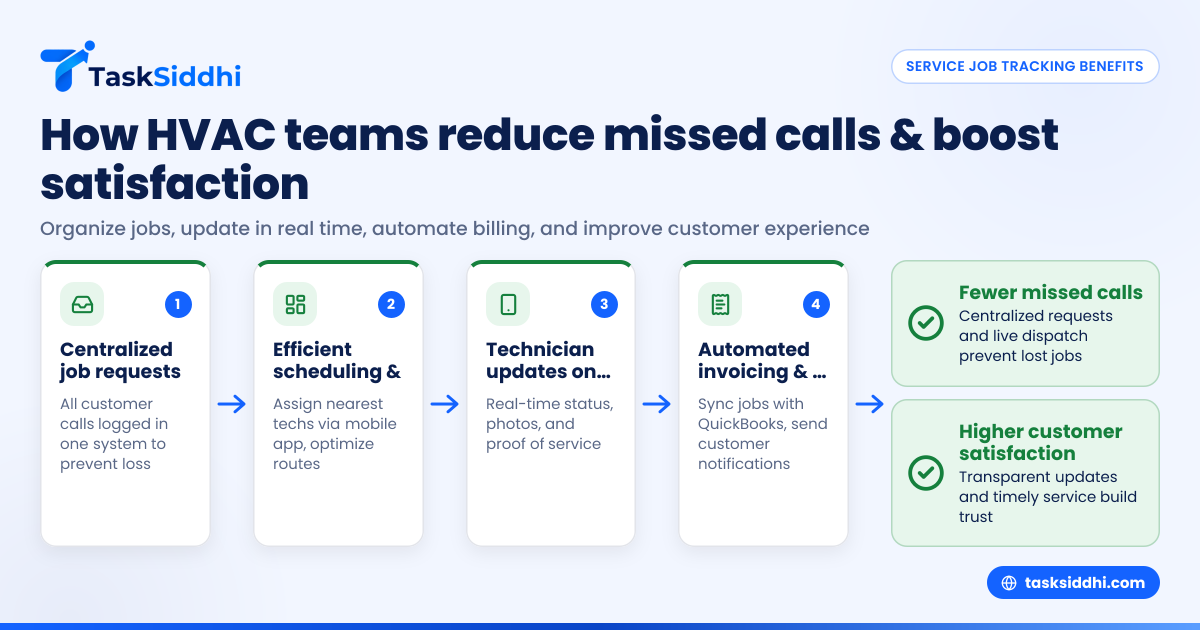
Service job tracking helps HVAC teams in the US manage customer requests, schedules, and follow-ups efficiently. It reduces missed calls and delays, boosting customer satisfaction and team productivity. Using the right tools, businesses streamline operations from dispatch to billing, making service delivery smoother and more reliable.
Key takeaways
- Service job tracking ensures no customer call or request is missed by organizing jobs clearly.
- Real-time updates and proof of service boost accountability and customer trust.
- AI service job tools automate scheduling and predict equipment issues to reduce downtime.
- Mobile apps let field technicians update job status and capture evidence onsite.
- Effective tracking supports faster billing and reporting, improving cash flow.
- US HVAC businesses benefit from integrating job tracking with QuickBooks and complying with local regulations.
why is service job tracking important for HVAC teams in the US?
For HVAC companies in cities like Houston, Chicago, and Detroit, service demands fluctuate with the seasons and weather. Staying on top of customer requests is critical. Service job tracking organizes and monitors every step of a service call, from the initial contact to job completion and billing.
Without proper tracking, businesses risk missed calls, delayed appointments, or lost paperwork. This frustrates customers, causes lost revenue, and increases operational costs. For example, a missed emergency AC repair call during a heatwave in Houston can cost not just lost income but damage your reputation.
how organized service job tracking helps
Service job tracking centralizes requests, improves scheduling, boosts accountability, and supports invoicing. This keeps service timely, documented, and compliant.
- Centralizes customer requests: Instead of scattered WhatsApp groups or paper cards, info is in one system.
- Efficient scheduling and dispatch: Managers can optimize routes and assign techs quickly.
- Improves accountability: Time stamps, technician notes, and proofs like photos verify work.
- Supports invoicing and compliance: Detailed records ensure accurate billing and meet state regulations.
Worked example: Day-to-day with and without tracking
- Without tracking: A Detroit HVAC company handles calls via multiple phone lines, using paper cards and Excel sheets. Jobs get lost; follow-ups are manual and prone to errors.
- With tracking: The company logs requests instantly on a task board. Dispatchers assign nearby technicians via mobile app. Technicians update status and upload photos onsite. Invoices auto-generate. Customers get automatic SMS alerts.
This reduces missed jobs, improves transparency, and speeds payments.
how can AI service job technology improve HVAC operations?
AI service job technology optimizes scheduling, predicts maintenance needs, automates communications, and provides data insights, boosting efficiency and reducing errors.
AI analyzes technician availability and skills to assign jobs smartly, cutting travel time and boosting daily completions. It forecasts equipment failures for proactive maintenance, lowering emergency visits. Automated reminders prevent no-shows. AI also identifies patterns to help allocate resources strategically.
practical benefits for US HVAC teams
For example, during Houston’s scorching summers, AI ensures enough technicians are scheduled when demand peaks. In Chicago’s cold winters, predictive maintenance minimizes heating breakdowns.
AI reduces manual scheduling workload, minimizing human errors like double-booking. This lets managers focus more on customers.
pitfalls to avoid when adopting AI
Don’t rely solely on AI: human judgment remains vital, especially in emergencies. Data quality is key; inaccurate inputs weaken AI. Automated messages must follow TCPA rules to avoid legal issues.
what features should HVAC businesses look for in service job tracking software?
Look for real-time job boards, mobile app support, proof of service capture, time tracking, integrations with QuickBooks or Stripe, custom reporting, and automation tools.
TaskSiddhi’s boards and views and time tracking provide these features to help HVAC teams manage work clearly and efficiently.
checklist of must-have capabilities with examples
| Feature | Benefit | Example usage |
|---|---|---|
| Real-time job boards | Visibility into all jobs | Track emergency vs regular calls |
| Mobile app | On-site updates and communication | Technicians upload photo proof |
| Proof of service | Customer trust and billing support | Digital signatures |
| Time tracking | Accurate payroll and billing | Calculate technician hours |
| QuickBooks integration | Accurate invoice generation | Sync job costs and taxes |
| Reporting | Performance and trend analysis | Identify busy service routes |
| Automation | Reduce repetitive tasks | Send automatic reminders |
how does service job tracking reduce missed calls and improve customer satisfaction?
Missed calls stem from scattered communication channels. Tracking systems centralize requests, preventing details from getting lost.
improved call handling process
Customers call or request via one system. Managers log requests with priority and location immediately. Dispatchers monitor technician availability live. Tasks can be reassigned fast if delays occur. Customers get automated confirmations and arrival times.
This reduces missed calls, especially during busy or holiday periods.
enhancing technician readiness
Technicians access job details via mobile apps, arriving prepared with parts and tools. Uploading proof of work reassures customers.
example scenario
In Chicago, a family requests furnace repair on a cold day. The job is logged and assigned to the nearest technician through the tracking system. The technician checks in via the app, completes the job, and uploads photos. The customer receives alerts and a digital invoice, improving satisfaction.
can integrating service job tracking with finance tools like QuickBooks benefit HVAC companies?
Yes. Integration reduces errors, speeds invoicing, improves cash flow, and supports tax compliance like 1099 preparation.
how integration helps
Data—labor hours, parts, materials—flows directly from job tracking to QuickBooks or Stripe. This eliminates duplicate entry and speeds invoice generation. Accurate records ease tax filings and audits.
worked example: invoice generation
A Detroit HVAC technician logs a 3-hour AC repair with materials used. Job data syncs with QuickBooks. The invoice shows labor, parts, and applicable state sales tax. The customer pays swiftly online via Stripe.
pitfalls to watch for
Ensure job categories map correctly to QuickBooks accounts. Train staff on consistent data input. Choose software with PCI-compliant data protections.
how mobile apps support service job tracking for HVAC field teams
Mobile apps let technicians update jobs in real time, reducing paperwork and delays.
key benefits of mobile apps include:
- Instant job updates and new assignments.
- On-site upload of photos and digital signatures.
- GPS routing to jobs.
- Communication with dispatchers.
- Material ordering and rescheduling capabilities.
TaskSiddhi’s mobile app keeps your team connected and accountable.
common use case in field teams
In Houston, a technician finds unexpected HVAC damage. They send photos and request parts via the app. Dispatch reschedules jobs dynamically. The customer is notified promptly.
tips for successful mobile adoption
Provide rugged smartphones or tablets. Train staff thoroughly. Encourage real-time updates. Monitor connectivity and data usage.
what are the practical steps to implement service job tracking in your HVAC business?
Beginners should start simple and scale up carefully.
- Choose the right software: Pick one fitting your team size and workflow. TaskSiddhi suits US-based HVAC businesses and integrates with common finance tools.
- Train your team: Hold hands-on sessions on using the app, updating jobs, and communication.
- Integrate finance tools: Connect with QuickBooks or Stripe and test invoice workflows.
- Set workflows and automation: Define call logging, job assignment, and notifications.
- Monitor and improve: Use reporting to spot issues and adapt.
- Stay updated: Keep regulatory compliance and customer needs in mind.
common pitfalls and avoidance
Skipping training leads to poor adoption. Ignoring user feedback stalls improvements. Overcomplicated workflows frustrate users. Poor data quality breaks reports and AI predictions.
why is compliance important in US HVAC service jobs?
Compliance protects your business and customers.
Follow OSHA standards and state building codes. Dispose of refrigerants properly. Use CAN-SPAM and TCPA-compliant messaging to respect customer privacy. Keep detailed service job records for audits and disputes.
Automation helps meet these requirements efficiently.
how can I start using service job tracking with TaskSiddhi?
Getting started is simple. Take the product tour to see how TaskSiddhi’s platform fits US HVAC service teams’ needs. It offers boards and views for clear job management and a mobile app for real-time field updates. Review pricing to pick the right plan.
Using TaskSiddhi, your team can work smarter, respond faster, and deliver better service while improving your bottom line.
Frequently asked questions
What does service job tracking software do for HVAC teams?
It consolidates all service requests, assignments, and updates into one platform. This streamlines scheduling, dispatch, and customer contact, reducing missed calls and boosting service quality.
Can AI service job features replace dispatchers?
AI supports dispatchers by automating routine tasks but doesn’t replace human judgment, especially for emergency or complex jobs.
Is mobile access essential for my HVAC service job tracking?
Yes. Mobile apps let technicians update status, upload proof, and communicate from the field. This reduces delays and improves satisfaction.
How does service job tracking help with billing?
It logs job details including labor and materials. Syncing with accounting software like QuickBooks generates accurate invoices faster, enhancing cash flow.
Can service job tracking software handle emergency calls?
Yes. Modern tools prioritize urgent jobs and allow rescheduling of non-urgent ones, helping your team respond effectively.
How soon can I see benefits after implementing service job tracking?
You’ll notice fewer missed calls and better scheduling within weeks. Full customer satisfaction and revenue benefits usually follow after several months as processes and automation mature.
Explore how TaskSiddhi makes job tracking simple and effective for HVAC service teams by taking a product tour today or reviewing your options at pricing.