














Service job tracking helps small appliance repair teams in India record, monitor, and manage customer jobs efficiently. This builds stronger trust through accurate work details, timely updates, proof of service, and transparent billing. Digital tracking also simplifies GST compliance and team coordination.
Key takeaways
- Service job tracking digitises job details, reducing manual errors common in WhatsApp and paper records.
- Accurate tracking boosts customer confidence with clear proof of completed work and quicker resolutions.
- Mobile apps enable real-time updates during field visits, essential for repair teams in Mumbai, Pune, and tier-2 cities.
- Using AI service job features can automate status updates and job categorisation, saving time.
- Digitally logged jobs help with GST compliance, invoicing, and audit trails.
- TaskSiddhi’s service job tracking tools help organise teams of 5 to 30 for better work management.
What is service job tracking and why is it important for appliance repair teams?
Service job tracking means digitally recording and overseeing each customer repair job from request to finish. For small appliance repair businesses in India, it replaces handwritten notes, WhatsApp messages, or Excel sheets with a clear system capturing job details, time spent, parts used, and proof of site visits.
It is vital because manual tracking often causes errors and delays that frustrate customers. Accurate tracking ensures better transparency and quick follow-ups, helping teams meet commitments and maintain trust.
How does AI service job technology improve efficiency for repair teams?
AI service job technology automates routine tasks like categorising jobs, predicting delays, and prompting follow-ups. It saves time by reducing manual updates and helps managers prioritise urgent jobs effectively.
Beyond automation, AI analyses repair patterns to suggest parts stocking or training. It also assists technicians by auto-filling job details or recognising spoken issues. These features help Indian repair teams work faster with less admin burden.
How does service job tracking improve customer trust?
Service job tracking enhances trust by delivering clear evidence of work done and keeping customers informed promptly. When technicians update job status live, capture photos of repairs, and issue transparent invoices, customers feel assured of professional service.
Online tracking reduces disputes by clearly logging replaced parts and labour time. Regular status updates cut repeated WhatsApp queries and improve communication. This openness builds stronger customer relationships, leading to more positive reviews and repeat business.
How can small appliance repair teams in India implement accurate service job tracking?
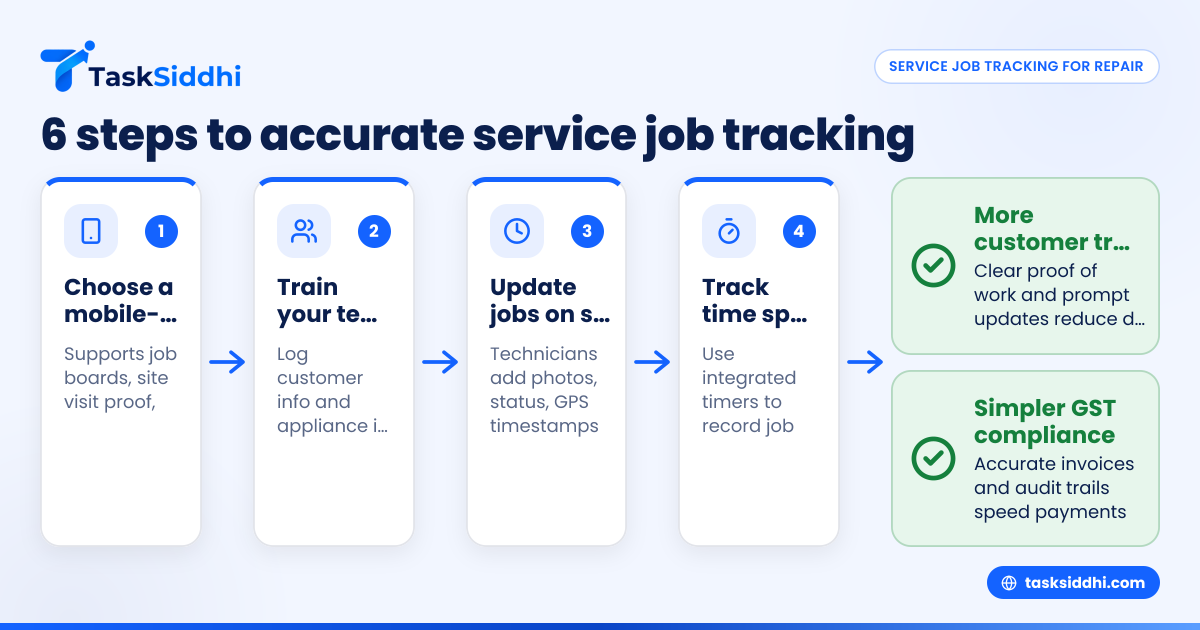
Implementing accurate service job tracking involves these steps:
- Select a digital tool built for mobile teams, supporting job boards, cards, and site visit proof.
- Train your team to log details immediately, including customer info and appliance issues.
- Equip technicians with mobile devices to update job status and add photos during visits.
- Track time spent per job using apps like time tracking.
- Generate GST-compliant digital invoices automatically from logged job data.
- Use reporting dashboards to monitor performance and spot recurring faults.
This digital approach prevents errors found in WhatsApp or manual systems. Repair teams in Pune report improved onsite communication and billing accuracy using such tools.
What is the cost and effort to adopt service job tracking digitally in an SME?
Adopting digital service job tracking is affordable and simple. Many apps scale for teams of 5–30 members, often with free trials before paid plans. The main effort lies in initial training and changing processes, which usually takes a few weeks.
High smartphone use among Indian service teams means mobile app adoption is smooth. Integrating with WhatsApp communication while storing job data digitally eases the transition. Enhanced accuracy and faster payments typically outweigh setup costs through better customer retention and GST invoicing.
How to use site visit proof for better service job tracking?
Site visit proof means capturing technician visits with timestamps, GPS location, and repair photos or videos. This evidence is critical in India’s service market where customers expect clear accountability.
Technicians use mobile apps to document appliance condition before and after repair and add descriptive notes. GPS tagging verifies location and time, helping quickly resolve disputes and speed up payments.
For example, teams in tier-2 cities like Surat rely on site visit proof to build trust with new IndiaMART customers, replacing unclear WhatsApp confirmations and handwritten notes.
How does service job tracking help with GST compliance and invoicing?
Service job tracking apps integrate with GST billing by automatically generating invoices from job details—parts replaced, labour time, service charges—reducing errors that cause GST audit issues.
E-invoicing support helps businesses above turnover thresholds comply with government mandates. Digitally generated invoices also speed payments via UPI or Razorpay links.
Well-organised job and invoice records simplify accounting with tools like Tally, reducing tax filing hassles for Indian SMEs.
What challenges might Indian small appliance repair teams face in switching to digital tracking?
Main challenges include resistance to leaving WhatsApp groups, learning new apps, and patchy internet in some areas. Some technicians may feel uneasy using smartphones or entering data.
Overcome this by training staff on benefits and ease of tracking. Choose apps with offline features syncing data when connectivity returns. Run old and new systems side-by-side during transition to build confidence.
Leadership support and clear communication foster acceptance and improve team accountability.
How TaskSiddhi supports service job tracking for Indian field teams
TaskSiddhi is designed for Indian service teams, with boards and views that organise jobs visually. Its mobile app lets technicians capture site visit proof, update status live, and track time seamlessly using integrated time tracking.
Managers get rich reporting to monitor workload and job quality, plus automation tools that reduce follow-ups and ease job assignment.
By switching from WhatsApp and spreadsheets to TaskSiddhi, repair teams in Bengaluru, Pune, and other cities can boost accuracy and customer trust.
See the product tour to explore how TaskSiddhi streamlines your service job tracking or compare plans at pricing.
Frequently asked questions
What is the difference between service job tracking and general task management?
Service job tracking centres on managing customer repair jobs with onsite updates and proof. General task management covers broader projects not specific to service delivery or field evidence.
Can service job tracking tools handle emergency or same-day repair requests?
Yes, digital tools enable urgent job prioritisation and instant alerts, improving response times essential for Indian markets.
How can service job tracking help with team performance reviews?
Tracking completion times, feedback, and job counts gives objective data for evaluations, boosting accountability and skills development.
Do service job tracking apps support offline use in areas with poor network?
Yes, some apps, including TaskSiddhi’s, allow offline data entry that syncs once connectivity returns, ensuring reliable updates.
Is integrating service job tracking software with accounting tools like Tally possible?
Many systems let you export data or connect via APIs with Tally, simplifying GST invoicing and bookkeeping.
Will switching to digital service job tracking reduce paperwork for my team?
Definitely. Digital tracking cuts paper use, speeds data access, and reduces errors common in handwritten notes or WhatsApp messages.