














Service job tracking for manufacturers in Maharashtra means digitally managing repair and maintenance tasks on factory machinery. It ensures timely fault reporting, real-time updates with photo and time proof, and accountability, reducing downtime and improving repair quality across Mumbai, Pune, and Nagpur plants.
Key takeaways
- Service job tracking helps Maharashtra manufacturers reduce machine downtime and improve repair efficiency.
- Field technicians can capture photo and time proof on the go, ensuring transparency and work validation.
- Digital tools replace manual job cards and WhatsApp chaos, making fault repair tracking more reliable.
- AI service job features can help prioritize repairs and suggest solutions based on past data.
- Integrating tracking with GST-compliant invoicing and reporting aids smooth business operations.
- Mobile apps enable managers and technicians to update jobs from anywhere across Pune, Mumbai, and Nagpur factories.
What is service job tracking, and why is it important for manufacturers in Maharashtra?
Service job tracking monitors repair and maintenance work on manufacturing equipment. It keeps fault reports and repairs organised and timely, critical for Maharashtra’s busy factories in Mumbai and Pune. This reduces costly downtime and improves team efficiency with proper onsite proof and documentation.
Service job tracking replaces the traditional manual methods like WhatsApp groups or paper cards with a digital system. It ensures faults on machinery are reported quickly, assigned to the right technician, and resolved with evidence such as photos and timestamps. Maharashtra’s manufacturing sector, from automotive components to food production, relies on efficient machine maintenance to avoid production delays. Tracking these service jobs also helps manufacturers comply with safety and quality rules, while boosting accountability and transparency within their teams.
How does AI service job tracking benefit my manufacturing repair team?
AI service job tracking uses algorithms to prioritize urgent faults and suggest optimal repair steps based on historical data.
AI service job tools analyze repair histories from Maharashtra factories to identify recurring issues and recommend fixes. This reduces inspection time and boosts first-time repairs. AI also balances technician workloads by assigning jobs based on skills and availability, which helps keep repairs timely across plants in Pune and Nagpur.
With AI, service job tracking becomes a smart assistant, not just a record-keeper. It helps spot patterns, reduce errors, and improve repair quality across Maharashtra’s manufacturing operations, saving time and money.
How to implement effective service job tracking for fault repairs in Maharashtra manufacturing
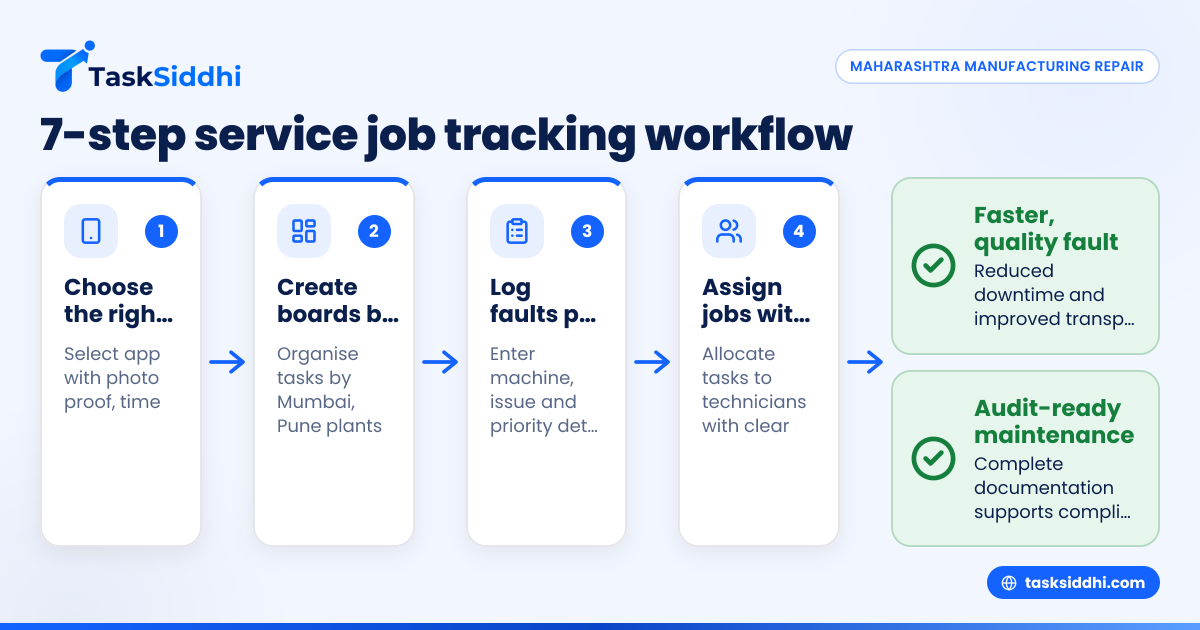
Start by moving from informal fault management with WhatsApp and Excel to a structured digital tool. Follow these seven steps:
- Choose the right tool: Select a task management app suited for Maharashtra’s field teams, supporting job cards with photo proof, time tracking, and mobile access. TaskSiddhi offers features tailored for Indian manufacturers.
- Create boards by site or machine: Segregate tasks by factory (Mumbai plant, Pune unit) or equipment type (press, motors) for clear organisation.
- Log faults promptly: Operators or technicians enter fault details directly into the system, specifying machine, issue, and priority.
- Assign jobs with deadlines: Supervisors allocate repairs to specific technicians with clear timelines and priority tags, replacing chaotic WhatsApp messages.
- Collect onsite proof: The technician captures photos and records repair start and end times via the mobile app, ensuring transparent work verification.
- Monitor progress: Managers track jobs in real time on dashboards, with alerts for pending or overdue repairs preventing delays.
- Close with documentation: Completed jobs are verified, including notes on parts changed, feeding into maintenance reports and billing cycles.
Implementing service job tracking using these steps helps Maharashtra manufacturers improve fault repair speed, quality, and audit readiness.
What challenges do manufacturers in Maharashtra face with service job tracking?
Manufacturers with teams of 5 to 30 spread across locations face:
- Paper and message clutter: Job cards can be lost; WhatsApp conversations create scattered fault data.
- Verification issues: Supervisors cannot always confirm if repairs happened or were quality-checked.
- Delay risks: Without real-time updates, urgent fixes might miss deadlines, causing costly downtime.
- Fragmented data: Repair history and downtime are captured inconsistently, complicating maintenance planning.
- Resistance to change: Technicians may prefer familiar WhatsApp workflows over new tools.
Digital service job tracking addresses these by centralising information, adding accountability, and providing real-time visibility for Maharashtra manufacturers.
How does service job tracking help with GST compliance and invoicing in Maharashtra?
Service job tracking systems gather detailed job information—work done, parts replaced, technician hours—that support GST-compliant invoicing and e-way bills.
In Maharashtra, accurate maintenance records help claim input tax credits on spare parts and reduce GST errors. Integration with accounting software like Tally and payment gateways such as Razorpay streamlines billing, speeding up payments and improving cash flow.
By linking service jobs to invoicing, manufacturers can meet GST regulations better while avoiding manual data entry mistakes.
How to ensure your team adopts new service job tracking tools effectively?
Smooth adoption depends on:
- User-friendly mobile apps: Provide simple Hindi or Indian English interfaces easily used by Maharashtra technicians.
- Relevant training: Use Maharashtra factory examples and scenarios for practical learning.
- Clear benefits: Show how digital tracking prevents rework and reduces constant calls from supervisors.
- Support champions: Assign team members as in-house app experts.
- Monitor and assist: Track usage and fix issues quickly.
- Reward prompt updates: Recognise technicians who use the system well.
This approach encourages buy-in and ensures faster transition from informal systems.
What features to look for in service job tracking software for Maharashtra manufacturers?
Key features include:
- Mobile apps with offline capability for remote sites in Nagpur or Aurangabad.
- Job cards with integrated photo and time capture to avoid disputes.
- Boards to visualise workflows by team, machine, or repair status.
- Time tracking to measure technician productivity.
- Reporting dashboards showing fault trends and maintenance costs.
- Automation that assigns jobs and alerts managers automatically.
- Compliance with DPDP Act 2023 for data privacy.
- Integration with Tally and Razorpay for GST-compliant invoicing and payments.
Choosing software designed for Indian manufacturing teams boosts effectiveness and ease of use.
How much does service job tracking cost for small to medium manufacturers in Maharashtra?
Prices vary with features and number of users. Many vendors offer tiered plans suitable for teams of 5 to 30 technicians common in Maharashtra.
Small manufacturers can start affordably, avoiding complex ERP systems. Larger companies can add automation and advanced reporting as they grow.
Savings from reduced downtime, faster billing, and improved team productivity offset software costs. Visit pricing to find the right fit.
How does service job tracking fit with other manufacturing functions in Maharashtra?
Service job tracking integrates with:
- Inventory, tracking spare parts used for smoother GST compliance.
- Vendor management, for external repairs or warranty claims.
- Customer service, speeding up issue resolution for clients in Mumbai and Pune.
- Compliance reporting, contributing to quality audits.
- Financial accounting, linking repair costs to Tally entries and cost centres.
This holistic view helps Maharashtra manufacturers improve efficiency and governance.
Try service job tracking designed for Indian manufacturing teams and see how you can streamline fault repairs with real-time updates and proof on the go. Visit our product tour to see it in action or compare plans at pricing.
Frequently asked questions
What is the typical workflow for service job tracking in Indian manufacturing?
Faults are identified and logged, then technicians are assigned. Repairs include photo and time proof, followed by supervisor checks and closure with data used for billing.
Can service job tracking reduce machinery downtime in Maharashtra?
Yes, it ensures quick fault reporting, clear task ownership, and real-time progress, leading to faster repairs and less unplanned downtime.
Is a mobile app necessary for effective job tracking?
Absolutely. A mobile app lets technicians update jobs onsite with photo and time evidence, vital for Maharashtra’s dispersed factory locations.
How do AI service job features improve repair quality?
AI analyzes fault patterns and repair histories to prioritize jobs and suggest best fixes, helping teams increase first-time repair success.
Does service job tracking software comply with India’s DPDP Act 2023?
Reputable solutions protect personal data, restrict access, and ensure secure storage, helping Maharashtra manufacturers avoid legal risks.
How can I measure the ROI of implementing service job tracking?
Track machine uptime, repair speed, billing cycles, and technician productivity improvements to see clear benefits against software costs.