














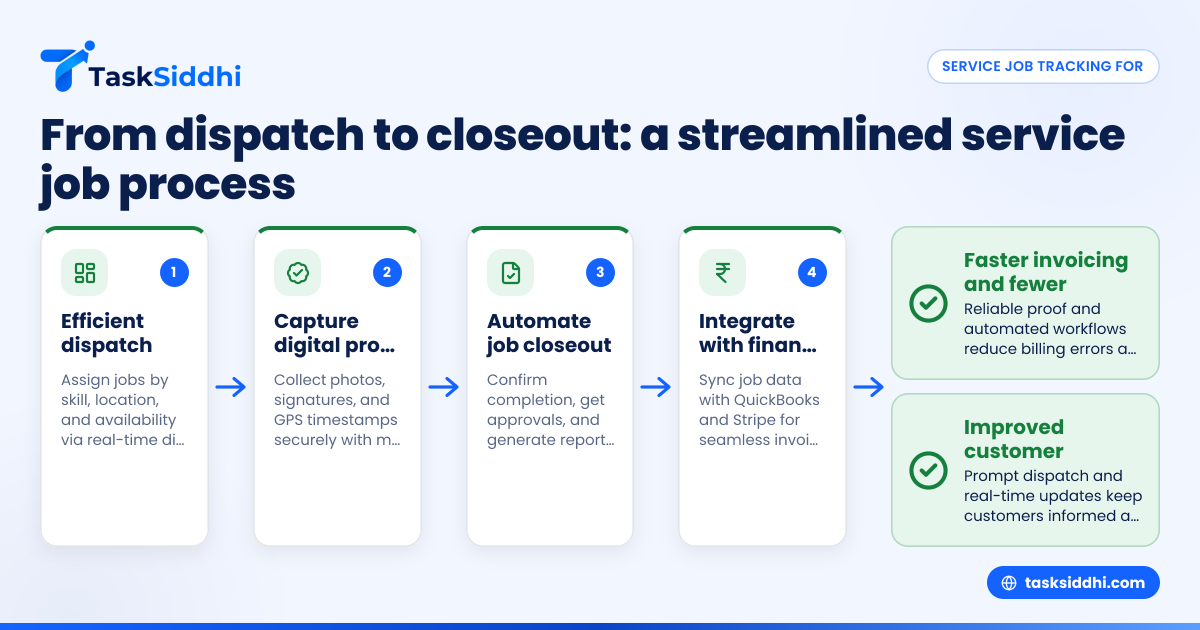
Service job tracking software helps US electrical contractors manage dispatch, capture proof of work, and complete job closeouts efficiently. It replaces scattered WhatsApp messages, paper cards, and Excel sheets with organized digital workflows for teams of 5 to 30 field and service workers.
Key takeaways
- Service job tracking software centralizes work allocation, status updates, and team communication.
- It improves dispatch efficiency by assigning the right technician at the right time.
- Digital proof of job completion, including photos and signatures, reduces disputes and billing delays.
- Automated closeout processes speed up invoicing and record-keeping.
- Integrating time tracking and reporting enables better project oversight and payroll management.
- Solutions like TaskSiddhi offer mobile access to field teams, supporting real-time updates from any US location.
Why US electrical contractors need service job tracking software
Electrical contractors in cities like Houston, Detroit, and Chicago juggle dispatching technicians, managing parts and tools, and delivering timely services. Many still rely on WhatsApp groups, Excel sheets, or paper job cards to coordinate. These methods cause confusion and delays, risking customer dissatisfaction and missed completion deadlines.
Service job tracking software digitizes and streamlines these operations for small to midsize teams. It ensures job dispatch is prompt and visible, work completion proof is easily collected onsite, and job closeout is automated. This improves customer trust, reduces administrative workload, and increases revenue capture by avoiding missed or incorrect billing.
How does AI service job tracking benefit electrical contractors?
AI service job tracking uses artificial intelligence to prioritize dispatch, predict delays, and flag incomplete tasks. This leads to faster responses, improved scheduling, and fewer missed appointments for electrical contractors in the US.
AI service job tracking systems optimize daily schedules, helping contractors manage emergency calls and high-priority jobs more effectively. Combined with mobile apps, technicians get smart notifications and clear onsite instructions. This improves first-time fix rates, reduces repeat visits, and cuts down manual coordination.
How does service job tracking improve dispatch efficiency?
Service job tracking software provides a centralized platform where managers view all incoming jobs, technician availability, and location in real-time. Dispatchers can assign jobs based on skills, proximity, and workload, ensuring prompt service. Automated notifications update technicians instantly via mobile devices, reducing SMS and call dependency.
This system minimizes travel time and keeps customers informed about technician arrivals, enhancing satisfaction. When emergency requests arise, dispatchers quickly rearrange schedules using drag-and-drop boards tailored for US electrical teams. This saves time compared to manual tracking with Excel or handwritten notes.
At TaskSiddhi, boards and views streamline dispatch with visual work boards adaptable to any workflow style.
What proof of work features help with US regulatory compliance?
Proof of work features include photo attachments, technician signatures, customer acknowledgments, and GPS timestamps. Collecting this data onsite protects contractors by documenting completed tasks, material use, and technician hours.
Proof also supports compliance with US standards, such as OSHA site safety verification or insurance audits, even if not regulated precisely for electrical work. Having reliable evidence reduces payment disputes and speeds billing cycles, especially for subcontracted or 1099 technicians.
Mobile apps enable technicians to capture proof seamlessly without returning to a truck or office. TaskSiddhi’s mobile app supports instant photo uploads and signature capture, all linked to specific job cards for record accuracy.
What is the process for closing out electrical service jobs effectively?
Closing out a job means confirming all tasks are done, approvals collected, and invoicing prepared accurately. Service job tracking software automates notifications to confirm job completion and triggers workflows to handle billing and documentation.
Steps include:
- Technician completes onsite tasks and uploads proof.
- Manager reviews the job card and verifies completion.
- Customer signs off digitally or via app confirmation.
- System generates job reports and sends data to invoicing or accounting software like QuickBooks.
- Payroll records update automatically with verified time tracking.
These steps reduce errors and prevent invoice delays common with paper-based or spreadsheet methods. Automation is especially useful for recurring service contracts or multistep repairs.
TaskSiddhi's reporting and time tracking features support an efficient closeout and audit trail.
How does service job tracking integrate with US business finance tools?
Most US electrical contractors use QuickBooks for accounting and Stripe for payment processing. Service job tracking software often integrates directly with these platforms to sync customer data, work orders, and payment statuses.
Integration means invoices can be generated automatically once jobs close, eliminating duplicate entries. It ensures sales tax compliance by pulling correct rates based on state and city regulations, such as Chicago’s 10.25% total sales tax.
Additionally, linking job tracking with payroll simplifies payments, especially for 1099 contract electricians. The software logs hours and task details precisely, supporting wage calculation and IRS reporting requirements.
TaskSiddhi supports exporting job data compatible with popular finance tools to keep your accounting in sync.
What security and compliance considerations should electrical contractors know?
Customers and regulators increasingly expect secure handling of data, including job records and customer information. While SOC 2 is a common buyer expectation in software, electrical contractors should ensure their job tracking platforms protect sensitive data with encryption and access controls.
For outreach communications via phone or email, contractors must comply with the CAN-SPAM Act and TCPA regulations to avoid legal penalties. Job tracking solutions that offer secure messaging or automation should help maintain these compliance standards.
Before choosing software, verify their privacy policies and data protection practices align with your risk management needs.
Why switch from WhatsApp or Excel for service job tracking?
WhatsApp groups and Excel sheets are popular but limited for managing complex service jobs. They lack structured job cards with fields for materials, timelines, and proof of work. Communication is fragmented, making it hard to track work status or employee productivity.
Service job tracking apps unify these aspects into one system accessible on desktops and mobiles. With easy-to-use interfaces and automation, managers spend less time coordinating and more time on customer service. Teams receive real-time updates without manual calls or texts.
These coordinated workflows increase reliability, a competitive advantage when bidding on commercial electrical contracts or public projects in US cities.
How do mobile apps enhance field work management for electrical contractors?
Mobile apps let technicians receive assignments, update job status, and capture proof onsite, eliminating paperwork and back-office trips. GPS tracking linked to mobile use ensures accurate location data, helping with time tracking and job verification.
Mobile access means teams stay connected everywhere—from skyscraper maintenance in Chicago to residential calls in Houston. Push notifications alert technicians of schedule changes instantly, reducing no-shows.
TaskSiddhi’s mobile app is designed for field teams, allowing seamless communication and job updates in real time.
How can automation simplify service job tracking tasks?
Automation handles repetitive processes like sending job reminder messages, updating work status upon proof upload, and generating reports. This reduces administrative work and human error.
Electrical contractors can configure rules such as automatic rerouting if a job is delayed or creating follow-up tasks after site visits. Automation improves consistency of service delivery and client communication.
Explore TaskSiddhi’s automation to learn how easy it is to streamline your workflows.
Service job tracking software transforms how US electrical contractors dispatch teams, collect proof, and close jobs. By shifting from scattered tools to centralized digital systems, businesses improve efficiency, reduce disputes, and boost revenue. See how it works with our product tour or compare plans to find what suits your team at pricing.
Frequently asked questions
What is service job tracking software?
Service job tracking software centralizes all aspects of managing field jobs—from dispatch and scheduling to proof collection and closeout—into one digital platform. It helps teams communicate clearly, reduce paperwork, and complete jobs efficiently.
How does AI service job tracking improve scheduling?
AI service job tracking uses data patterns to prioritize jobs and assign resources wisely, reducing response times and optimizing daily routes. This leads to fewer missed appointments and better customer satisfaction.
Can service job tracking support subcontractors and 1099 workers?
Yes. These systems track hours, locations, and job completion proof for subcontractors, helping contractors manage compliance and accurate payment with IRS reporting requirements.
How does proof of work help electrical contractors?
Proof of work protects contractors from disputes by documenting completed tasks with photos, signatures, and timestamps. It also supports billing accuracy and compliance audits.
Is mobile access important for service job tracking?
Absolutely. Mobile access allows technicians to update job progress and upload proof immediately onsite, reducing errors and improving communication with dispatchers.
Can service job tracking software integrate with accounting tools?
Most platforms integrate with US accounting tools like QuickBooks and payment processors like Stripe. This streamlines invoicing, payroll, and sales tax calculations, reducing manual data entry and errors.