














Service job tracking software helps HVAC and plumbing teams in the US manage work orders, track technician visits, and keep accurate records of jobs. It reduces missed visits and improves communication between the office and field staff. This leads to better customer satisfaction and operational efficiency.
Key takeaways
- Service job tracking software keeps technician visits organized, reducing missed or delayed jobs.
- Real-time updates and proof of service ensure transparency with customers and supervisors.
- Mobile app access allows field teams to update jobs on site, even without continuous internet.
- AI service job features automate scheduling, identify issues, and forecast workloads for better planning.
- Integration with common US financial tools like QuickBooks improves billing accuracy.
- Reporting tools provide insights into team performance and job completion rates.
What is service job tracking software and why does it matter for HVAC and plumbing teams?
Service job tracking software is a digital system that helps HVAC and plumbing businesses organize field service work. It manages job assignments, technician visits, and job records in real time. This software is key for teams in cities like Chicago, Houston, and Detroit to avoid missed visits and scheduling errors.
Manual methods like WhatsApp groups and paper job cards create confusion and lost information. A centralized system keeps job details, technician availability, and client communication in one place. This results in faster job completions, improved customer service, and fewer billing disputes.
How does service job tracking software reduce missed visits?
Service job tracking software reduces missed visits by giving teams a live, shared schedule with notifications. When a job is allocated, technicians get alerts and update their status onsite. Managers track job progress and upcoming visits instantly.
This visibility eliminates double bookings and forgotten appointments. Mobile apps let technicians access their schedules anytime, without depending on office calls. This is especially helpful in busy cities like Detroit or Houston with heavy traffic.
Can AI service job features improve field operations?
AI service job features automate dispatching and route planning. They analyze technician skills, past jobs, and travel times to create efficient schedules. AI predicts delays or resource needs, helping managers prioritize urgent repairs.
By applying AI, HVAC and plumbing businesses reduce technician idle time and improve on-time job completions. This makes labor use more productive and raises customer satisfaction.
What does service job tracking software typically include?
Common features include:
- Job boards listing all active and scheduled work
- Digital job cards with customer info, notes, and photos
- Time tracking for technician hours on each job
- GPS-based proof of visit with photos or signatures
- Automated customer alerts via SMS or email
- QuickBooks integration for invoicing and billing
- Reporting dashboards for job completion and technician productivity
How to choose the right service job tracking software for your HVAC or plumbing business?
Choosing software depends on your team’s size, workflow, and tools. The right choice supports your daily jobs, field workers, and management needs.
Look for mobile apps so technicians can update jobs on the go. AI-powered scheduling reduces errors and saves time. Integration with QuickBooks and other business software helps billing run smoothly.
Also, consider reporting features to track team performance and improve operations. Testing software with a product tour or trial will help ensure it fits your workflow.
How does AI in service job tracking software work?
AI service job tools analyze past technician routes, job completion times, and skill sets. Using this data, they optimize job assignments and routes for efficiency. This reduces downtime and improves appointment accuracy.
What does it cost to implement service job tracking software?
Costs vary by number of users and features. Free versions offer basic scheduling, while paid plans include AI scheduling and reporting. Compare plans carefully to match your business size and needs.
Why is proof of service important and how does tracking software help?
Proof of service confirms technicians completed visits properly. It usually involves photos, GPS data, or digital signatures. Tracking software captures this via mobile apps automatically.
This reduces client disputes and supports compliance with state regulations. It helps verify warranties and schedule follow-up service.
How does integration with QuickBooks and other finance tools improve billing accuracy?
Connecting tracking software with QuickBooks or Stripe automates invoice creation. Job details and hours flow directly into billing, reducing manual errors.
Faster and accurate billing increases cash flow and fewer client disputes. It also helps with sales tax management by state and service type.
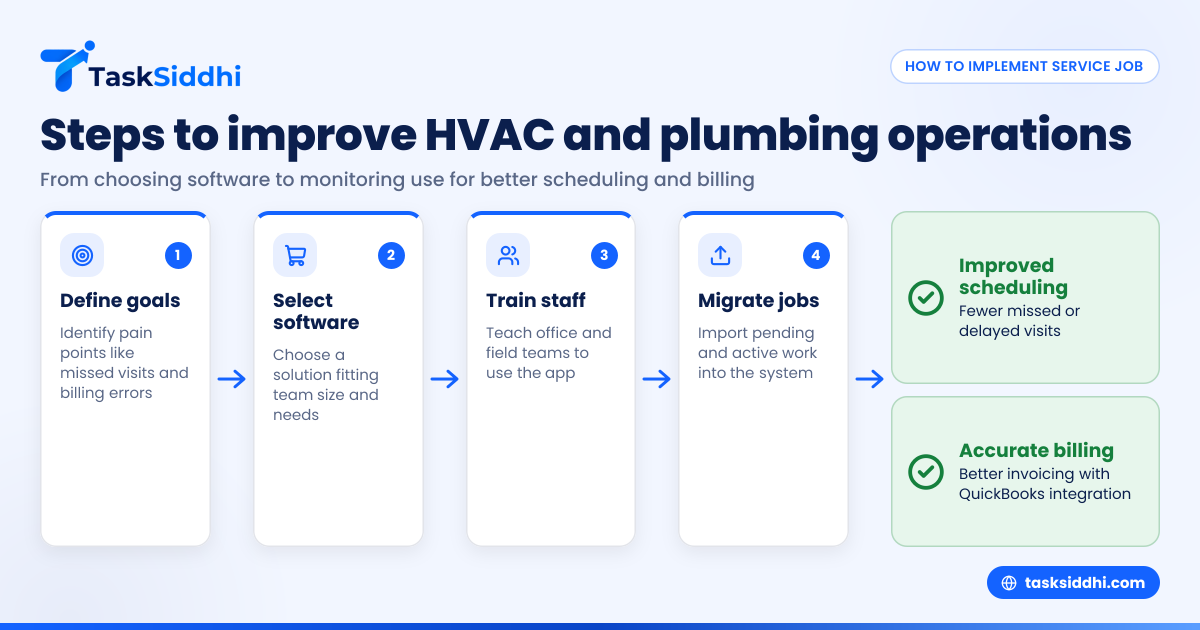
How to implement service job tracking software in your field service business?
Implementing the software involves clear steps:
- Define your goals by identifying pain points like missed visits or billing errors.
- Select software that fits your team size and needs.
- Train your office and field staff on how to use it.
- Migrate pending or active jobs into the system.
- Monitor usage through reporting dashboards regularly.
- Gather feedback and adjust workflows using automation features.
How does a mobile app solve common field service challenges?
Mobile apps connect technicians to the team and job details without phone calls or paperwork. They enable instant job updates, access to customer histories, and capture photos onsite.
This lowers errors and improves response time — key in congested cities like Chicago or Houston where delays impact service quality.
Summary
Service job tracking software provides HVAC and plumbing businesses in the US with solutions for scheduling, proof of work, and billing. AI service job features add automation that saves time and improves efficiency. Combined with mobile apps and accounting integration, these tools boost team productivity and customer satisfaction.
Explore how service job tracking can enhance your operations by taking a product tour or comparing plans.
Frequently asked questions
What types of businesses benefit most from service job tracking software?
HVAC, plumbing, electrical, and similar US field service companies with multiple technicians benefit most. It improves scheduling, onsite tracking, and communication.
Can service job tracking software work without continuous internet access?
Yes. Many solutions, including TaskSiddhi, provide mobile apps that work offline and sync data when reconnected. This suits technicians in basements or remote locations.
How secure is the data stored in service job tracking software?
Most providers use strong encryption and secure cloud storage meeting US business standards. Reviewing vendor security policies before purchasing is advisable.
How does service job tracking software support compliance requirements?
It collects proof such as time stamps, photos, and signatures. These support warranties, client contracts, and licensing rules for HVAC and plumbing work.
What training is required for field staff to use tracking software?
Training focuses on updating job status, capturing proof of service, and using the mobile app. Users typically learn within a few days.
Is AI service job scheduling suitable for small teams?
Yes. Even small teams with five technicians benefit from AI scheduling. It optimizes routes and workload distribution, reducing missed jobs and saving time.