














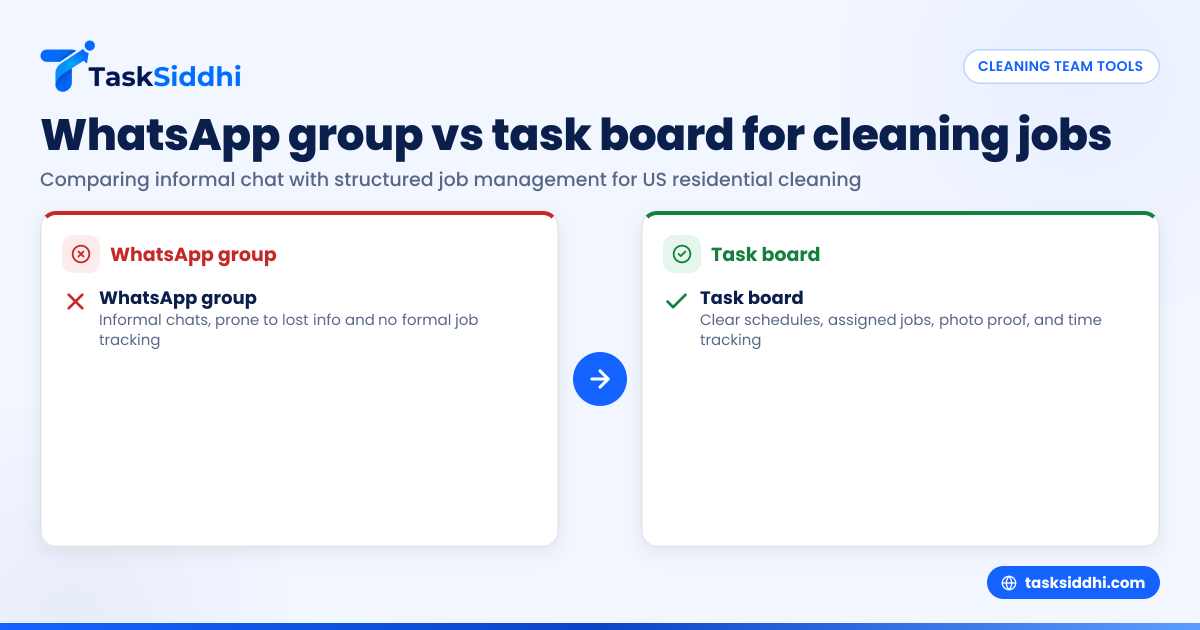
WhatsApp group vs task board is a common debate among residential cleaning service teams in the United States. While WhatsApp groups offer quick chat-based updates, task boards bring structure, better scheduling, and clearer job tracking—helping you manage cleaning jobs, verifications, and proof more efficiently.
Key takeaways
- WhatsApp groups are informal and easy for communication but prone to miscommunication and lost details.
- Task boards provide clear job schedules, assign responsibilities, and store job verification in one place.
- Using task boards improves accountability and client satisfaction with time tracking and proof of work.
- Integrating a mobile app lets cleaning teams update jobs on-site, replacing messy chat clutter.
- Compliance and reporting become easier with digital records from task boards for US cleaning businesses.
- AI-powered WhatsApp group features can add some automation, but they don't replace the clarity of a task board.
Challenges of using WhatsApp groups for residential cleaning services
WhatsApp groups are often the go-to tool for US cleaning teams. Teams use them to share daily plans, relay client requests, and confirm job completions. This familiarity makes WhatsApp convenient.
However, WhatsApp groups have limitations:
- Information overload: Important job instructions get buried in long chat threads.
- Lack of structure: There’s no clear way to assign jobs, track progress, or view schedules across days.
- Verification difficulties: Cleaning supervisors can't easily confirm that tasks were done with proper proof.
- No formal records: Chats are informal and impossible to archive for reporting, billing, or dispute resolution.
- Distractions: Non-work chatter can clutter communications, reducing focus.
These challenges can cause missed appointments, unhappy clients, and stress for cleaning crews and managers.
What benefits do task boards offer over WhatsApp groups?
Task boards are digital or software-based tools designed to organize work visually. They show different jobs as cards on a board, which you can move as statuses change—just like sticky notes on a wall.
The benefits for US residential cleaning teams include:
- Clear scheduling: Jobs appear on a calendar with assigned cleaner names and expected times.
- Easy job assignment: Managers drag and drop jobs to individual crew members or teams.
- Proof of completion: Photos or notes can be attached to each job for client verification.
- Time tracking integration: Record actual start and finish times to improve payroll accuracy.
- Better client communication: Status updates can be sent directly without relying on informal chats.
- Digital records: Saves all data for tax time, client invoicing, and compliance audits.
This structured approach minimizes confusion and helps make the cleaning workflow predictable and accountable.
How does AI WhatsApp group automation improve daily cleaning jobs?
AI WhatsApp group features can automate simple tasks, such as reminding cleaners of upcoming jobs or prompting for job completion reports in the chat.
By using AI tools integrated with WhatsApp groups, managers can reduce manual follow-ups and receive quick status updates without leaving the chat. However, these tools still operate within the WhatsApp environment, which lacks formal scheduling and verification records. Therefore, AI automation complements but does not replace the need for a dedicated task board in managing cleaning jobs effectively.
How can task boards improve job verification for cleaning businesses?
Task verification ensures that cleaning jobs meet client standards and reduces disputes. Task boards improve this process by letting team members upload photos, leave notes, or check off completed steps directly on each job card.
This proof is timestamped and tied to the assigned employee, making field visits transparent. Managers in Chicago or Detroit can remotely verify that a house cleaning was done as requested. Additionally, this documentation helps resolve any client questions quickly and improves trust.
With WhatsApp groups, proof usually comes as shared files or messages, which are harder to track and organize consistently.
What are the steps to switch from a WhatsApp group to a task board?
Switching to a task board for your cleaning service team requires careful planning:
- Choose the right tool: Look for software that supports mobile access, photo uploads, and time tracking in addition to job boards.
- Train your team: Explain the benefits and show how to add and update jobs on the board.
- Import existing data: If you rely on WhatsApp chats for scheduling, summarize and input those jobs into the task board.
- Set clear processes: Define who assigns jobs, verifies completion, and updates status on the platform.
- Gradually reduce WhatsApp use: Encourage team members to update the board first, using WhatsApp only for emergencies or quick clarifications.
- Monitor and adjust: Review workflows after a few weeks to fix any issues and ensure smooth adoption.
By following these steps, your Houston-based cleaning team can improve organization and accountability with minimal disruption.
Why does time tracking matter in residential cleaning, and how do task boards help?
Accurate time tracking is crucial for US cleaning businesses to manage labor costs and payroll, especially when paying hourly wage or filing 1099 forms for contractors.
Task boards integrated with time tracking let team members clock in and out for each job from their mobile phones. This data ensures you pay accurately and identify productivity bottlenecks.
In contrast, WhatsApp groups do not offer built-in time tracking. Managers must guess or manually record hours based on chat claims, which can cause payroll errors or disputes.
Ensuring compliance and data security when managing cleaning jobs
US businesses face increasing demands for protecting client data and maintaining records. Task boards centralize job information securely, complying with business standards and simplifying audits.
Unlike WhatsApp, which encrypts chats but stores data on personal devices, task boards often back up information in secure servers with admin controls. This setup helps cleaning companies maintain professionalism and meet expectations of larger enterprise clients.
How do task boards improve reporting and insights for cleaning team managers?
Reporting is vital for analyzing operations and growing your cleaning business. Task boards enable managers to generate reports on job completion rates, team productivity, client satisfaction, and time spent per job.
These insights help owners in Detroit or Chicago refine schedules, plan capacity, and improve service quality. WhatsApp group chats do not readily support such reporting or metrics extraction, leaving managers without clear data to make decisions.
Why is a mobile app important for residential cleaning teams?
Mobile apps let cleaning crews update job statuses, upload photos, and track time from site, avoiding delays in communication.
Task boards with mobile app support streamline workflows and reduce reliance on WhatsApp for daily updates. Crews focus on jobs instead of scrambling to explain details over chat.
This field-ready approach is essential in busy US cities where cleaning teams must move quickly between appointments.
Conclusion
For US residential cleaning services, WhatsApp groups may start out as a simple communication tool but they fall short in scheduling, verification, and accountability. Task boards bring much-needed structure, better job tracking, proof of service, and time tracking. With the addition of a mobile app and automation, they transform your cleaning operations from chaotic to efficient. See how it works at TaskSiddhi’s product tour or compare plans to find the best fit for your team at pricing.
Frequently asked questions
Can a WhatsApp group replace a task board for cleaning schedules?
WhatsApp groups are good for informal chats but lack formal job scheduling, assignment, and verification. A task board offers organized views and accountability designed specifically for managing cleaning jobs effectively.
How does photo proof on a task board help in cleaning services?
Photo proof lets cleaners upload images showing completed work. These photos are tied to job cards with timestamps, offering clear evidence of service quality and helping resolve client disputes.
Is AI WhatsApp group automation enough for cleaning job management?
AI automation on WhatsApp can send reminders and prompt updates, but it cannot replace the structured scheduling, verification, and reporting that task boards provide. Together, they improve efficiency.
What features should I look for in a task board for residential cleaning?
Look for boards with job assignment, calendar views, photo uploads, time tracking, mobile app support, and reporting tools—features that simplify managing cleaning teams on the ground.
How easy is it to train a cleaning team to use a task board instead of WhatsApp?
Most teams adapt quickly once they see the benefits of clear schedules and proof of work. Step-by-step training and gradual transition help reduce resistance and ensure smooth adoption.
Can task boards help with billing and payroll accuracy?
Yes, integrated time tracking and job verification improve accuracy in payroll and invoicing, reducing errors and saving time compared to manual methods based on WhatsApp messages.