














Field team task management in India is about organising, assigning, and tracking jobs for teams working outside the office. Moving beyond WhatsApp groups and Excel means using dedicated apps and systems that make fieldwork visible, timely and accountable. Such tools help businesses improve efficiency, customer service, and compliance.
Key takeaways
- WhatsApp groups and Excel sheets are common but limited tools for managing Indian field teams.
- Dedicated task management apps streamline job assignments, site visits, proof collection, and time tracking.
- Field team task management software improves communication, reduces errors, and speeds up reporting.
- AI field team solutions automate routine tasks, predict delays, and optimise resource allocation based on Indian contexts.
- Migrating from WhatsApp and Excel requires clear planning, team buy-in, and stepwise adoption.
- TaskSiddhi offers practical features tailored to Indian field, service and client-work teams, including offline mobile support.
why is WhatsApp insufficient for field team task management in India?
In India, WhatsApp is the universal communication channel across urban and semi-urban areas like Mumbai, Bengaluru, Pune, Surat and Lucknow. Most SMEs rely heavily on WhatsApp groups to coordinate their field teams because it is free, familiar, and widely adopted on smartphones.
However, WhatsApp is fundamentally a chat app. It lacks task organisation, formal job allocation, priority setting, and deadline management. Here are some common pain points faced by Indian businesses:
- Lost information: Important job instructions or updates get buried as new messages arrive. Managers and staff waste time scrolling back trying to find details.
- No accountability: Messages asking for updates, assigned tasks and deadlines are often missed or ignored in busy groups. There is no clear owner or status tracking.
- Manual reporting: Managers manually consolidate WhatsApp conversations and photos into Excel or paper reports for billing, payment, or customer feedback.
- Risk of errors: Transcribing handwritten notes or Excel lists leads to mistakes, causing rework and delays.
- No time tracking: Teams cannot track how much time each job takes reliably, affecting payroll and billing accuracy.
- Compliance challenges: Without structured records, it becomes difficult to meet GST or DPDP Act 2023 documentation needs.
For example, a service provider in Pune with 25 field technicians managing multiple sites daily will find WhatsApp hard to scale. They may spend hours every day following up individually or chasing lost job cards. Their customers also hesitate to rely on patchy updates sent through chats.
Excel sheets offer some advantages by listing jobs and dates clearly. But they become cumbersome to maintain when teams operate outside the office, often lacking real-time updates, proof of job completion, and mobile usability needed for on-the-go teams.
what are the benefits of using dedicated field team task management software?
A dedicated field team task management system solves many of the WhatsApp and Excel challenges by bringing job management into a single, structured platform. Here are the key benefits:
1. clear assignments and visibility
Software platforms use digital job cards showing the task, client details, location, assigned team member, priority level, and deadline. Each worker sees only their tasks, reducing confusion and overlap typical in WhatsApp groups.
For example, a Bengaluru-based pest control company can assign daily tasks on a digital board, so technicians receive clear job details with client addresses, preferred timings, and special instructions.
2. real-time updates and proof collection
Field staff update task status from their mobile app, instantly visible to managers. They can upload photos or videos as proof of work done, along with GPS location stamping during site visits or service calls. This builds trust and reduces customer disputes.
Consider a rooftop solar installation team in Mumbai using a mobile app to capture completion photos which automatically attach to the job card — eliminating paper job cards or Whatsapp photo shares.
3. time tracking and billing accuracy
Tracking time spent on each job gives managers data to analyse productivity and generate accurate bills. This replaces manual timesheets or verbal estimates commonly used in Indian field teams.
For example, a home appliance repair company in Surat can use app timers to capture technician hours per visit, improving payroll transparency and client invoicing.
4. better communication and reduced errors
Structured task boards and notifications replace endless WhatsApp chats. Automated reminders for deadlines and approvals reduce human error and missed jobs. Data entry duplications also decrease.
A painting contractor in Lucknow, managing multiple subcontractors, can benefit from automated job alerts and status changes without chasing teams on chat.
5. efficient reporting and compliance
Managers access dashboards summarising job statuses, team utilisation, pending approvals, and client feedback. Reporting modules support compliance with GST invoicing and DPDP Act personal data management requirements.
For instance, an event management firm in Pune can generate reports on completed jobs by date, helping reconciliation and client billing.
6. integration with Indian payment and accounting systems
Leading software integrates smoothly with payment gateways like Razorpay for easy collection, and accounting software like Tally for financial bookkeeping. This reduces the manual closing of accounts common in Indian SMEs.
example — a Mumbai landscaping firm scenario
A landscaping firm in Mumbai with 20 field workers used to rely on WhatsApp for job assignments and Excel for billing. After switching to dedicated task software, they saved hours daily on paperwork, improved customer satisfaction with timely updates, and reduced payment delays through integrated Razorpay collections.
how does AI help improve field team task management?
Artificial intelligence (AI) is increasingly integrated into field team management to automate routine decisions and optimise resource use. Here are some AI use cases relevant in Indian contexts:
1. intelligent scheduling and route optimisation
AI analyses historical data on job durations, travel times, and city traffic patterns to suggest efficient schedules and routes. This can mean fewer hours spent in Bengaluru traffic or Mumbai’s busy roads.
For example, AI might recommend rearranging jobs in Mumbai to group nearby locations, reducing travel costs and improving on-time completion.
2. automated reminders and follow-ups
AI-powered notifications sent as WhatsApp messages or SMS can remind field staff of upcoming visits or last-minute changes. This reduces no-shows or missed appointments common in Indian field teams.
3. predicting delays and risks
By analysing weather forecasts, local holidays, or vehicle maintenance records, AI flags probable delays before they happen, enabling proactive reassignments or customer communication.
4. workload balancing
AI considers staff availability, skills, and current load to dynamically assign new jobs, preventing burnout and improving overall productivity.
example — a pest control company in Pune
A pest control business in Pune uses AI-powered task management to analyse traffic and job complexity. The system suggests optimised daily routes for technicians. Over time, it predicts peak pest infestation seasons and prompts managers to hire temporary staff in advance.
how do i transition from WhatsApp groups and Excel to a dedicated task management app?
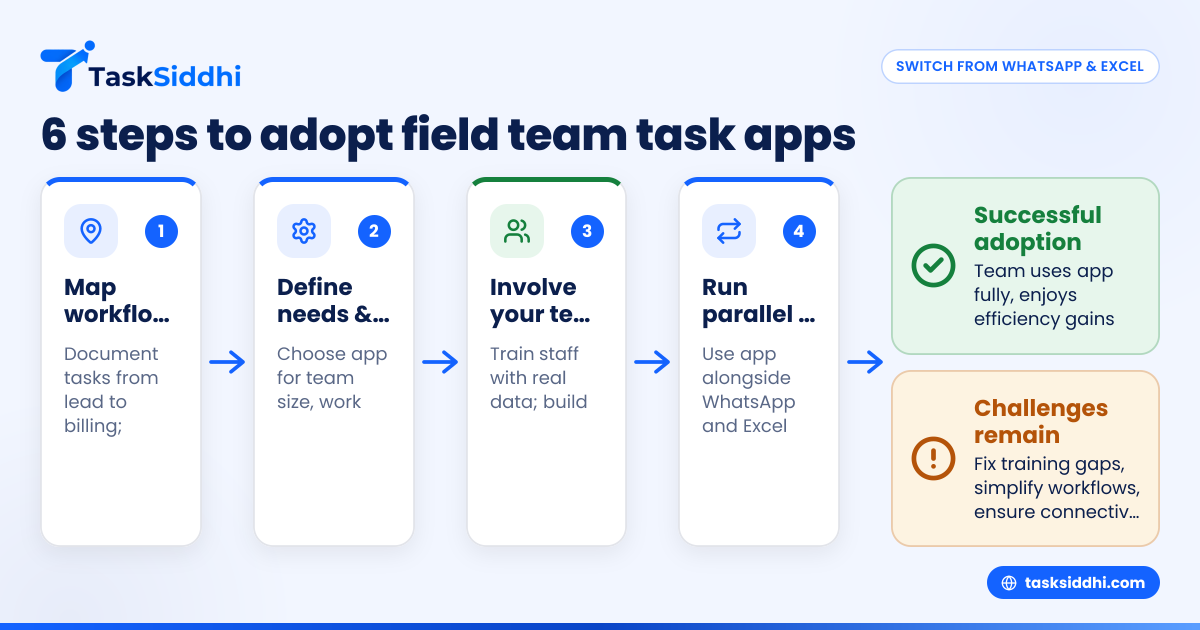
Moving a field team from informal WhatsApp and Excel to structured software requires careful planning to succeed. Here are practical steps:
1. map existing workflows
Document how tasks currently flow — from lead assignment to job completion and invoicing. Identify pain points like late updates or data duplication.
2. define needs and select software
Choose a solution suited for your team size (5–30 members) and type of work (field visits, service jobs, client work). Consider mobile apps with offline support for tier-2 towns and multi-language input if required.
3. involve your team early
Organise training sessions with field staff and managers. Use real job data for test assignments so users experience the software first-hand.
4. run parallel systems initially
Continue WhatsApp and Excel alongside the new app for 1–2 weeks. This helps build trust and reduces disruption.
5. migrate fully and standardise
Switch all task assignments, updates, and reporting to the app. Replace manual Excel reports with automated dashboards.
6. review and optimise workflows
Leverage built-in reporting and time tracking to spot inefficiencies. Use automation to reduce repetitive work.
pitfalls to avoid
- Rushing the switch without adequate training leads to low adoption.
- Overcomplicating software settings confuses users; keep workflows simple initially.
- Ignoring low connectivity zones causes field staff frustration; choose apps with offline modes.
- Not involving field workers in choosing software risks resistance.
what features should i look for in field team task management software for indian teams?
When evaluating software, ensure it fits the daily realities of Indian field teams serving SMEs. Critical features include:
mobile app with offline support
Since internet quality varies widely, an Android app that works offline and syncs automatically is crucial for tier-2/3 cities and rural areas.
customisable boards and views
Tools to create boards and views allow adapting task stages (e.g., assigned, in progress, completed) to your specific business process.
proof collection
Capture photos, videos, and GPS location during field visits to confirm task completion and quality standards.
payment and accounting integration
Support integration with popular Indian accounting software like Tally and payment gateways such as Razorpay or UPI for smoother invoicing and collections.
notifications via WhatsApp and SMS
Automated alerts for upcoming jobs, follow-ups, approvals, and delays help maintain communication on platforms familiar to Indian staff.
multi-language input
If your teams operate across regions with different languages, support for Hindi, Marathi, Tamil, Telugu, or other local languages improves usability.
compliance features
Ensure the app respects personal data privacy under DPDP Act 2023, with data encryption and controlled access.
automation capabilities
Reduce manual tasks like status updates, reminders, and report generation by using built-in automation.
can small teams in tier-2 cities benefit from field team task management apps?
Yes, and often more so than larger teams in metros. Tier-2 and tier-3 cities like Surat, Vadodara, or Lucknow present unique challenges:
- Irregular internet connectivity: Offline-enabled apps keep fieldwork uninterrupted.
- Wider service areas: Efficient routing saves time and fuel in spread-out locations.
- Limited skilled supervisors: Automation and clear workflows reduce dependence on constant oversight.
- Budget sensitivity: Affordable plans and free tiers make task software accessible.
Even teams of 5 to 10 employees gain significant advantages by eliminating Excel errors and chaotic WhatsApp chats. Faster data capture, evidence-backed job completion, and built-in time tracking enhance billing transparency and client trust.
how to get started with tasksiddhi for your field team?
TaskSiddhi is tailored for Indian field, service, and client-work teams. It simplifies field task management on a single platform, combining:
- Quick job assignment with flexible boards and views
- Mobile updates, photo proof, GPS stamping, and time tracking for field staff
- Built-in automation to reduce repetitive tasks
- Insightful reporting dashboards for managers
- A mobile app with offline support, ideal for tier-2 and tier-3 teams
To start, map your workflows and gradually move from WhatsApp and Excel to TaskSiddhi’s digital boards. Experience the ease of organising, assigning, and tracking jobs in real-time.
See how TaskSiddhi works for Indian teams by taking the product tour or comparing plans at pricing.
frequently asked questions
how does field team task management software handle low internet connectivity?
Good software includes offline capability allowing field workers to update job status, capture photos, and track time without internet. Once connectivity is restored—whether in Mumbai’s suburbs or village outskirts—the data syncs automatically to the central system. This feature is essential for Indian teams working in areas with spotty networks.
can i integrate field task software with tally or razorpay?
Yes. Many field team management apps offer integrations with Tally ERP software for smooth accounting and with Razorpay payment gateway for quick collection of client payments. This integration streamlines invoicing, reconciliations, and reduces manual bookkeeping workload.
is data security and privacy considered in these apps?
Reputable task management software designed for India complies with the DPDP Act 2023’s requirements on personal data privacy and security. They use encrypted data storage, secure user authentication, and role-based access to protect both customer and employee information.
how do i track time spent by field staff on each task?
Most field task management apps provide integrated time tracking features. Staff can start and stop timers via the mobile app while working on jobs. Managers access detailed reports showing actual hours spent per client or project, enabling better payroll management and accurate billing.
can small businesses afford dedicated task management software?
Yes. Several solutions, including TaskSiddhi, offer flexible pricing plans and free versions that fit small teams. The time and error reduction they bring usually offset subscription costs quickly through improved efficiency and faster payments.
how can ai improve scheduling for field teams in indian cities?
AI analyses past traffic data, job times, and staff skills to optimise job sequences and routes. For congested cities like Bengaluru or Mumbai, it helps reduce fuel costs and meet appointment windows. AI also forecasts periods of high demand, helping managers plan shifts and resources in advance.
Switching your Indian field team from WhatsApp and Excel to a dedicated task management app can transform your operations, boost productivity, and improve client satisfaction. Try TaskSiddhi today to experience an Indian-focused solution that simplifies fieldwork management and grows with your team. Take the product tour or explore plans at pricing to get started.