














Field team task management organizes jobs, schedules, and communication to ensure field crews complete work efficiently, minimizing travel time and costs. Using AI-powered tools and mobile apps, U.S. businesses can optimize routes, reduce fuel and labor expenses, and improve customer satisfaction.
Key takeaways
- Efficient scheduling cuts unnecessary travel and fuel costs.
- Mobile apps provide real-time updates to prevent redundant visits.
- AI field team software enhances route and work allocation.
- Automation reduces manual tasks and errors.
- Clear communication avoids trip delays and cancellations.
- TaskSiddhi features simplify workload balancing and tracking field operations.
What is field team task management and why does it matter?
Field team task management is assigning, tracking, and coordinating jobs done outside the office, such as installations, deliveries, or inspections. In U.S. cities like Chicago, Houston, and Detroit, poor management leads to wasted driving, lost labor, higher fuel bills, and unhappy customers.
Proper task management ensures jobs are assigned smartly to minimize back-and-forth trips, improve first-time fixes, and boost satisfaction. For example, technicians in Houston spend over 20% of the day driving without optimized routes—a cost businesses can avoid.
How does AI field team software enhance task management?
AI field team software analyzes job locations, team availability, traffic, and job urgency to optimize assignments and routes dynamically, saving time and resources.
By prioritizing urgent tasks, assigning the nearest teams, and avoiding traffic or weather delays, AI helps businesses respond faster and manage workloads effectively. Over time, it learns from data to improve scheduling accuracy and reduce guesswork.
Benefits of AI in task management
- Dynamic route optimization cuts driving time.
- Balanced workload assignment prevents overload.
- Predictive alerts for delays or resource needs.
- Proactive rescheduling keeps service quality high.
How can better scheduling help reduce travel time?
Better scheduling groups nearby jobs and sequences visits to avoid extra driving. For instance, a plumbing company in Chicago can:
- Map all daily customer locations.
- Cluster jobs by neighborhoods like Lincoln Park.
- Arrange visits to minimize backtracking.
- Schedule around rush hours.
This reduces fuel use and driving hours. TaskSiddhi supports this with digital boards and views that let managers reorder assignments easily and adapt plans in real time.
Steps to reduce travel time with scheduling
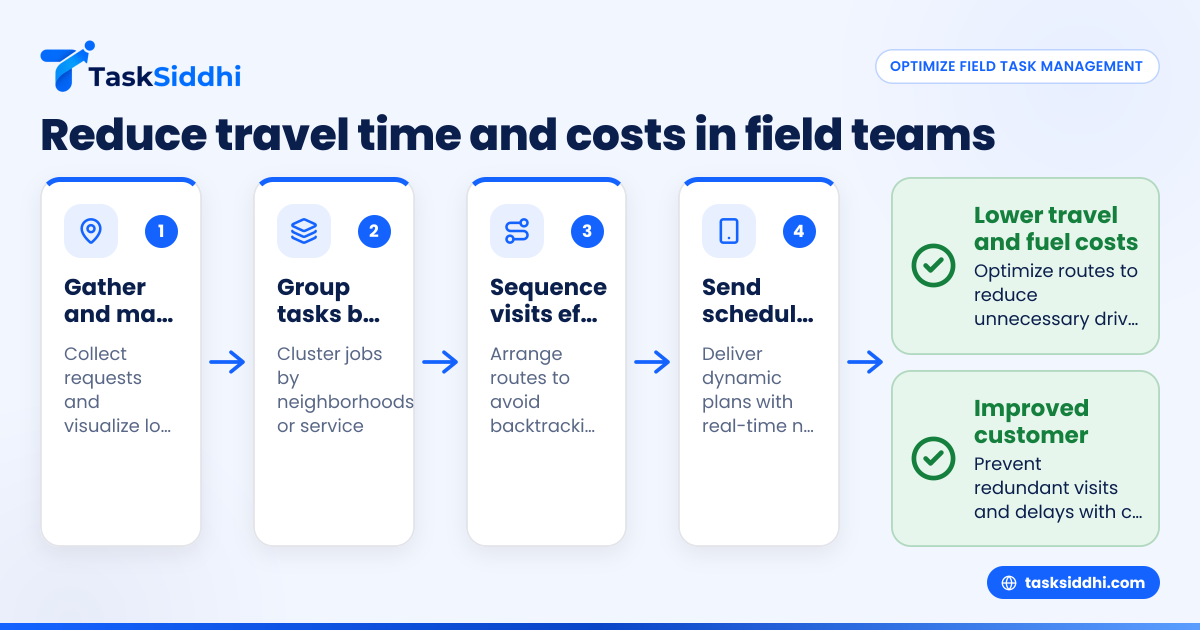
- Gather job requests into a task app.
- Visualize job locations on a map.
- Group jobs by area or type.
- Sequence visits for efficient routing.
- Send schedules via mobile notifications.
- Update plans dynamically based on progress.
What role does communication play in minimizing travel costs?
Clear, real-time communication stops wasted trips. When customers cancel or reschedule, instant updates prevent technicians from driving to empty sites.
Mobile apps enable technicians to report delays or missing parts, allowing managers to reallocate jobs swiftly. Sharing photos, videos, or GPS data can solve issues remotely, cutting down unnecessary site visits.
Tips for effective communication
- Use push notifications for instant updates.
- Encourage immediate issue reporting.
- Let clients reschedule online without calls.
- Maintain open links between dispatch and field staff.
How do mobile apps support field team task management?
Mobile apps connect field workers with dispatch in real time. They let teams receive jobs instantly, update progress, capture proof with photos, and log hours and expenses.
Apps also provide GPS tracking, so managers in large urban areas like Detroit can monitor technician locations, improving dispatch decisions and reducing delays.
How to group tasks and jobs to save on travel costs?
Grouping bundles tasks near each other or by service type. For example, an HVAC company in Houston might:
- Map all filter replacement jobs.
- Divide them into clusters (West Houston, Downtown, East Houston).
- Assign each cluster to a technician on separate days.
This reduces driving back and forth, saves time, and simplifies parts management.
Worked example
With 15 jobs, the company schedules:
- Monday: 5 jobs in West Houston
- Tuesday: 5 jobs Downtown
- Wednesday: 5 jobs East Houston
This orderly plan saves miles and streamlines workflows.
What automation can reduce manual work in task management?
Automation handles repetitive tasks like sending appointment reminders, updating job statuses, and generating invoices. This improves accuracy and frees managers to focus on critical decisions.
TaskSiddhi’s automation can send SMS or email reminders compliant with the Telephone Consumer Protection Act (TCPA), notify customers when technicians are en route, and trigger billing instantly after jobs finish.
How can reporting identify opportunities to reduce travel time?
Reporting tools analyze job completion, travel mileage, and time on-site. Managers spot inefficiencies like excessive rerouting or overloaded teams.
A Detroit delivery service might discover drivers repeatedly visit nearby neighborhoods on different days. Combining these visits can cut miles and speed deliveries.
Reports also guide hiring or job redistribution to balance workloads across teams for better efficiency.
What are the challenges of switching to digital field team task management?
Moving from WhatsApp groups, Excel sheets, or paper cards to digital software involves:
- Staff resistance due to unfamiliarity.
- Initial technical glitches or poor connectivity.
- Upfront subscription and training costs.
How to manage the switch successfully
- Start with a pilot team or project.
- Train users emphasizing time savings.
- Select cloud apps like TaskSiddhi with reliable mobile access.
- Roll out gradually, using feedback to refine.
Ongoing support eases adoption and helps realize productivity gains quickly.
Conclusion
Efficient field team task management is vital for U.S. companies aiming to reduce travel time and costs. Smart scheduling, AI field team software, clear communication, automation, and detailed reporting help businesses in Chicago, Houston, and Detroit optimize operations and serve customers better. TaskSiddhi offers features, a mobile app, and flexible boards and views to support these goals.
See how it fits your team with a product tour or compare plans at pricing.
Frequently asked questions
What is the average travel cost savings for field teams using software?
Most U.S. companies see 10-20% fuel and labor cost reductions after adopting digital task management. Optimized route planning and real-time updates drive these savings.
Can mobile apps help with regulatory compliance?
Yes. Mobile apps capture timestamped proof, photos, and GPS data, aiding audit readiness and compliance in many industries.
How does task grouping work in different US cities?
Task grouping adapts to city layouts. Dense Detroit neighborhoods use micro-zones, while sprawling Houston clusters larger areas for efficient travel.
Is AI only useful for large field teams?
No. Small teams of 5–10 benefit from AI scheduling and routing too. It maximizes resources and reduces inefficient trips regardless of size.
How can automation reduce overseer workload?
Automation handles reminders, status updates, and reporting, freeing managers from manual follow-ups to focus on strategic tasks.