














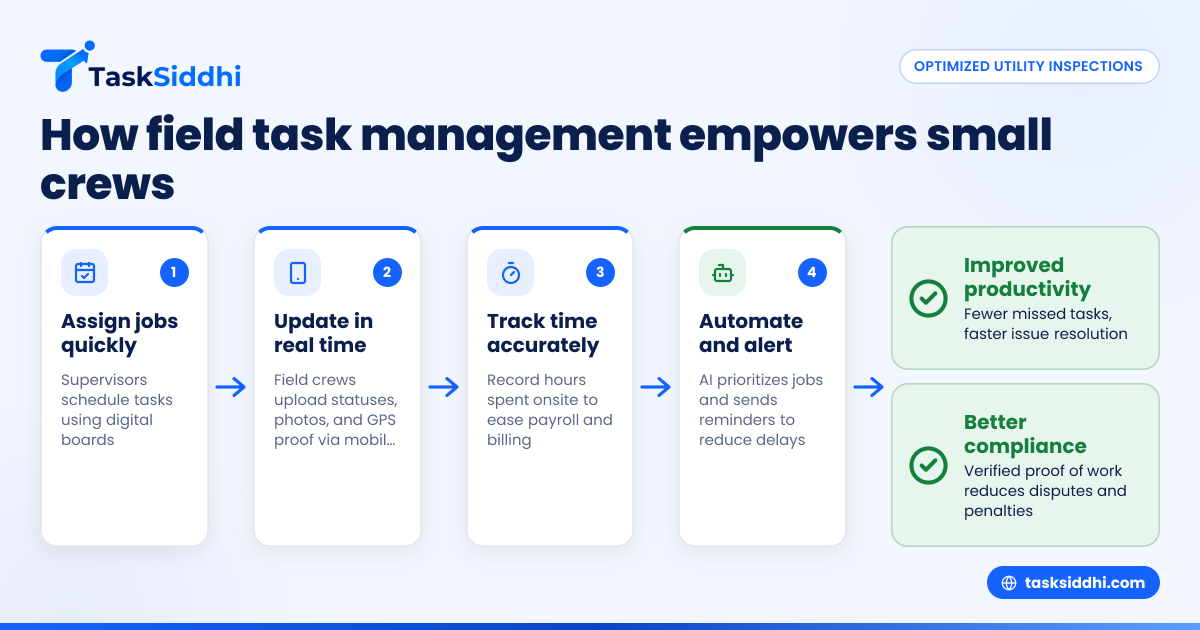
Field team task management streamlines scheduling, communication, and reporting for small US utility inspection crews. Using specialized tools helps track job progress, proof of work, and time spent on site while reducing errors and delays. These tools boost productivity and customer satisfaction in demanding field conditions.
Key takeaways
- Field team task management improves scheduling, job tracking, and communication for utility inspection crews.
- Mobile apps provide real-time updates, photos, and GPS proof from inspection sites.
- Time tracking and reporting features simplify payroll and client billing processes.
- AI field team tools can automate routine tasks and optimize work allocation.
- Effective management reduces errors, delays, and reliance on WhatsApp or spreadsheets.
- Small crews benefit from tailored solutions that scale with team size and workload.
Why small utility inspection crews need field team task management
Small utility inspection teams often rely on phone calls, WhatsApp groups, and paper job cards. This can cause missed tasks, incomplete reports, and poor visibility into site work. With multiple teams working at different locations in cities like Detroit or Houston, it’s easy to lose track of assignments and customer requests.
Field team task management software helps supervisors assign jobs quickly, monitor progress from the office, and capture proof of work with photos and site visit logs. Teams can update their job cards from mobile apps without carrying paperwork. This improves accountability and speeds up issue resolution for utilities companies.
The software centralizes job data on digital boards that update automatically. This makes reporting and billing more accurate, and reduces the chance of errors caused by manual data entry or communication gaps. For small crews handling inspections in neighborhoods across Chicago or nearby suburbs, this solution is essential for operational efficiency.
How does AI field team technology improve utility inspections?
AI field team tools use artificial intelligence to automate task allocation, prioritize urgent jobs, and analyze work patterns. They help small crews handle fluctuating workloads and optimize travel routes to inspection sites.
AI can identify which crew member is best suited for a job based on skills, availability, and location. It can also flag delays or potential issues needing supervisor attention. This reduces wasted time and improves job completion rates without requiring constant manual oversight.
In practical terms, AI-driven task management boosts productivity for inspection teams operating on tight deadlines while managing multiple client sites. It also offers insights for continuous improvement by analyzing data trends collected during field visits.
What features should small inspection crews look for in field team task management software?
When choosing a task management solution, small utility inspection teams should focus on features that enhance their day-to-day operations:
- Job boards and views: Visualize tasks by priority, location, or crew to ensure no job is overlooked.
- Mobile app support: Enable crews to update job status, log time, upload photos, and collect signatures directly from the field.
- Time tracking: Record accurate hours spent on each inspection to simplify payroll and customer billing.
- Site visit documentation: Capture GPS location, photos, and notes for proof of work compliance.
- Reporting: Generate detailed reports for supervisors and clients highlighting job status, delays, or issues.
- Automation: Schedule recurring inspections, assign jobs automatically, and send reminders to crews and clients.
With these features, small crews can replace disparate tools like Excel sheets and WhatsApp with an integrated digital system tailored to field service workflows.
How do field team task management tools improve compliance and client satisfaction?
Utility inspections often require strict documentation to comply with regulatory standards and contracts. Field team task management software records every job’s details securely and consistently.
Having digitally verified site visit proof, including images and timestamps, reduces disputes both internally and with clients. Automated reminders help crews meet deadlines promptly, minimizing penalties or contract breaches.
Clients appreciate real-time visibility into inspection progress through status updates or shared reports. Transparent communications build trust and can increase repeat business opportunities. In competitive markets like Chicago’s utility service sector, this operational transparency provides an edge.
How can small crews integrate field task management with existing systems?
Most small utility inspection teams use QuickBooks for accounting and may have ERP systems for overall operations. Modern task management solutions support integration with such tools to synchronize job costs, invoices, and client data.
For example, after inspection reports are finalized, billing information can flow automatically into QuickBooks, reducing manual entry and errors. Integration also ensures sales tax data is accurate and complies with state regulations.
Some platforms offer open APIs or built-in connectors that make linking to existing software straightforward. This preserves current workflows while enhancing field operations invisibly to crews.
How does task management software help with 1099 contractor oversight?
Many small field teams work with independent contractors filing IRS 1099 forms. Task management software provides visibility into contractor schedules, job completion, and hours worked.
Time tracking and digital job cards document the exact work done by contractors, simplifying payroll and tax record keeping. Managers can verify contractors met requirements before issuing payments and prepare accurate 1099 information at year-end.
This oversight reduces risks of misclassification and supports compliant payment practices.
How does implementation affect small utility inspection teams?
Switching to digital task management requires initial setup time and crew training. However, most small utility teams adapt rapidly due to tangible benefits like fewer missed jobs and easier reporting.
Starting with a simple board and mobile app for remote updates allows crews to see immediate improvements without overwhelming complexity. As comfort grows, teams can enable automation features and reporting dashboards for supervisors.
Gradual onboarding minimizes disruptions, so crews continue inspections without losing momentum.
How much does field team task management cost for small utility crews?
Pricing varies by provider based on user count, features, and usage levels. Many solutions offer subscription plans billed monthly or annually with tiered pricing for small teams.
Costs in the United States often range from $10 to $30 per user per month for a complete package including mobile apps, time tracking, and reporting. Some vendors provide free trials or freemium tiers with limited features.
Choosing a provider like TaskSiddhi, designed for field and service teams, ensures a tailored fit and transparent pricing. Small crews can review pricing pages to compare options easily.
What common challenges do US utility inspection crews face with manual field task management?
Manual systems relying on WhatsApp groups, spreadsheets, or paper can cause confusion, lost data, and delayed communication:
- Job details may be missed or duplicated.
- Photos or proof might be misplaced or delayed.
- Supervisors lack real-time visibility into field progress.
- Time tracking is error-prone or incomplete.
- Payroll and invoicing require tedious manual data transfers.
Digital task management eliminates these issues by offering a single source of truth accessible to teams and managers anytime.
This is especially critical for crews covering large metropolitan areas like Houston, where multiple sites and teams operate simultaneously.
How does TaskSiddhi help small field teams manage utility inspections?
TaskSiddhi provides field team task management through intuitive boards and views, enabling quick job assignment and progress tracking. Crews use the mobile app to update jobs with photos, site proof, and timestamps from any location.
Built-in time tracking simplifies payroll and billing. Automated reminders and task assignment eliminate oversight errors. Powerful reporting offers detailed insights for supervisors.
Designed specifically for field, service, and client work teams, TaskSiddhi helps small US utility inspection crews transition off manual tools and improve operational efficiency.
See how it works with a quick product tour or explore detailed pricing plans to find your best fit.
Frequently asked questions
What is field team task management?
Field team task management involves organizing and tracking the tasks assigned to field workers, enabling real-time updates, job proof, and streamlined communication between crews and supervisors.
Can AI really improve field inspections?
Yes, AI helps by automating job assignments, predicting delays, and optimizing routes, reducing manual workload and improving operational efficiency for small teams.
Do I need a mobile app for my inspection team?
A mobile app is essential—it allows crews to update jobs on site, capture photos and GPS proof, and communicate instantly without returning to the office.
How does task management affect payroll and billing?
By accurately tracking hours and job details, task management tools simplify issuing payments and generating invoices, reducing errors and saving administrative time.
Is TaskSiddhi suitable for small US utility crews?
Absolutely—TaskSiddhi caters to small teams working in the field, offering tailored features that fit US business needs, including integration with popular finance tools like QuickBooks.
How quickly can my team start using field task management software?
Most teams begin with simple setups and see benefits within days. Training is straightforward, minimizing downtime while improving job tracking and reporting immediately.