














Manufacturers in Maharashtra often need reliable site visit proof to manage field teams, service jobs, and client work efficiently. Mobile check-ins combined with photos offer a practical way to document visits, reducing disputes and improving job tracking. This article explains how you can use these tools effectively.
Key takeaways
- Mobile check-ins with GPS and timestamps provide accurate, tamper-proof site visit proof.
- Photos taken during site visits validate work progress and conditions.
- Digital site visit proof reduces errors from paper job cards and WhatsApp communication.
- AI site visit tools can automate verification and reporting, saving time.
- Maharashtra manufacturers can improve field team productivity and accountability with mobile apps.
- Pairing proof with time tracking and reports helps handle audits, customer queries, and compliance.
What is site visit proof and why does it matter for Maharashtra manufacturers?
Site visit proof is the documented evidence that a field or service team member actually visited a client site or job location. It usually includes digital check-ins with location data and photos taken during the visit. For manufacturers in Maharashtra, especially those operating in cities like Pune, Aurangabad, and Nashik, this proof is vital:
- To ensure supervisors know jobs progress as scheduled.
- To avoid disputes over service delivery or installation work.
- To comply with contract terms and internal quality checks.
- To maintain accountability of the team managing expensive machinery, spare parts, or equipment.
Relying on WhatsApp messages or paper job cards for proof can cause delays or errors. Using mobile check-ins and photos ensures accurate, timely information available in a central system.
How do mobile check-ins with photos create reliable site visit proof?
Mobile check-ins use GPS data and timestamps to confirm where and when a team member checked in. This data is often combined with photos captured on the spot, showing ongoing work or site conditions.
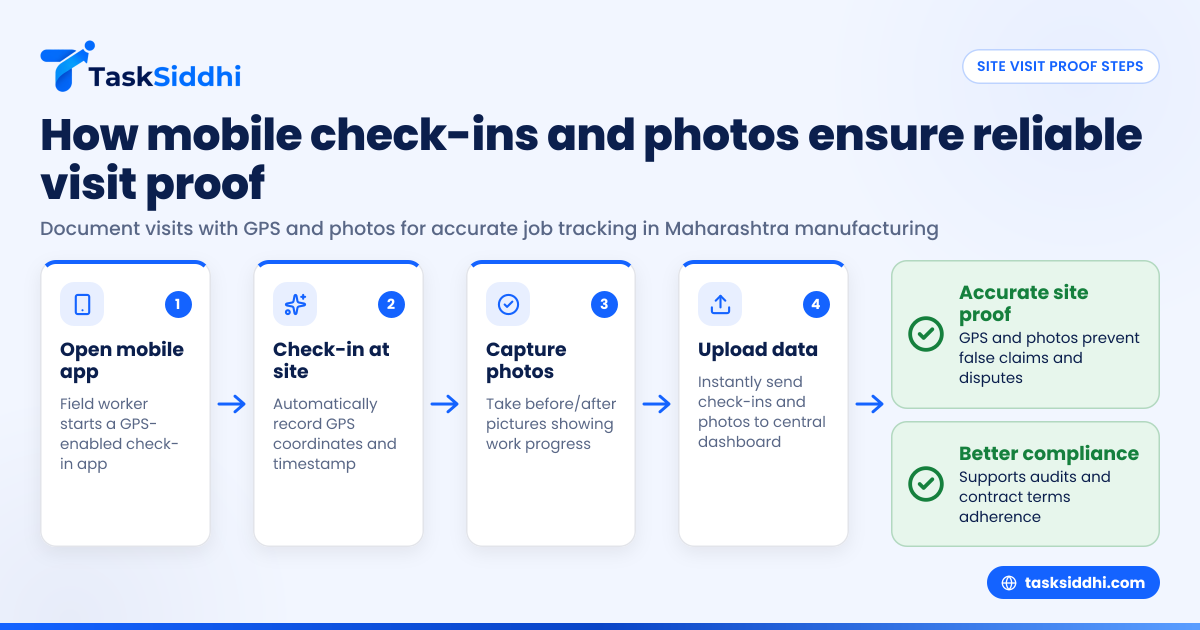
Using smartphones, the process typically works like this:
- The field worker opens a dedicated app on their mobile.
- At the client site, they “check-in” using GPS, which records location and time automatically.
- They capture photos related to the job, including before and after images.
- All data uploads immediately to a central dashboard accessible by managers.
This method provides multiple proof points:
- GPS coordinates prevent false claims of visits.
- Timestamps confirm when work happened.
- Photos show the actual status or completed work.
For manufacturers handling machinery installations in Mumbai or equipment servicing in Nagpur, this verification boosts trust with clients and avoids payment delays.
How can manufacturers in Maharashtra implement mobile check-ins practically?
Maharashtra manufacturers can follow these steps to adopt mobile check-ins and photo proof:
- Choose a suitable app: Look for apps tailored to Indian field teams, supporting GPS, photos, and offline mode when internet is poor.
- Train your teams: Explain how and when to check in and take photos, highlighting reasons such as GST audits or DPDP Act compliance.
- Set protocols for photo capture: Specify which photos are mandatory, e.g., machine serial numbers, installation sites, or client signatures.
- Monitor data daily: Managers should review check-in logs and photos using a web dashboard, verifying visits promptly.
- Use reports for billing and compliance: Combine visit proof with work reports or time tracking to generate invoices or fulfill audit needs.
Manufacturers in cities like Pune can benefit from these real-time updates, reducing time spent chasing field teams or clarifying job statuses.
What is AI site visit and how can it help Maharashtra manufacturers?
AI site visit is technology that uses artificial intelligence to analyze site visit data, photos, and reports automatically. It identifies patterns, flags anomalies, and speeds up validation.
By scanning photos for quality or missing information, and cross-checking GPS data with schedules, AI reduces manual verification effort. Maharashtra manufacturers can get real-time alerts on discrepancies or delays, improving decision-making and ensuring reliable client deliverables.
Integrating AI site visit tools with mobile check-ins enhances accuracy and boosts productivity, which is crucial for manufacturers who handle multiple field visits daily.
How does mobile check-in help with DPDP Act 2023 compliance for site visit proof?
Mobile check-in apps can be designed to comply with India’s Digital Personal Data Protection (DPDP) Act 2023 by securing personal data of employees and clients. These apps:
- Store GPS and photo data securely with encryption.
- Allow access only to authorized personnel.
- Provide audit trails for data access and usage.
- Ensure data retention aligns with legal requirements.
Manufacturers in Maharashtra must ensure their field data collection tools respect privacy and data protection laws while maintaining proof integrity.
How can manufacturers solve common challenges in site visit proof collection?
Field teams can face obstacles such as poor network coverage, device misuse, or inconsistent photo quality. Manufacturers can tackle these by:
- Using apps supporting offline mode with automatic syncing when online.
- Setting clear guidelines on mobile phone use and regular training.
- Standardizing photo requirements to maintain quality across the team.
- Scheduling regular audits of site visit data to catch lapses early.
For example, a manufacturer in Aurangabad dealing with rural clients can issue smartphones with pre-installed apps and offline capability to ensure field visits are recorded despite low connectivity.
How can digital site visit proof improve business operations beyond accountability?
Reliable site visit proof offers multiple operational benefits:
- Streamlined billing, linking proof of work to invoicing automatically.
- Faster dispute resolution with verifiable evidence.
- Improved customer satisfaction due to timely updates.
- Better deployment and scheduling of field teams using real-time data.
- Enhanced compliance with GST invoicing and service contracts.
These strengthen a manufacturer’s reputation and cash flow, especially in competitive Maharashtra markets like Mumbai and Pune.
What does it cost to implement a mobile check-in system with photo proof?
Implementing such a system involves costs for:
- Choosing an app suitable for Indian field teams; some charge monthly fees per user.
- Mobile devices if your team lacks smartphones.
- Training time and change management.
- Possible integration with existing tools like Tally or GST portals.
However, the return on investment usually exceeds the cost through reduced errors, faster payments, and improved field productivity. You can compare plans and features to find the best fit at pricing.
How do I get started with mobile check-in and photo site visit proof?
To get started:
- Assess your current field proof methods.
- Select a mobile app with GPS check-ins and photo capture features.
- Pilot with a small team in Maharashtra to adjust processes.
- Roll out to all field workers with training and support.
- Monitor and refine based on feedback and reports.
A tool like TaskSiddhi, which combines task boards, mobile app, time tracking, and reporting, can centralize and simplify the entire process.
See how it works in practice
Ready to improve your site visit proof and transparency in Maharashtra manufacturing? Take a product tour or explore the pricing plans to find your best solution.
Frequently asked questions
What is the difference between mobile check-in and manual job cards?
Mobile check-in automatically captures GPS location and timestamps digitally, reducing errors and fraud common in manual job cards which rely on handwritten notes or messages.
Can photos taken on mobile devices be tampered with?
Modern apps embed metadata (location, time), and secure uploads prevent easy tampering. Also, AI tools can flag suspicious photos for review.
Is GPS location data accurate enough for site visit proof in Maharashtra’s urban areas?
Yes, GPS accuracy in cities like Mumbai or Pune is generally precise enough to confirm visits at client locations, especially when combined with photos and time stamps.
How does site visit proof help with GST and invoicing?
Site visit proof supports claims of service delivery under GST rules and can be linked directly to invoice generation in systems like Tally, reducing compliance risks.
Can I use WhatsApp photos as site visit proof?
While WhatsApp photos help communication, they lack automatic GPS and timestamp validation, making them less reliable than dedicated mobile apps for legal or audit purposes.
How does AI improve the management of site visit proof?
AI analyzes large amounts of site visit data quickly, detects anomalies, automates report generation, and notifies managers of missing or incorrect information—saving time and increasing accuracy.