














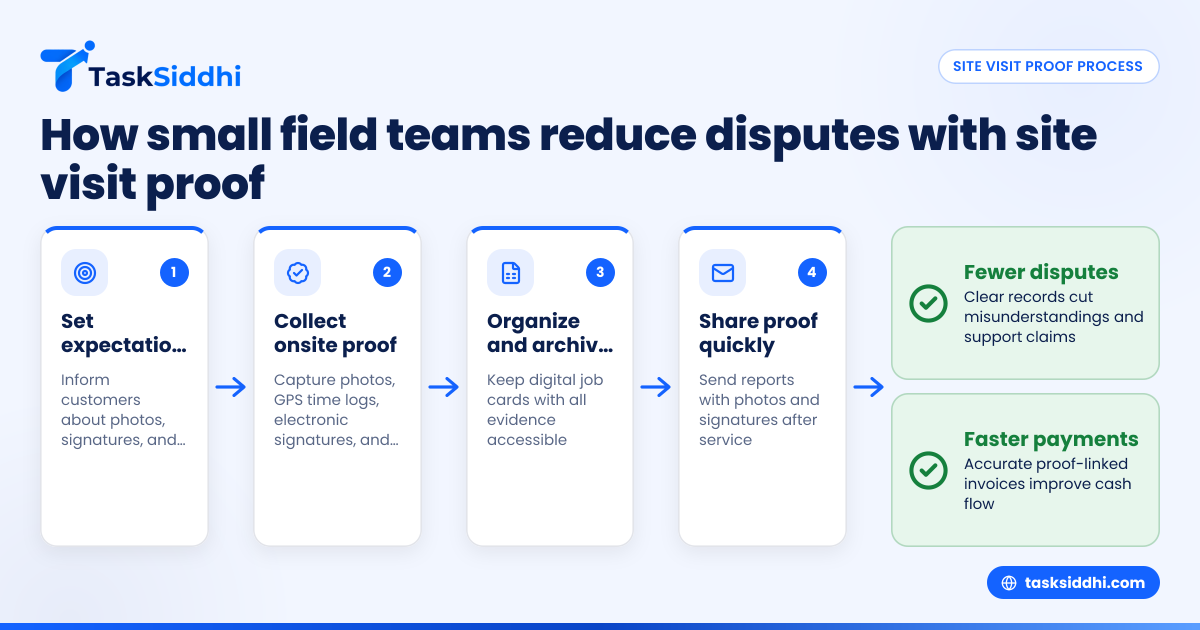
Small US field teams use site visit proof to confirm work done, reduce disputes, and improve billing accuracy. Collecting photos, signatures, time logs, and GPS data onsite creates clear records. This transparency helps resolve issues faster and builds customer trust.
Key takeaways
- Site visit proof documents field activities, cutting disputes and misunderstandings.
- Digital tools simplify capturing photos, signatures, and GPS data.
- Proper proof supports accurate billing and quicker payments.
- AI site visit technology automates proof collection, raising efficiency.
- Clear customer communication about proof avoids confusion.
- TaskSiddhi’s mobile app and job cards streamline site visit proof for US teams.
What is site visit proof and why does it matter for small field teams?
Site visit proof is onsite evidence showing that tasks were completed as agreed. It includes photos, time stamps, electronic signatures, notes, and GPS data. This proof reduces disputes, ensures correct invoicing, and builds trust with customers. Without it, teams risk disagreements, delayed payments, and harmed reputations.
In industries like HVAC repair in Houston or landscaping in Chicago, customers want confirmation jobs are done right. Site visit proof provides a transparent record both sides can check. It also protects businesses with warranty claims or follow-up work.
How can small field teams collect site visit proof effectively?
Small teams need simple, reliable tools their staff can use onsite. Many still use WhatsApp groups, paper forms, or Excel sheets—prone to errors and loss. Mobile apps made for field work centralize proof digitally. Key proof types are:
- Photos and videos
Smartphones capture clear images of finished work or site conditions, automatically timestamped. Videos help document complex fixes.
- Electronic signatures
Get customer or supervisor signatures directly on devices. This is safer than paper sign-offs.
- Time tracking with GPS
Record arrival, start, and end times with location to prove staff presence onsite.
- Job notes and checklists
Use digital job cards with steps to tick off and spaces to add notes.
- Document uploads
Attach permits, safety certificates, or delivery slips to jobs.
Using one platform like TaskSiddhi keeps all proof together on accessible job cards.
How does AI site visit technology improve proof accuracy?
AI site visit technology automates verifying and collecting onsite evidence to cut errors. It can scan photos to check if replaced parts match orders, verify timestamps and GPS data, and flag inconsistencies. This speeds up dispute resolution and improves record quality for small teams.
For example, AI can detect if a replaced HVAC filter is the correct model or alert if GPS location doesn’t match the job address. Integrating AI in your workflow saves time and boosts transparency.
How to use site visit proof to reduce customer disputes?
Site visit proof cuts disputes by providing clear evidence of completed work:
- Set expectations early
Tell customers you’ll collect photos, notes, and signatures during the visit. This clarifies scope and pricing.
- Collect proof every time
Train your team to gather required proof consistently.
- Share proof quickly
Send customers a report with photos and signatures soon after service.
- Use proof to address complaints
Refer to records to resolve issues faster without delays.
- Keep proof organized
Maintain digital archives for warranties, audits, or billing questions.
Following these steps helps teams in Detroit or Chicago avoid payment delays or service denials.
Can site visit proof help improve billing and payments?
Yes. Site visit proof validates completed work and lowers billing mistakes. Invoices linked to signed job cards and timestamped photos encourage on-time payments. Proof also guards against chargebacks or 1099 disputes in contract work.
Connecting proof management with QuickBooks or Stripe streamlines invoicing and collections for US teams. Automated invoices can include embedded proof, reducing admin effort and improving cash flow.
What legal and compliance considerations apply to site visit proof in the US?
Site visit proof aids business processes but US teams should consider:
- Data privacy: Store customer photos and signatures securely and comply with privacy laws.
- CAN-SPAM and TCPA: Follow consent rules if proof is sent via email or phone.
- Tax documentation: Maintain accurate records for IRS audits.
- Record retention: Keep proof as long as contracts or laws require.
Always get explicit consent to collect and use site visit data.
How can TaskSiddhi help small US field teams collect and use site visit proof?
TaskSiddhi offers a mobile app and platform designed for US field teams. It supports digital job cards with photo attachments, electronic signatures, GPS-tracked time logs, and customizable checklists. All proof is centralized and available to managers and customers.
Automation cuts data entry and ensures consistent proof collection. TaskSiddhi also integrates with QuickBooks to link proof with billing. This helps Houston, Chicago, or Detroit teams reduce disputes and build trust professionally.
See how it works on the product tour page and compare plans at pricing.
Frequently asked questions
What is site visit proof exactly, and why do I need it?
Site visit proof is onsite evidence confirming your field team finished the job, such as photos, signatures, and time logs. You need it to reduce disputes, ensure proper payment, and protect your business reputation.
How do I capture site visit proof easily with limited tech skills?
Use a mobile app built for field teams that guides users through photos, time tracking, and signatures. This replaces paper or spreadsheets with an easy digital system.
Does AI site visit technology require expensive equipment?
No, it runs on standard smartphones and cloud services. AI analyzes photos and data to improve accuracy without extra hardware costs.
Can site visit proof improve invoicing and collections?
Yes. When invoices include clear proof, customers pay confidently and on time. Proof also prevents chargebacks and service quality disputes.
Are there privacy concerns with taking photos and signatures onsite?
Always get customer consent before capturing images or signatures. Store data securely and follow privacy and company policies.
How long should I keep site visit proof records?
Keep records according to contracts or state rules, usually 3-7 years. This helps with audits, warranty claims, and disputes.