














Field team task management is the process of organizing, tracking, and completing work done by employees working outside the office. Instead of relying on WhatsApp groups, digital task boards bring clarity, accountability, and efficiency to field teams in the United States.
Key takeaways
- WhatsApp groups often create confusion, missed updates, and lack of structure for field team task management.
- Digital boards provide real-time visibility, prioritize jobs, and track progress in one place.
- Job cards with site visit proof and time tracking ensure accountability and accurate billing.
- Automation reduces manual tasks like notifications and follow-ups.
- AI field team tools can analyze data for better resource allocation and forecasting.
- Integrations with accounting and reporting software streamline business processes.
Why is WhatsApp not enough for field team task management?
Many small and medium US businesses rely on WhatsApp groups to communicate daily tasks with their field staff — technicians, delivery drivers, sales reps, or service teams. While WhatsApp is free and familiar, it wasn’t designed to track work progress. Messages get buried, details go missing, and managers spend excessive time chasing updates.
This method creates problems like duplicate requests, delayed job completion, and no audit trail of work done. For example, a Houston-based HVAC company using WhatsApp may struggle to verify whether a technician completed an emergency repair or just acknowledged the message. Without proof, customer disputes and invoicing errors rise.
How do digital boards improve field team task management?
Digital boards are cloud-based platforms designed to organize tasks visually using columns, cards, and tags. Each job is a card that moves through stages like “assigned,” “in progress,” and “completed.” Managers and workers see real-time status on any device.
This transparency fosters accountability. In Chicago, a landscaping company found using a digital task board reduced missed jobs by 40% because everyone saw what was due today. Unlike WhatsApp’s chat flow, boards keep task details structured — customer info, deadlines, required materials, and contact numbers.
How does AI enhance field team task management?
AI field team tools automate data analysis to predict workloads, optimize routes, and flag potential delays. They sift through job data, timesheets, and visit proofs to suggest better resource allocation.
With AI, Detroit-based plumbing services can forecast peak demand periods, schedule extra technicians, and reduce overtime costs. AI does not replace managers but supports smarter decisions and faster responses to field challenges.
What features should a field team task management app have?
Look for a platform that includes:
- Boards and views: Visual job boards that display tasks by status, priority, or zones.
- Job cards: Detailed work orders with customer info, job description, checklist, and site visit proof (photos, signatures).
- Mobile app: Field staff can access and update jobs on smartphones, even offline.
- Time tracking: Capture start and end times for precise billing and payroll.
- Reporting: Generate reports on completed jobs, staff productivity, and customer satisfaction.
- Automation: Set rules for reminders, follow-ups, or reassignments to reduce manual work.
Why is mobile access critical for field teams?
Field teams spend most of their time on-site or in transit. A mobile app allows workers to receive new assignments, update job status, and submit proof without returning to the office. This minimizes delays and errors.
In a Dallas-based pest control firm, mobile updates cut administrative hours by 30%, enabling faster customer invoicing. Mobile apps also empower team members who may not be comfortable with lengthy emails or desktop tools.
How to transition from WhatsApp to a digital task board successfully?
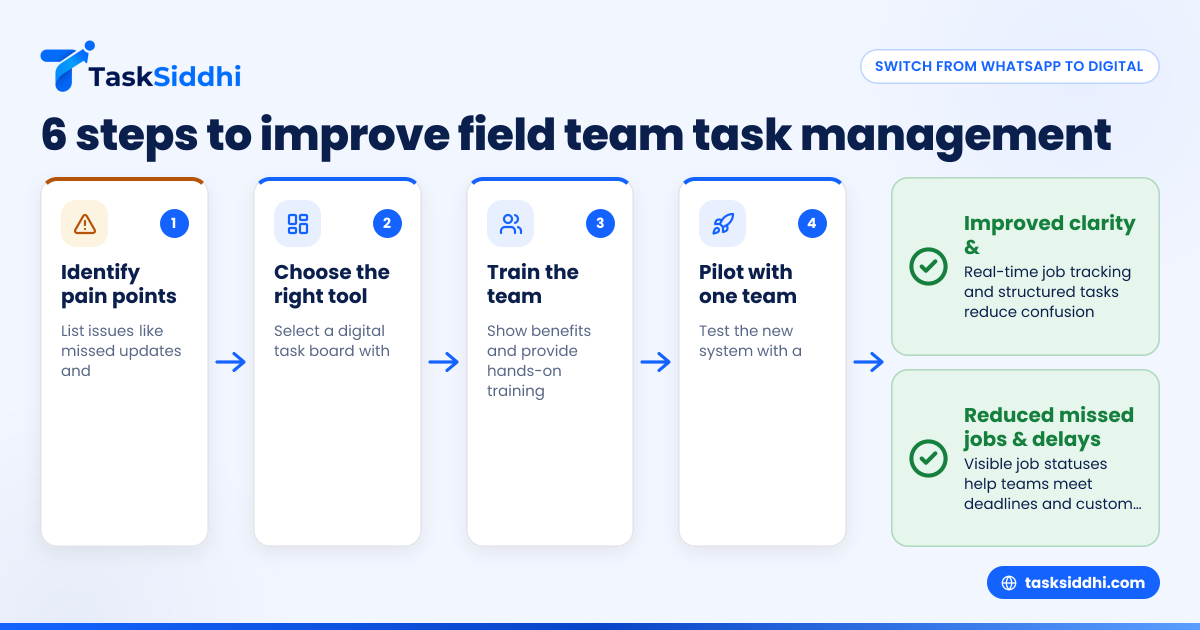
The key is step-by-step adoption:
- Identify pain points: List issues caused by WhatsApp, such as missed updates or lost job cards.
- Choose the right tool: Pick a solution tailored for field work with mobile access.
- Train the team: Demonstrate benefits and provide hands-on training for managers and staff.
- Pilot with one team: Start with a small group to work out kinks before company-wide rollout.
- Set clear processes: Define how job cards are created, assigned, and updated.
- Monitor and adjust: Use reporting to spot adoption issues and improve.
How does AI field team management integrate with standard US business systems?
AI-powered platforms often provide APIs or native integrations with common business tools like QuickBooks for accounting, Stripe for payments, and ERP systems used in manufacturing. This integration eliminates duplicate data entry, speeds up invoicing, and improves compliance.
For example, when a service job is marked complete on the digital board, the billing details can automatically sync with QuickBooks, helping businesses in New York avoid delays and human errors in invoicing.
What counting steps help optimize field team work using digital boards?
Tracking and managing field teams can improve through these steps:
- Create job cards: Each field task gets a card with all required info.
- Assign tasks: Managers assign staff by skill, location, or availability.
- Track progress: Workers update status during the job.
- Collect proof: Photos, customer signatures, or notes are attached to job cards.
- Record time: Time tracking helps verify hours billed.
- Review reports: Managers analyze daily and weekly reports to improve operations.
How can automation reduce manual work in field team task management?
Automation rules can send reminders when a job is overdue, notify the next technician if a task is reassigned, or update customers when visits are scheduled or completed. This reduces reliance on phone calls and texts, freeing managers for higher-value tasks.
In San Francisco, a commercial cleaning business using these automations improved client communication and reduced missed appointments by 25%.
Summary: the benefits of switching from WhatsApp to digital boards
Digital task boards help US field teams gain control and transparency over their jobs. They replace chaotic chat threads with structured job cards, real-time updates, and powerful reporting. Mobile apps keep field workers connected anytime, ensuring faster problem resolution and better customer satisfaction. Additionally, AI tools and automation streamline operations and enable informed decisions.
For any US business running field operations, this means less time spent chasing updates and more time delivering quality service.
See how digital boards work in practice for your team with a product tour or compare plans and features at pricing.
Frequently asked questions
What is field team task management?
Field team task management organizes, tracks, and coordinates all work done by employees working outside the office. It ensures timely job completion with real-time communication, resource allocation, and accountability.
How can AI help manage field teams better?
AI analyzes data from field tasks to predict workload trends, optimize routes, and allocate resources effectively. It helps managers plan proactively, reduce costs, and improve service quality.
Why are WhatsApp groups not ideal for task management?
WhatsApp lacks structured task organization, leading to missed updates, lost information, and no tracking of job progress. It works for quick chats but not for managing multiple ongoing jobs.
Do I need a special app on phones for digital task boards?
Yes, most digital boards offer mobile apps that let field staff receive and update tasks from their smartphones, even offline. This mobile access is crucial for timely communication and accuracy.
Can digital boards integrate with accounting software like QuickBooks?
Many digital task management tools provide integration with QuickBooks and other accounting platforms to automate billing and financial workflow, saving time and preventing errors.
How difficult is it to switch from WhatsApp to digital boards?
The switch requires selecting a suitable platform, training teams, and gradually transitioning workflows. Starting with a pilot project minimizes disruption and helps gather feedback for improvement.