














Field team task management is essential for US service businesses to complete jobs on time. It helps coordinate schedules, track jobs, collect proof of work, and communicate clearly between office and field staff. Optimizing these processes boosts productivity, improves customer satisfaction, and reduces costly delays.
Key takeaways
- Effective field team task management streamlines job scheduling, communication, and documentation.
- Clear job cards and mobile access ensure field teams stay focused and informed.
- Time tracking and proof of work reduce disputes and improve billing accuracy.
- Automation and AI field team tools speed up repetitive tasks and optimize routes.
- Regular reporting highlights bottlenecks and helps managers make data-driven decisions.
- US businesses should comply with local regulations like CAN-SPAM and TCPA in communications.
Why is field team task management crucial for US service businesses?
Managing teams in the field is challenging when relying on WhatsApp groups, Excel sheets, or paper job cards. These methods often cause missed updates, unclear instructions, and lost information. For companies providing services in cities like Chicago, Houston, or Detroit, delayed or incomplete jobs can hurt customer trust and revenue.
Field team task management centralizes all task assignments, status updates, and job details in one system. It lets supervisors assign tasks accurately with all necessary information, including customer locations, exact job requirements, materials needed, and expected completion times. This clarity reduces confusion and miscommunication.
With proper tools, field workers can see their job lists on mobile devices, get directions, upload proofs like photos or signatures, and mark tasks complete in real time. Managers get instant visibility into progress and can quickly intervene if problems arise. This workflow helps maximize first-time completion rates, which is vital in the competitive US service market.
How can AI improve field team task management?
AI field team software uses machine learning and automation to optimize task distribution, route planning, and workload balancing. It analyzes past job data to predict how long tasks will take and assigns jobs to the right field workers based on their skills and availability. It can also generate reminders and alerts automatically.
By reducing manual scheduling and guesswork, AI helps managers focus on higher-value work and ensures field teams operate efficiently. For example, AI can create optimized daily routes that save fuel and travel time, crucial for businesses with many site visits across sprawling metropolitan areas like Dallas or Atlanta.
AI-powered chatbots can also help field workers get quick answers to common questions without calling the office. Overall, AI tools increase on-time job completion and job quality while lowering operational costs.
What are best practices to ensure on-time completion of field jobs?
The single biggest factor affecting on-time job completion is clear task management supported by mobile technology. Here are concrete steps for service businesses to improve performance:
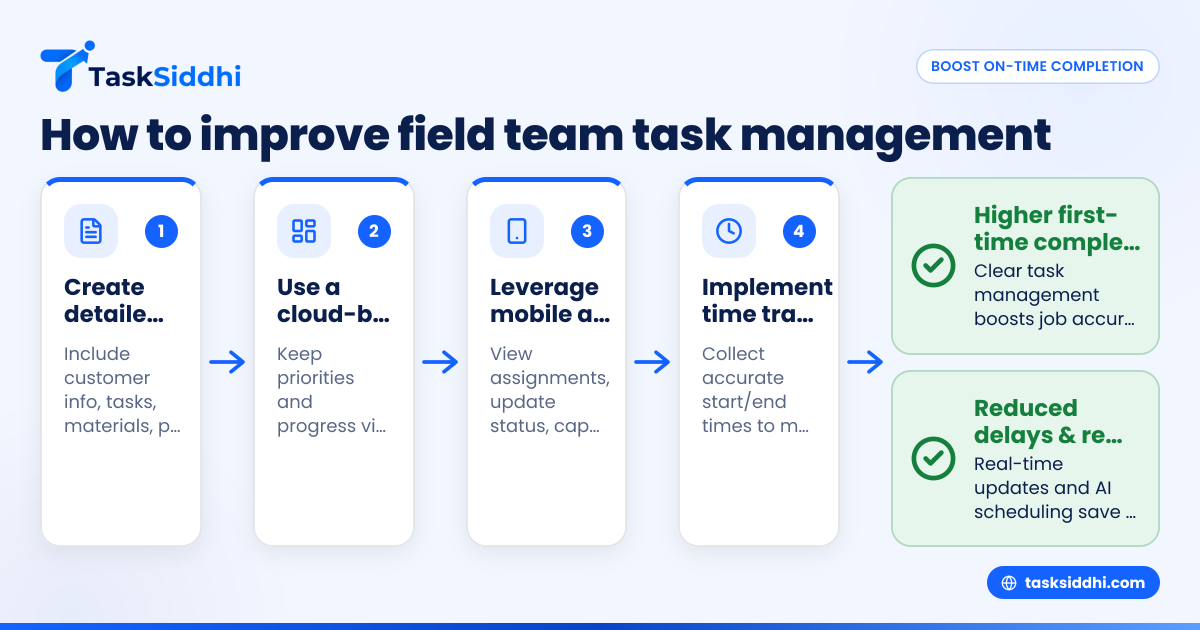
- Create detailed job cards: Include customer info, full task description, required materials, photos, and deadlines. This reduces back-and-forth questions.
- Use a cloud-based task board: A digital board accessible by both managers and field staff keeps priorities and progress visible to all.
- Leverage mobile apps: Let field workers view assignments, update status, capture proof (photos, signatures), and track time on their phones.
- Implement time tracking: Collect accurate data on start/end times to measure productivity and support billing accuracy.
- Automate notifications: Send reminders for upcoming jobs and alerts if tasks fall behind schedule.
- Review performance regularly: Use reports to identify bottlenecks, missed deadlines, and areas needing training.
Following these practices creates transparency, accountability, and agility in field operations.
How does AI field team scheduling work?
AI field team scheduling automatically assigns and sequences jobs based on real-time data such as employee skills, location, and job urgency. It evaluates historical completion times and travel distances to optimize daily routes.
This means fewer manual adjustments and better adherence to schedules, which lowers overtime and fuel expenses. AI scheduling can adapt dynamically if a job is delayed or canceled, re-optimizing routes and notifying affected employees immediately. This flexibility is critical in fast-paced US service industries like HVAC repair or pest control.
What are common challenges when managing field team tasks, and how can I overcome them?
The most frequent challenges are poor communication, unclear instructions, and lack of real-time updates. These frequently lead to missed appointments, rework, and unhappy customers.
To overcome these hurdles:
- Replace WhatsApp groups and paper job cards with centralized digital task boards.
- Provide mobile apps that allow field workers to update job status instantly.
- Use job cards with consistent templates to avoid missing key info.
- Train your team on communication protocols respecting local laws like TCPA for calling clients.
- Implement time tracking and proof-of-work deposits to verify job completion.
Combining the above reduces inefficiencies and builds customer confidence.
How can reporting help improve field team task management?
Regular reporting on field activities gives managers actionable data on job completion rates, average job durations, travel times, and worker productivity. It highlights patterns such as frequent delays in certain neighborhoods or recurring task types that need extra resources.
With these insights, businesses can:
- Adjust manpower allocation per region or service type.
- Identify training needs to speed up specific jobs.
- Spot opportunities to automate repetitive steps.
- Validate SLA adherence for contracts.
Using software with strong reporting features helps drive continuous improvement. Some solutions integrate with QuickBooks and other finance tools, linking operational data with invoicing.
Why is mobile access important for field teams?
A mobile app empowers field workers with immediate access to all job details, customer contacts, navigation, and proof upload capabilities. It eliminates the need for constant calls back to the office and paperwork.
For example, a plumber in Detroit can check route changes on the app, update job status once repairs finish, and upload photos of the completed work. The office receives instant confirmation and can schedule follow-ups if required.
Mobile access also allows better time tracking, helping managers assess on-site vs. travel time. This on-the-go efficiency directly contributes to higher on-time job completion rates.
What compliance issues should US service businesses consider in field team task management?
In the US, businesses must comply with laws such as:
- CAN-SPAM Act: For email marketing and automated notifications, ensuring opt-out options and truthful sender info.
- Telephone Consumer Protection Act (TCPA): Governs phone call and text marketing, restricting unsolicited messages.
When setting up automated reminders or customer communications, businesses should follow these laws to avoid penalties. Also, collecting customer signatures or proof of service must respect privacy and data security standards.
Proper task management software helps enforce compliance by keeping communication logs and managing consent preferences.
How do I get started improving my field team task management?
Start with assessing where your biggest pain points are: Is it inconsistent scheduling, poor communication, paperwork delays, or time tracking? Next:
- Choose a digital platform with a mobile app suitable for field teams.
- Digitize your job cards and build detailed task templates.
- Train your team on the new system to ensure adoption.
- Set up automated notifications and collect proof of work.
- Use regular reports to monitor progress and adjust workflows.
Adopting these steps gradually will build better habits and yield faster on-time completion.
Improving your field team task management can significantly reduce job delays and boost customer satisfaction. See how it works on our product tour or compare plans at pricing to find the best fit for your US service business.
Frequently asked questions
What is field team task management?
Field team task management organizes and tracks tasks assigned to mobile workers. It ensures clear job instructions, real-time updates, and accountability for on-time job completion.
How can AI help field service teams?
AI helps by automatically scheduling tasks, optimizing routes, balancing workloads, and sending reminders. It reduces manual effort and improves overall efficiency.
Why is proof of work important?
Proof of work, like photos or signatures, verifies job completion and protects against billing disputes. It builds customer trust and supports accurate invoicing.
Can I use Excel or WhatsApp for field team task management?
While common, Excel and WhatsApp often lead to lost info and miscommunication. Dedicated task management software offers better organization, reporting, and mobile accessibility.
How do I ensure compliance with US laws in field communications?
Follow CAN-SPAM for email and TCPA for calls/texts. Use opt-in consent, respect do-not-call lists, and keep logs of communications to avoid penalties.
What features should a field task management app have?
Look for mobile apps, detailed job cards, time tracking, proof collection, automated notifications, AI scheduling, and reporting tools to maximize on-time job completion.