














Creating airtight site visit proof is essential for US small field teams to verify work done, maintain client trust, and streamline billing. Mobile check-ins paired with GPS tracking provide reliable, real-time validation of site visits, minimizing disputes and boosting accountability.
Key takeaways
- Site visit proof confirms the time, location, and work done during field visits.
- Mobile check-ins using GPS ensure accurate, timestamped records for each visit.
- Real-time data collection reduces paperwork and errors for small teams.
- AI site visit tools can automate proof collection and reporting for better insights.
- Legal compliance and client transparency improve with digital check-ins.
- TaskSiddhi’s mobile app and time tracking turn site visit proof into actionable data.
What is site visit proof and why do field teams need it?
Site visit proof is verified documentation that a field employee visited a client’s location and completed assigned tasks. This proof can include timestamps, GPS coordinates, photos, job notes, and signatures. For US small businesses, this helps avoid billing disputes, supports compliance with contracts, and improves customer satisfaction.
Without proper proof, managers must rely on verbal reports or handwritten logs, which are prone to errors and fraud. Site visit proof is especially important in regulated sectors or when billing is hourly or task-based. Transparent records also simplify reporting and audits.
How can mobile check-ins with GPS create airtight site visit proof?
Mobile check-ins use smartphone apps to record the exact time and GPS location when a field employee arrives at or leaves a job site. These check-ins are automatically timestamped and geo-tagged, providing objective, tamper-evident proof of presence.
Field workers use apps to log start and end times, submit photos, add notes, and even scan QR codes on site. This method eliminates paper job cards or Excel sheets and ensures data is instantly uploaded to a central system. GPS data confirms the visit happened at the right location within acceptable proximity.
Combining check-ins with mobile app features like photo and file attachments makes site visit proof comprehensive. Proof is then available in real-time to managers, enabling quick resolution of any disputes.
How does AI site visit technology improve proof collection?
AI site visit tools analyze captured data such as photos, timestamps, and GPS points to verify job completion automatically. They detect anomalies like incorrect locations, missing check-ins, or inconsistent timestamps.
With AI, small teams can reduce manual oversight and spot potential errors before they affect invoicing or reporting. For example, an AI system might flag a photo that looks staged or a GPS check-in far from the client’s address.
Integrating AI site visit capabilities with simple reporting dashboards saves managers time and increases confidence in site visit data integrity.
What legal and compliance benefits does site visit proof offer?
In the US, accurate site visit proof aids compliance with contractual obligations and billing transparency. It helps ensure invoicing meets audit standards set by clients or regulators. For field teams working in industries like installation, maintenance, or inspection, proof supports liability protection and service level agreements.
Site visit logs with GPS and timestamps also assist in verifying compliance with labor regulations, including hours worked for 1099 contractors. Proper proof mitigates risks of wage disputes and supports fair pay.
Additionally, electronic proof meets record-keeping requirements, which can be critical if disputes escalate to legal claims.
How can my small team start using mobile check-ins and GPS for site visit proof?
Mobile check-ins with GPS provide precise, timestamped proof of visits right from employees’ smartphones. Start by equipping your team with a simple app that tracks location and logs check-in times automatically.
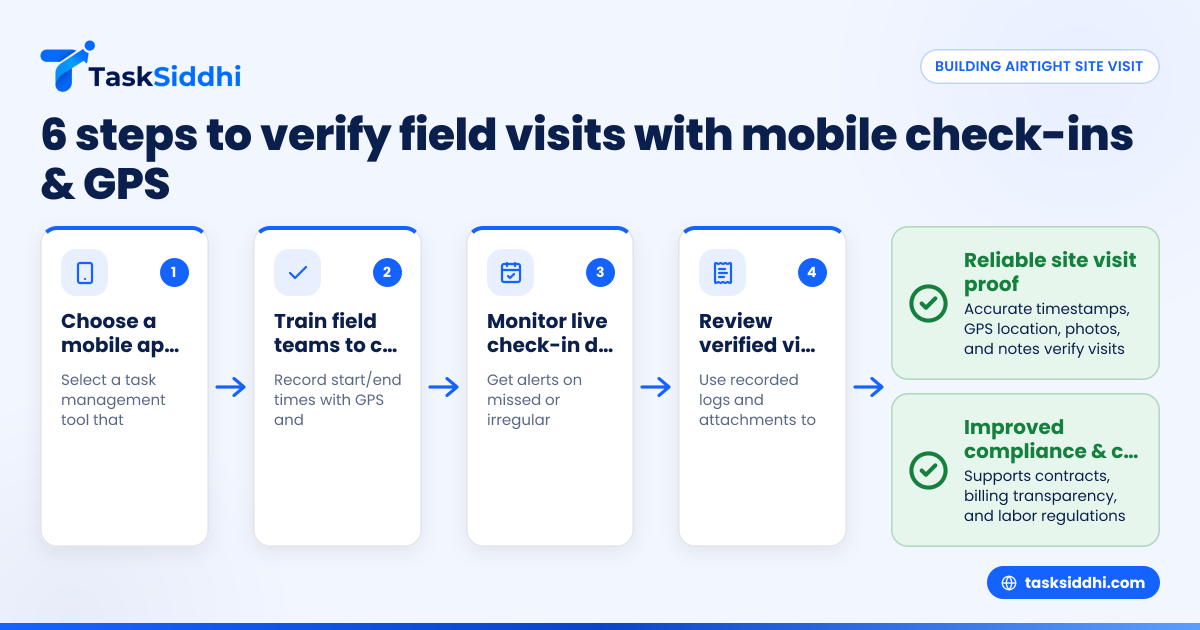
- Choose a task management app with built-in check-in and GPS tracking, like TaskSiddhi.
- Train your field employees to use the mobile app for check-ins at every site visit start and end.
- Customize job cards to include photo uploads, notes, and signature capture.
- Monitor check-in data live from the office with automated alerts for missed or irregular visits.
- Review visit proof during billing and client communications to reduce disputes.
- Use reporting tools to analyze visit frequency, duration, and employee productivity.
Starting with a simple, user-friendly mobile app reduces the burden on small teams and builds reliable site visit records from day one.
How much does mobile-based site visit proof cost small US businesses?
Mobile check-in and GPS proof solutions vary in cost based on features and user numbers. Many small field teams benefit from affordable SaaS apps that charge per user per month, often bundled with task boards and time tracking.
Using software like TaskSiddhi offers cost-effective proof of visits without needing expensive hardware or complex installation. Switching from paper or Excel to a digital system saves money on errors, manual data entry, and client disputes.
Choose a provider that offers free trials or a tiered pricing model so you can test usability and value before committing.
What challenges should small field teams watch for when adopting site visit proof tech?
Adopting site visit proof tech can bring hurdles that small teams should anticipate. Resistance to new tools and privacy concerns top the list, but connectivity and integration also matter.
- Resistance to change: Train workers to use mobile check-ins and stress benefits.
- Connectivity issues: Ensure apps support offline check-ins synced later.
- Privacy concerns: Use GPS only during job hours and respect worker privacy.
- Data security: Verify software encrypts data and complies with US privacy standards.
- Integration: Prefer systems that connect smoothly with QuickBooks or Stripe for billing.
Addressing these issues upfront leads to better adoption and sustainable improvements in site visit proof.
How does site visit proof integrate into billing and client communication?
Having airtight proof enables faster billing cycles and fewer invoice disputes. Managers can share verified work logs, photos, and check-ins with clients to validate charges and maintain transparency.
Proof also improves client satisfaction by demonstrating service quality and timeliness. This documentation supports stronger business relationships and differentiates your team in competitive markets such as Chicago or Houston.
Digital records can even be exported or linked directly to accounting tools, simplifying finance workflows.
Summary
Mobile check-ins with GPS tracking provide US small field teams with effective, reliable site visit proof. Such proof safeguards revenue, ensures compliance, and boosts customer trust. Utilizing AI site visit insights enhances accuracy while easy-to-use mobile apps support everyday field workflows. Small teams ready to shift from paper can start with digital check-ins and leverage tools like TaskSiddhi’s mobile app, time tracking, and reporting.
See how TaskSiddhi works on a product tour or compare plans on our pricing page to find the right fit for your business.
Frequently asked questions
What counts as acceptable site visit proof in the US?
Acceptable proof includes GPS-tagged timestamps, photos of the work done, field notes, and client signatures gathered via mobile apps. The data must be secure, verifiable, and correspond to the actual job location and time.
Can GPS check-ins work if my field team works in low connectivity areas?
Yes, many mobile check-in apps allow offline data capture that syncs automatically once the device regains service. This ensures site visit proof continuity even in rural or spotty coverage zones.
How does site visit proof affect billing disputes?
Detailed proof eliminates guesswork and verbal claims, reducing the frequency and duration of disputes. Managers and clients can review objective logs to confirm what was done and when, speeding up payment approval.
Is it legal to track GPS location of employees during site visits?
Yes, US law permits GPS tracking during scheduled work hours, especially when employees consent as part of company policy. Tracking must be limited to on-duty times to respect privacy rights.
Can AI site visit tools replace manual checks entirely?
While AI enhances accuracy by flagging inconsistencies, human oversight remains important to interpret unusual cases and handle exceptions. AI complements, rather than replaces, good management practices.
How do mobile check-ins improve team accountability?
Mobile check-ins provide transparent, timestamped proof, making it harder for false reporting or no-shows. Knowing visits are verifiable encourages punctuality and diligence among field staff.