














Managing field team tasks means assigning, tracking, and completing jobs outside the office. For small US service businesses, this process ensures jobs are done on time, communication stays clear, and customers are happy. Using software with AI features can make this easier and more efficient.
Key takeaways
- Field team task management deals with organizing jobs done away from the office.
- Common challenges include missed deadlines, poor communication, and lack of work proof.
- AI field team software automates scheduling and improves real-time updates.
- Mobile apps support on-site job cards and accurate time tracking.
- Linking task management to accounting helps track finances and team output.
- Choosing tools made for fieldwork boosts user adoption and results.
What is field team task management?
Field team task management means planning, assigning, and monitoring jobs performed by employees working offsite. It involves scheduling visits, dispatching tasks, collecting proof of completion, and enabling real-time communication. This is key for small US service businesses like HVAC, plumbing, or IT support that handle many client visits daily.
Using apps designed for field teams helps digitize job cards, track job progress live, and keep all data centralized on a dashboard accessible by managers and technicians alike.
Why do small service businesses struggle with field team task management?
Managing field teams with WhatsApp or Excel sheets often leads to problems:
- Important job details get lost in chat threads.
- Scheduling errors cause double bookings or missed visits.
- Paper job cards fail as reliable proof or records.
- Time tracking inaccuracies affect billing and payroll.
- Managers lack live visibility of jobs and team progress.
Since field employees rarely return mid-day, issues often surface only after jobs are incomplete or customers complain.
How can AI field team software improve your workflow?
AI field team software automates tasks like scheduling and route planning based on job priority and locations. It sends reminders and updates to technicians and managers in real time.
By analyzing historical data, AI can estimate job durations and flag conflicts early, allowing your team to reschedule proactively. It can also categorize service requests from messages and assign jobs automatically, reducing errors and saving admin time.
This lets your business focus more on service quality, cutting back on manual task management.
What are common field team task management challenges and how to overcome them?
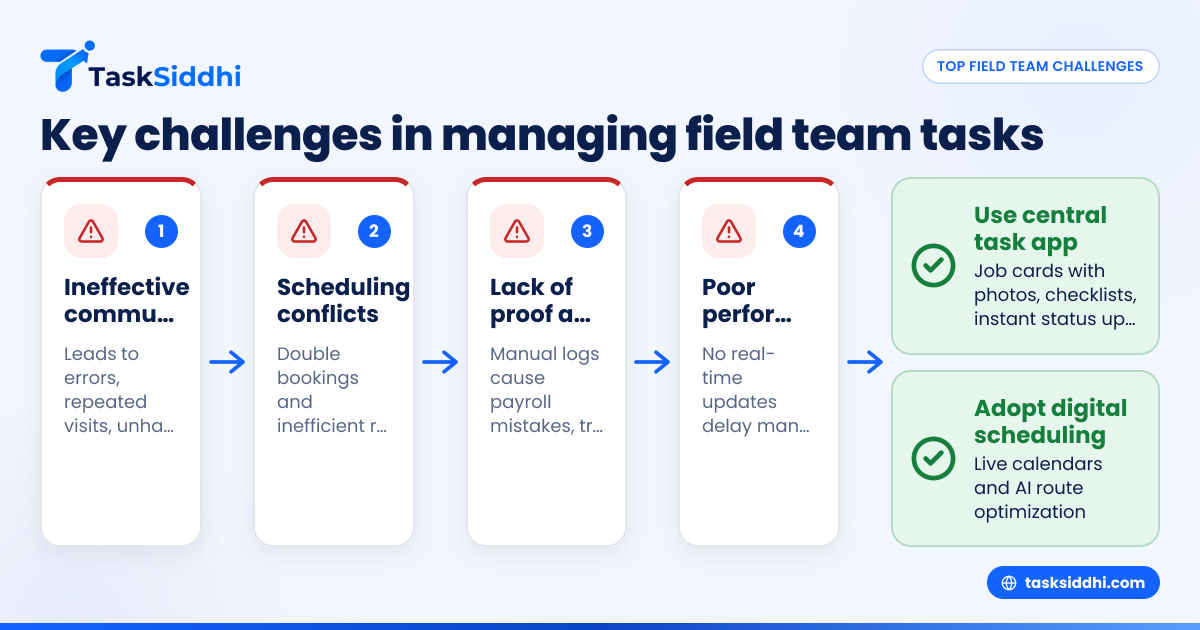
Small service businesses face several challenges managing field tasks. These include missed deadlines, poor communication, scheduling conflicts, incomplete proof of work, difficulty tracking performance, and employee resistance to new tools. Each requires specific strategies to solve.
1. Ineffective communication and instructions
Poor communication leads to errors, repeated visits, and unhappy customers.
Solution: Use a central task management app featuring detailed job cards with photos, checklists, and notes. Mobile apps let technicians update job status and upload proof instantly, alerting managers to problems early.
2. Scheduling conflicts and job overlaps
Double bookings and inefficient routes waste time and fuel.
Solution: Adopt digital scheduling tools that display live calendars and use AI to optimize routes. Integration with Google Calendar or Outlook keeps the whole team synchronized.
3. Lack of accurate time tracking and proof of work
Manual logs can cause payroll mistakes and damage client trust.
Solution: Use mobile apps with timers and photo or signature capture. This creates reliable proof to support invoicing and compliance.
4. Difficulty monitoring team performance and job status
Without real-time updates, managers cannot react quickly to delays or no-shows.
Solution: Choose software offering dashboards with live job progress, late tasks, and technician locations. This aids timely decisions and workforce allocation.
5. Poor integration with billing and accounting
Disjointed processes slow invoicing and increase errors.
Solution: Select solutions that sync with QuickBooks or Stripe, so billing happens automatically after job completion. This improves cash flow and accuracy.
6. Employee resistance to new tools
Technicians accustomed to WhatsApp or paper can resist digital change.
Solution: Provide easy-to-use mobile apps with offline support. Offer training and highlight benefits like fewer errors and faster payments to encourage use.
How do small businesses get started with field team task management software?
Start by listing your main pain points in communication, scheduling, or proof collection. Then evaluate software focused on field service workflows rather than generic task apps. Include your team in selecting features like time tracking and mobile access.
Pilot with a small group, train them fully, and integrate the software with your finance and reporting tools. Monitor results and adjust your processes gradually for best outcomes.
What typical features should a field team task management app include?
A suitable app provides:
- Boards and views for quick job prioritization and monitoring
- Shareable job cards with photos, checklists, and client notes
- Mobile app support, including offline mode for remote sites
- Built-in time tracking with start/stop timers
- Customer communications and proof of visit capture
- Notifications for upcoming or missed deadlines
- Integration with accounting tools and automation like automation
- Dashboards offering insights into team productivity and compliance
These features together reduce admin effort and improve field team efficiency compared to messaging apps or paper workflows.
Why choose a mobile app for your field team?
Mobile apps allow field staff to get job assignments instantly, access updated instructions, and upload status or proof right on site. This cuts down delays caused by phone or text-based updates.
Offline mode is vital for technicians working in low-coverage areas near Detroit or remote Houston. Real-time dashboards let managers reassign jobs quickly if emergencies arise, raising customer satisfaction.
Can AI-powered task boards replace traditional methods entirely?
AI field team tools automate many scheduling and task assignment steps but can't replace human judgment fully. Complex jobs and customer interactions still need personal oversight. Combining AI automation with strong management yields the best results for small US service businesses.
Conclusion
Field team task management is key to running small US service businesses efficiently. Overcoming challenges with dedicated software featuring AI, mobile apps, and accounting integration boosts productivity and customer satisfaction. Whether improving communication or scheduling, the right tools make all the difference.
See how TaskSiddhi helps service teams by taking a product tour or comparing our pricing plans.
Frequently asked questions
What is the best way to track field team time accurately?
Mobile apps with built-in timers let technicians log start and stop times on site easily. This reduces errors and speeds up payroll and billing. Integrations with payroll software ensure accurate wage payments.
How does AI help in field team scheduling?
AI analyzes travel times, job duration, and skills to optimize schedules. It suggests efficient routes and reassigns appointments dynamically, reducing downtime and missed visits.
Can mobile apps work offline during field visits?
Yes, leading field team apps store data locally when offline and sync automatically once connected again. This is critical for jobs in low-coverage or rural areas around Detroit and elsewhere.
How do I ensure my field team adopts new task management software?
Clear communication about benefits, choosing intuitive apps, and good training all support adoption. Focus on easy mobile use and reducing paperwork to encourage everyday use.
Is integration with accounting software important?
Yes, integrating with QuickBooks or Stripe streamlines invoicing and payment collection. It cuts errors and speeds up cash flow by automating job-to-invoice processes.
What kinds of proof of work can field teams capture?
Proof includes photos of completed jobs, client signatures, GPS stamps, and detailed notes. These help handle disputes and maintain professionalism for audits or client questions.