














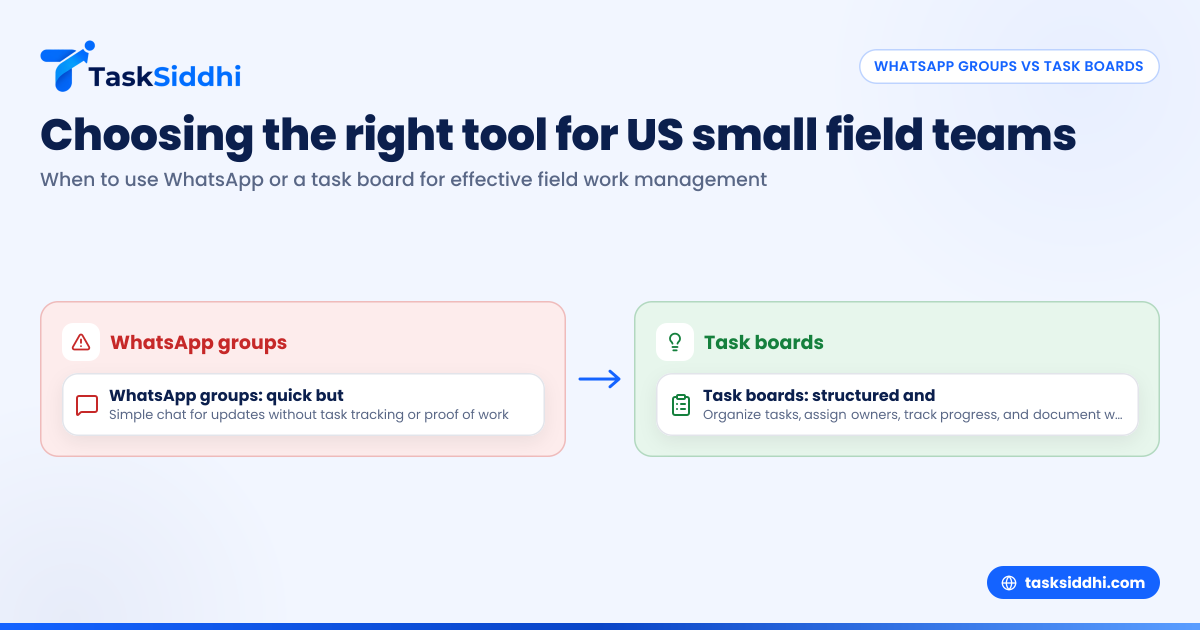
WhatsApp groups are informal chat-based tools often used by small field teams in the US to coordinate work quickly. Task boards, on the other hand, are structured work-management apps designed to organize tasks, track progress, and ensure accountability. Choosing between them depends on your team’s size, workflow complexity, and the need for accountability and reporting.
Key takeaways
- WhatsApp groups are simple and familiar but lack task structure and reporting.
- Task boards provide clear task assignment, status tracking, and documentation.
- For field teams managing multiple jobs or clients, task boards improve visibility and control.
- Integration with time tracking and reporting makes task boards better for billing and compliance.
- AI WhatsApp group features can automate reminders but still don’t replace full task boards.
- Evaluating team workflow and complexity helps decide the right tool for your business.
What are the main differences between WhatsApp group vs task board?
WhatsApp groups are chat platforms designed primarily for communication. Field teams use them to share updates, ask questions, or send photos quickly. However, these messages can get lost in long threads, and there is no official tracking of who does what and when.
Task boards are apps or software designed specifically for work management. They organize tasks as cards or tickets on a board, assign them to team members, track due dates and completion, and maintain a clear history of activities. This creates accountability, reduces confusion, and helps managers stay on top of ongoing work.
Worked example: plumbing business in Detroit
Imagine a plumbing company based in Detroit with 10 technicians. They currently use a WhatsApp group to assign daily jobs, sending informal messages about client details and job updates. While this works for quick coordination, several problems arise:
- Job instructions get buried under chat messages.
- No clear accountability on who is doing which job.
- Missing customer details or photos of completed repairs.
- Difficulty proving work done when billing commercial clients.
Switching to a task board allows the dispatcher to assign each plumbing job as a card with specific customer notes, address, due time, and priority. The assigned technician can update the job status, upload photos of completed work, and even record the time spent. This data is all stored centrally and easily accessible for reporting or billing. The whole team benefits from clear task ownership and documented progress.
How does AI WhatsApp group support compare to task boards?
Some AI tools enhance WhatsApp groups by automating reminders, sending chatbot responses, or flagging unread messages. They help reduce missed follow-ups and improve responsiveness in chats.
However, AI features remain limited to the chat format:
- They cannot enforce task assignments or track progress clearly.
- Documentation and proof of work are still scattered in messages.
- Reporting and analytics are minimal or nonexistent.
Task boards integrate these capabilities directly into work processes. Reminders, alerts, and due-date notifications come linked with task status updates. You get timelines of work, proof uploads, and comprehensive reports. For teams that handle multiple simultaneous jobs, customer service, or billing needs, task boards offer a far better experience.
When should US field teams use a WhatsApp group?
WhatsApp groups work best for very small teams with simple, informal workflows that do not demand detailed tracking or reporting.
- Teams of fewer than 5 people.
- Single-project or single-site operations.
- Casual day-to-day communication with minimal administrative overhead.
For example, a landscaping crew in Houston managing just one or two jobs a day might find WhatsApp groups sufficient for quick status checks, sharing photos, and occasional calls. No one spends time sorting through complex workflows or records.
Pitfall: increasing workload or complexity
If your crew starts handling multiple clients or job types, or if billing and compliance need official records, WhatsApp quickly becomes a liability. Message threads become chaotic. Tasks get missed, or details lost. This leads to delays, errors, and frustrated customers.
Why do growing teams in the US switch from WhatsApp groups to task boards?
Business growth and workflow complexity highlight several shortcomings of WhatsApp groups:
- Lack of task clarity
Messages come as a continuous stream, and it’s hard to identify who owns which task or its priority level.
- No work history or documentation
Critical job details, instructions, and customer communications get buried or deleted over time, making retracing steps difficult.
- Limited proof of work
You can share photos or signatures in WhatsApp, but organizing these as job proofs or compliance evidence is cumbersome.
- No time tracking or analytics
Billing, payroll, or managing labor costs requires detailed time tracking that WhatsApp can’t provide.
- Difficulty managing multiple projects or clients
There’s no way to filter, categorize, or run reports on specific jobs or customers.
Example: home health care provider in Chicago
A home health care company managing multiple caregivers must maintain detailed visit logs, including timestamps and care notes, to bill Medicare or Medicaid properly. WhatsApp groups cannot produce reliable, auditable records or support administrative oversight. A task board with time tracking and reporting features enables supervisors to assign visits clearly, monitor completion, and generate reports needed for billing and regulatory compliance.
What are the key advantages of task boards for US field teams?
- Structured task management
Tasks are created as cards or tickets with clear ownership, priority, due dates, and instructions.
- Enhanced accountability
Every update ties to a specific task and team member, reducing confusion or missed work.
- Proof of completion
Technicians can upload photos, files, signatures, or notes directly to each task.
- Integration with billing and payroll
Time tracking on tasks supports accurate invoicing, pay calculations, and labor cost control.
- Improved communication
Task comments and alerts cut down noise compared to general chat, focusing conversations on action items.
- Remote and mobile access
Field workers can update tasks from their phones, reducing delays and enabling real-time progress tracking.
- Scalability
Works smoothly as teams grow, clientele diversifies, or workflows become more complex.
Detailed example: pest control company in Detroit
A pest control business managing multiple daily client visits needs to schedule technicians, update job statuses, track attendance and time on site, and generate client reports. Using a task board, dispatchers can create separate boards for different teams or job types, assign tasks, attach client instructions, and set reminders. Technicians use a mobile app to mark job stages, capture photos of treated areas, and log time. Managers get instant visibility on which jobs are done, pending, or delayed, enabling better resource allocation and client communication.
How do I choose the right tool — WhatsApp group vs task board?
Choosing depends heavily on your team size, workflow complexity, and regulatory or billing requirements.
- Assess team size and complexity
Teams under 5 with simple daily tasks might find WhatsApp enough. Larger teams or multiple concurrent jobs need more structure.
- Evaluate accountability needs
If task ownership, prioritization, or status tracking is important, a task board delivers clarity.
- Consider compliance and billing requirements
US businesses often need to prove work completion and maintain records for invoicing, taxes, or regulatory audits.
- Determine reporting needs
Want insights into job completion rates, team productivity, or client history? Task boards provide these metrics.
- Look at future growth potential
If you expect your workload or team to grow, task boards scale and integrate automated features to handle increasing complexity.
Pitfalls to avoid
- Jumping to a complex software with unnecessary features can overwhelm small teams.
- Sticking to WhatsApp past the point where task tracking is needed risks costly errors or missed deadlines.
- Lack of initial training or workflow redesign will limit benefits from task board adoption.
Proper assessment and selection ensure a solution that fits your current needs and supports growth.
How can TaskSiddhi help with task boards for US field teams?
TaskSiddhi specializes in task boards and work management tailored for field and service teams. You can assign tasks, track time, capture site visit proofs like photos and signatures, and generate reports from a single platform. It is built to handle client visits, service jobs, and multi-site fieldwork common in cities like Houston, Chicago, or Detroit.
Key benefits include:
- A powerful mobile app for technicians to update jobs on the go.
- Automated notifications and reminders to reduce manual follow-ups.
- Boards and views that help segment work by team, client, or job type.
- Integrated time tracking and reporting for billing and payroll support.
- Automation tools to streamline repetitive tasks.
By switching from WhatsApp groups to a dedicated task board like TaskSiddhi, your team gains transparency, accountability, and efficiency, helping you grow without chaos.
See how it works on a product tour or compare plans on our pricing page to find what fits your business.
Frequently asked questions
Can I keep WhatsApp groups after adopting a task board?
Yes, many teams continue to use WhatsApp for informal quick messages and immediate chat, while relying on task boards for structured job management, documentation, and accountability. The two can complement each other if roles are clear.
Are task boards difficult to set up for small teams?
Not really. Modern task boards like TaskSiddhi are designed for quick setup without complex IT support. Usually, small teams can start using core features within a day or two, with minimal training.
Can task boards help with invoicing and payroll?
Yes. When combined with time tracking, task boards provide accurate labor hour data and job completion records. Managers can generate reports that feed into invoicing software like QuickBooks or payroll systems.
What if my team primarily communicates by phone or SMS?
Most task boards support notifications by phone or email, ensuring critical updates reach your team even if chat apps like WhatsApp aren’t their primary mode. This keeps work organized and data centralized beyond calls or texts.
Do task boards comply with US business laws and regulations?
While task boards themselves are tools, they help you maintain proper documentation, time logs, and proof of work needed for tax, labor, or contract compliance under US laws. Always ensure any data handling respects privacy regulations and industry-specific rules like TCPA or CAN-SPAM as applicable.
For US-based small field teams, moving beyond WhatsApp groups to a task board helps you stay organized, accountable, and scalable. See the full capabilities for yourself on a product tour or find the right match on our pricing page.