














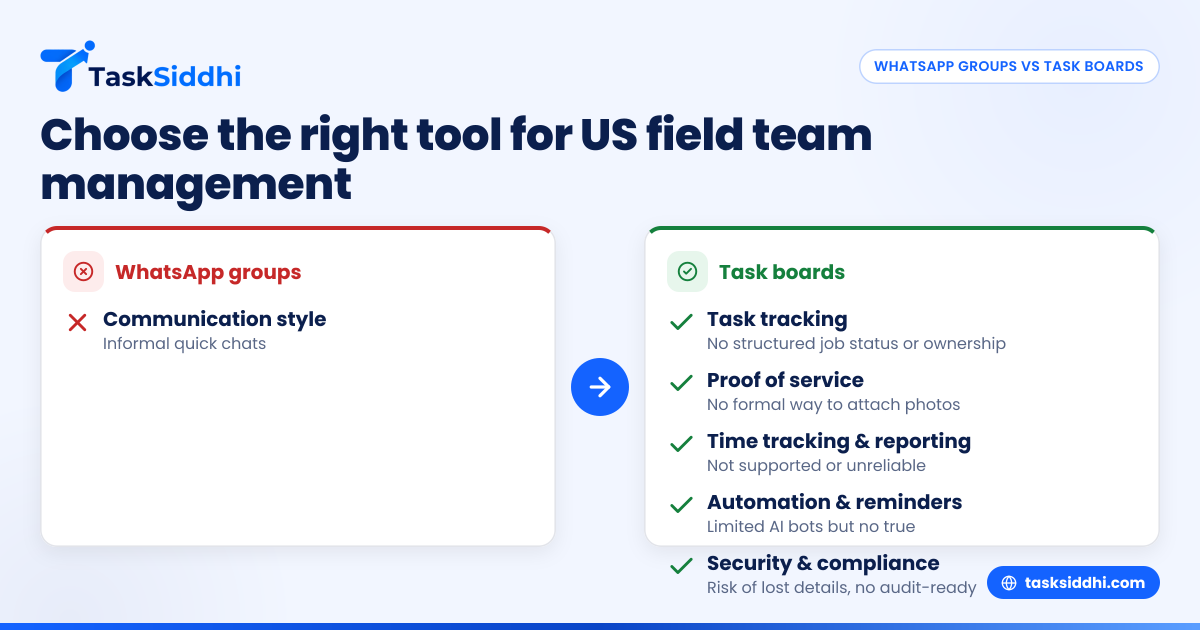
Choosing between WhatsApp groups and task boards for managing US field teams can dramatically impact your business’s efficiency. WhatsApp groups are familiar and quick for messaging but lack structured task tracking. Task boards offer clear job status, deadlines, and proof of work, vital for field teams handling client visits, service jobs, or deadlines in American cities.
Key takeaways
- WhatsApp groups are informal and good for quick chats but poor for detailed task management and reporting.
- Task boards improve organization, with clear job cards, deadlines, and progress tracking.
- Proof of service, time tracking, and reporting are easier with task boards than WhatsApp groups.
- AI WhatsApp group tools exist, but they don’t replace the task clarity and history logs needed for field teams.
- Many US field businesses benefit from switching to tools that integrate job cards and time tracking, like TaskSiddhi.
- Choosing the right tool can affect compliance, billing, and team productivity, especially for businesses in cities like Chicago or Houston.
What are the limitations of WhatsApp groups for managing field teams?
WhatsApp groups are very popular among small US businesses for quick communication, especially for teams running out of Chicago, Detroit, or other cities. Many team owners use them because the app is free, easy to access on mobile phones, and supports instant messaging, voice notes, photos, and location sharing.
However, when it comes to managing field visits or service jobs, WhatsApp groups often fall short:
- Lack of structured task management: WhatsApp chats are endless streams and it’s easy to lose track of job details or deadlines.
- No clear ownership or status updates: It’s hard to identify which jobs are assigned to whom and which are done, ongoing, or delayed.
- No formal proof or documentation: While photos can be shared, there’s no standardized way to attach these to specific job cards or client visits for invoicing or dispute resolution.
- Limited reporting: Business owners cannot generate reliable reports on team performance or time spent on client jobs.
- Security and compliance issues: Using AI WhatsApp group bots may help filter or respond automatically, but sensitive job details can still get lost or mismanaged, raising concerns for state sales tax records or billing audits.
These gaps often lead US field teams to maintain parallel spreadsheets or paper notes—which adds complexity, errors, and time wastage.
How does a task board improve field team management?
Using a task board helps organize work visually and systematically by creating “job cards” or tasks that are assigned, tracked, and completed transparently.
Task boards designed for US field or client work teams bring key advantages:
- Visual tracking: Boards display jobs grouped by status (To Do, In Progress, Completed), helping managers and teams quickly see priorities and bottlenecks.
- Clear ownership: Each job card has a designated team member responsible, preventing confusion.
- Proof and compliance: Photos, client signatures, or site visit proofs attach directly to jobs, critical for billing, state tax compliance, and 1099 tracking.
- Time tracking: Easy start/stop timers link labor hours to each job, streamlining payroll and reporting.
- Reports: Businesses can generate reports on job completion, idle times, or customer visits, enabling better insight into workforce productivity.
- Automation: Alerts, reminders, and templates keep tasks on schedule and reduce manual follow-ups.
US businesses across service sectors—from HVAC installers in Houston to consulting teams in Detroit—rely on task boards to maintain order and customer satisfaction while ensuring audit-ready records. Tools like TaskSiddhi offer mobile apps for field workers, enabling data capture onsite without switching apps.
Should I upgrade from WhatsApp groups to a task board?
Many US team owners wonder if they need to switch fully or add a new tool alongside WhatsApp.
Upgrading means better structure and control, but it can feel daunting to retrain:
- If you manage fewer than five people and mostly share quick updates, WhatsApp groups might be enough.
- Once your field team grows beyond 10-15 members or you run multiple daily jobs, task boards reduce confusion, errors, and micromanagement.
- A task board complements WhatsApp, not necessarily replaces it. You can keep WhatsApp for chat and use task boards for tracking and reporting.
- Time invested in setup and training pays off quickly with fewer missed deadlines, clearer workflows, and more accurate invoicing.
In the US, companies benefit from task boards especially when clients expect proof of work or when managing compliance with state laws. Task boards reduce risks of missed billing or payroll mistakes, essential for smooth operations in competitive markets.
Can AI WhatsApp group tools replace a task board?
AI tools for WhatsApp groups claim they can automate responses, schedule reminders, or extract simple data. This helps teams handle repetitive questions or organize some messages, but it does not substitute full task management.
AI WhatsApp group features may assist in filtering conversations or prompting team members about pending tasks, but:
- They don’t provide job cards with detailed checklists or proof uploading.
- They lack formal time tracking or integrated reporting.
- They can’t link photos or client signatures to specific visits or jobs for billing or audits.
- AI bots in WhatsApp are limited by WhatsApp’s messaging platform constraints.
Therefore, AI WhatsApp group bots complement but cannot replace dedicated task boards for field team management in US businesses.
What key features should I look for in task board software for US field teams?
When choosing a task board for managing a US-based field team, consider these features:
- Mobile app support: Field workers need to update job progress, upload photos, and log times on the go.
- Proof of service: Ability to capture onsite photos, signatures, or forms linked to each job.
- Time tracking: Inbuilt timers or integrations for tracking labor hours for payroll and billing.
- Customizable job cards: Add checklists, due dates, and client details to organize tasks fully.
- Reporting: Generate clear performance reports for invoicing, sales tax audits, or operational reviews.
- Automation: Automated alerts, SLA reminders, follow-ups, or recurring job templates reduce manual work.
- Integrations: Compatibility with tools like QuickBooks or Stripe to simplify invoicing and payments.
- Security: Ensure your platform provides secure data handling to meet US business standards.
A solution like TaskSiddhi addresses these needs with boards and views, time tracking, and reporting features designed especially for US field and client work teams.
How do I transition my team from WhatsApp groups to a task board?
Transitioning takes planning but can be smooth with these steps:
- Assess your needs: Identify daily tasks, job volume, and pain points with WhatsApp groups.
- Demo and select software: Explore platforms focusing on features for field visits, job tracking, and mobile entry.
- Train your team: Offer short training sessions explaining basic features and benefits.
- Start small: Run the task board alongside WhatsApp for a few weeks to build familiarity.
- Set up workflows: Create templates, assign jobs, and define checklists to standardize work.
- Encourage adoption: Use automation to send reminders and reduce manual follow-ups.
- Regular reviews: Check reports weekly to identify bottlenecks and celebrate successes.
Adopting a task board improves clarity, reduces stress, and boosts productivity in US businesses, even if your field teams still chat on WhatsApp.
What are common mistakes when switching to a task board?
Some US businesses struggle by:
- Skipping training and expecting staff to adapt instantly.
- Using task boards only for new jobs, not migrating existing tasks causing confusion.
- Relying solely on email or chat to communicate job changes, instead of the board.
- Failing to customize the board to specific workflows or client types.
- Ignoring time tracking, reducing payroll accuracy or job costing insights.
Avoid these by planning your transition and integrating the task board as the single source of truth for your field operations.
Managing field teams with WhatsApp groups might work initially but often creates chaos as your US business grows. Task boards like TaskSiddhi bring clarity, accountability, and essential features like proof of visit and time tracking to keep teams on track in cities like Chicago, Houston, and Detroit.
Explore how TaskSiddhi works on our product tour page or compare plans to find one that fits your team’s needs on our pricing page.
Frequently asked questions
Can I still use WhatsApp groups after adopting a task board?
Yes. Many teams continue WhatsApp for quick chats but move all job tracking and documentation to the task board. This hybrid approach balances informal communication and formal management.
How does task board time tracking work?
Task boards have built-in timers that employees start when beginning a job and stop on completion. This data helps manage payroll and shows actual time spent on client visits or service jobs.
Is it expensive to switch from WhatsApp to a task board?
Costs vary but task boards are generally affordable and deliver strong ROI through improved efficiency, reduced errors, and faster billing cycles. Check free vs paid options for suitable choices.
What about security and data privacy?
Reputable task boards use encryption and comply with business standards for data protection, which is more secure than informal WhatsApp groups for sensitive job details.
How does task board reporting help my business?
Reports give insights into team performance, job completion times, and client visit proofs. This data supports better decision-making and supports tax audits or client billing disputes with solid records.
Can AI tools in WhatsApp groups fully replace task boards?
No. While AI can automate message handling, full task management requires structured job cards, proof attachments, and detailed reporting that AI WhatsApp group bots can’t provide.