














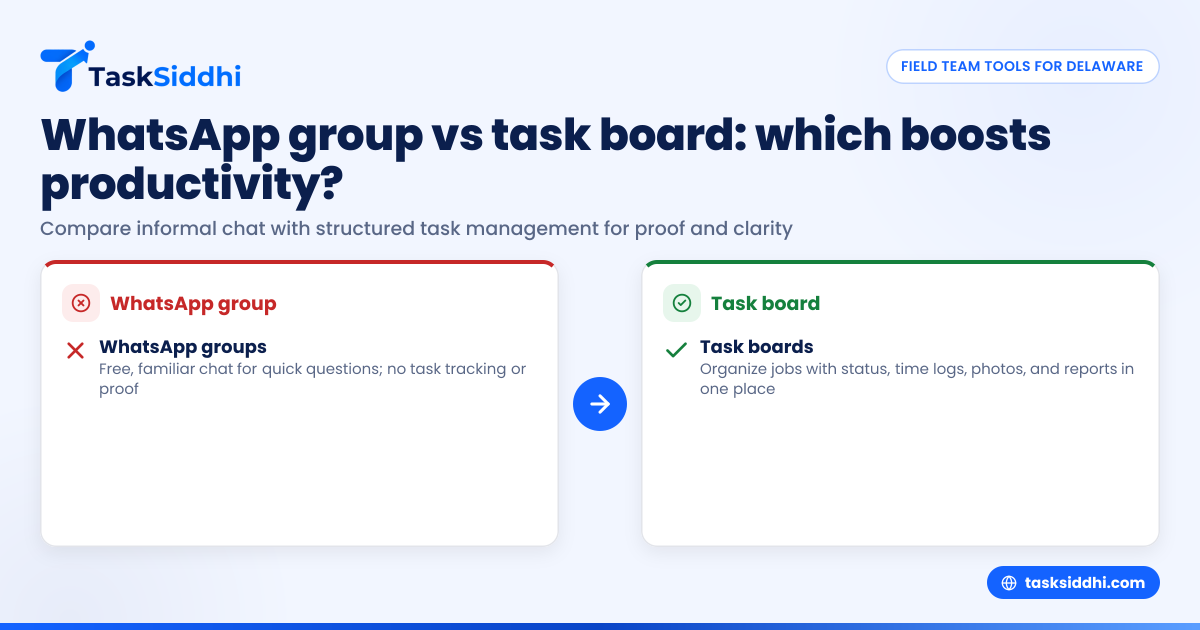
WhatsApp groups are common for quick chats among Delaware field teams, but task boards offer structured job tracking and real-time proof of work. For small businesses managing service or client visits, task boards bring clarity, accountability, and reporting that WhatsApp alone can’t provide.
Key takeaways
- WhatsApp groups are informal, good for immediate chat but weak on task tracking and job proof.
- Task boards organize field visits, service jobs, and client work with job cards, status updates, and proof of completion.
- Delaware businesses benefit from task boards for local compliance, documentation, and time tracking.
- Task boards save time compared to scrolling through long WhatsApp chats for job details.
- Mobile apps for task boards bring WhatsApp-like accessibility with added work management features.
- TaskSiddhi offers tools like time tracking and reporting that support Delaware field teams beyond chat.
Why do Delaware small businesses still use WhatsApp groups for field teams?
WhatsApp is free, widely used, and familiar to nearly every smartphone user, including your Delaware field workers. It works well for rapid questions, quick updates, or sharing photos on the fly. Delaware’s small teams often start with WhatsApp groups because they require no training and support natural, informal communication.
For example, a small HVAC repair business in Wilmington might create a WhatsApp group for its technicians and office staff. When a client calls in, dispatchers instantly share job details, and technicians quickly ask clarifying questions or report issues. The informality feels efficient and immediate.
However, as your business grows beyond 5 to 10 people and your jobs require proof of completion, check-ins, or timelines, WhatsApp groups begin to show their limits. Conversations get lost under endless messages. You have no easy way to verify if a task was done on time or properly. This lack of structure can affect compliance, billing, and customer satisfaction for your Delaware service or client jobs.
For instance, a pest control company in Dover that manages dozens of site visits weekly will struggle to track which jobs are pending, completed, or delayed just by scrolling chats. Missing photos of completed work or incomplete notes can create billing disputes or upset clients.
What are the limits of WhatsApp group communication for field work?
WhatsApp groups do not natively track job progress, assign tasks, or log hours. When your team talks in the group, important updates are buried in the chat history. Managers waste time scrolling to find proof of a completed visit or client approval. Plus, with no standardized job cards or task lists, errors or missed steps more easily happen.
Consider a security services team in Newark using WhatsApp to share daily guard post assignments. If one guard finishes early or faces an issue, the message might get lost as other team members continue chatting. This creates confusion and can cause double-bookings or missed coverage.
Also, from a Delaware small business perspective, keeping work records and proof affects billing accuracy and future disputes. WhatsApp photos and messages can be saved but aren’t organized or searchable in ways that help reporting or audits. For tax purposes, especially managing 1099 contractors or state sales tax compliance, having all job details and time stamps in one place is ideal.
Many teams experiment with “AI WhatsApp group” tools for automating replies or reminders, but these often don’t replace the need for full task management and reporting. Automation limited to chat still relies on unstructured communication and lacks centralized record keeping.
How does a task board improve productivity and proof for small Delaware teams?
A task board is a digital workspace that shows all jobs with clear statuses, assigned team members, deadlines, and documentation in one place. Each service job or client visit becomes a “job card” with details and proof of work photos attached. This organization helps Delaware small businesses avoid lost information and prioritize tasks.
Task boards bring structure and accountability
With a task board, you no longer need to rely on memory or chat logs. Your field teams have a clear list of what to do. Managers see real-time progress updates. This accountability keeps jobs on schedule and lets you verify quality before billing.
For example, a landscaping service in Middletown can create job cards for each client visit. The crew leader assigns workers, adds notes about the site’s conditions, and attaches photos. As workers update the job status from "Scheduled" to "Completed," managers instantly see progress without chasing the team.
Efficient communication without the noise
Teams can still chat or add notes on each job card, replacing endless WhatsApp group noise with focused conversations linked directly to the work. Managers and workers avoid information overload and reduce errors.
Instead of dozens of messages mixing different topics, the communication stays relevant to each task. If a painting contractor in Newark discusses color choices or prep work, these notes live on the job card for that client, not lost in a general chat.
Real-time proof for billing and compliance
Task boards allow attaching photos, signatures, or scanned documents as proof that the job was done according to plan. This helps Delaware businesses during client billing, reducing disputes and justifying charges. It also supports documentation needed for audits.
For example, a pest control technician can upload before and after pictures at the customer site. If the client disputes service, you have timestamps and images to confirm the visit occurred.
Time tracking integration
Accurate time logs linked to each job help Delaware companies comply with labor laws and manage payroll efficiently. Small businesses using 1099 contractors benefit from logging hours cleanly, easing tax filings and contractor management.
What features do Delaware small businesses need from task boards for fieldwork?
When searching for a task board, look for features tailored to your kind of field work in Delaware. Some essentials include:
- Customizable job cards to fit different service or client work, allowing fields like client name, address, materials used, or special instructions.
- Mobile apps so your field team can update jobs onsite without delays.
- Time tracking to log hours per job for accurate billing.
- Photo and document attachments as proof of site visits or completed service.
- Status columns to organize jobs by “Scheduled,” “In Progress,” “Completed.”
- Automated reminders or alerts to follow up on delayed or overdue jobs.
- Reporting options for oversight, billing, and improving team performance.
Step-by-step example: Setting up a task board for a Delaware cleaning company
- Create boards by job type—for example, Residential Cleaning and Commercial Cleaning.
- Build customizable job cards where you add client info, cleaning checklist, and materials used.
- Assign jobs to team members and set due dates.
- Enable photo upload so workers send before and after pictures.
- Add time tracking for staff to record hours spent per job.
- Set status columns so managers see jobs moving from Scheduled to Completed.
- Use automated reminders to alert if a job is not updated within 24 hours.
- Run reports weekly to review completed jobs, billable hours, and client feedback.
This setup helps the Delaware cleaning company avoid missed jobs, improve billing accuracy, and maintain good customer relationships.
WhatsApp group vs task board: what about cost and onboarding time?
WhatsApp is free, making it attractive for very small teams just starting out. Onboarding is zero because it’s familiar. But as your Delaware small business grows, the hidden costs of lost productivity, repeated communication, and billing errors add up.
Task boards usually come with a subscription fee but provide a huge return on investment by reducing miscommunication and boosting workflow efficiency. Many solutions, including TaskSiddhi, offer easy setup and training so your teams can start updating jobs from day one.
Pitfalls to avoid when switching from WhatsApp to task boards
- Rushing adoption without training can frustrate your team. Schedule a short demo and hands-on practice.
- Duplicating work by updating WhatsApp and the task board causes confusion. Choose clear guidelines on what info goes where.
- Not customizing job cards to your specific workflows leads to poor adoption. Tailor fields and statuses to your industry.
- Ignoring mobile usability can slow field updates. Ensure the app works well on phones your team uses.
Proper planning avoids these issues and maximizes the benefits of task boards.
How can Delaware small businesses combine WhatsApp groups and task boards effectively?
You don’t have to ditch WhatsApp completely. Use WhatsApp for quick reach-outs and urgent questions. Meanwhile, manage all formal work tasks, proof, and time tracking on a task board. This hybrid approach plays to the strengths of both tools.
Example workflow combining WhatsApp and task boards
- Dispatch sends new job alerts on WhatsApp for rapid awareness.
- Field workers discuss quick questions or confirm arrival times in WhatsApp.
- All official job details—including scope, deadlines, proof photos, and time logs—are recorded on the task board.
- Managers pull performance reports from the task board and address issues.
- Use task board notifications to remind teams of upcoming deadlines, not WhatsApp messages.
This balanced approach keeps informal chat fast while anchoring all critical work data in a structured system.
How does TaskSiddhi support Delaware field teams better than WhatsApp alone?
TaskSiddhi is built for American small teams doing service and client work, with boards, job cards, field visits, service jobs, and client work features to handle every step. It offers:
- A mobile app designed for on-the-go updates like WhatsApp.
- Real-time time tracking for payroll and billing accuracy.
- Proof collection with photo attachments onsite.
- Streamlined reporting for managers and owners.
- Simple boards and views showing exactly what’s scheduled, in progress, or complete.
- Automation tools to send reminders or notify managers automatically.
For example, a Delaware HVAC repair business using TaskSiddhi can dispatch a technician, track time spent per job, monitor real-time completion, and generate billing reports—all without losing information in chat logs.
This helps Delaware businesses run their field teams with less chaos and better documentation than WhatsApp groups alone.
Frequently asked questions
What is the main difference between WhatsApp group and task board for field teams?
WhatsApp groups are primarily chat tools designed for quick, informal communication. Task boards provide structured task assignment, real-time progress tracking, proof collection like photos and signatures, and detailed reporting, all tailored to managing fieldwork efficiently.
Can small Delaware businesses start with WhatsApp and later switch to a task board?
Yes, many small teams begin with WhatsApp due to its zero cost and ease of use. As their operations grow and require more accountability, time tracking, and proof of work, switching to a task board is a natural next step.
Does TaskSiddhi support mobile updates like WhatsApp?
Absolutely. TaskSiddhi’s mobile app allows field teams to update job progress, attach photos, add notes, and log time directly from the job site, with a user experience comparable to WhatsApp’s simplicity but integrated with work management features.
How does task board proof help with Delaware compliance and billing?
Organized proof of completed work—including time stamps, photos, and client signatures—simplifies billing accuracy and reduces disputes. Proper documentation also supports compliance with Delaware labor laws and helps manage 1099 contractor reporting.
What about training and adoption time for a task board?
Most small Delaware teams find TaskSiddhi intuitive, with a short learning curve. Built-in automation reduces manual follow-ups. With basic onboarding, teams can begin updating jobs on the task board the same day, much faster than manual documentation processes.
For Delaware small business owners ready to boost their field team’s productivity and proof, see how TaskSiddhi works on our product tour or compare plans at pricing. Get the best of chat plus task management in one platform.