














Field team task management is about organising and tracking the daily jobs of service teams working in the field. For small Indian service businesses, WhatsApp groups are common but can get chaotic. Replacing them with digital task boards improves clarity, accountability, and efficiency.
Key takeaways
- WhatsApp groups mix casual chat with work tasks, leading to missed or unclear jobs.
- Digital task boards help visualise, assign, and track field team work clearly.
- Task boards support real-time updates with photos, proof of work, and time tracking.
- Integration with Indian business tools like GST and UPI is seamless with specialised apps.
- Automating task workflows reduces manual follow-ups and errors.
- AI field team tools are emerging that suggest optimal team planning and resource use.
Why do small Indian service businesses rely on WhatsApp for field team task management?
WhatsApp is free, widely used, and simple to set up on smartphones. For small teams in cities like Mumbai or Pune, WhatsApp provides instant messaging for quick coordination. However, because it’s not designed for task management, important jobs get buried under messages, making it hard to track who is doing what and when.
Businesses also use WhatsApp for customer messages, work approval, expense sharing, and even sending photos from site visits. This mixing of roles causes confusion and delays since there is no clear system for updating job status or capturing completion proof.
What problems arise from using WhatsApp groups alone for managing field teams?
While WhatsApp groups keep teams connected, they cause several issues:
- No clear task list or priority view, so jobs get delayed or forgotten.
- Difficult to assign tasks formally to individual team members.
- Lack of proof of work or photos linked directly to tasks.
- Time spent updating managers is high due to repeated follow-ups.
- Disorganized chat history makes referencing past jobs slow.
- No reporting or audit trail for job progress or expenses.
For a Mumbai plumbing service, for example, WhatsApp chats could lead to overlapping site visits or missing service approvals. This affects customer satisfaction and profitability.
How can digital task boards improve field team task management?
Digital task boards provide a visual workspace where every job is a card on a board. Each card shows the job details, status, deadline, and assigned person. Managers and team members can move cards through workflow stages such as “Scheduled,” “In Progress,” and “Completed.”
This method brings immediate clarity on job priorities and progress. For service teams in Bengaluru or Pune, task boards become a single source of truth with real-time updates. They help teams plan visits, allocate jobs evenly, and track time spent per task.
Photos and customer approval signatures can be attached to each card for compliance and quality checks. This simplifies billing and GST invoicing too.
How do AI field team tools enhance task management for small service businesses?
AI field team solutions analyse past task data to suggest better visit routes, predict delays, and optimise team allocation. They save time and reduce costs by minimising travel and wait times.
For example, AI can help a Hyderabad electrical services business cluster jobs in the same area per day. AI-powered automation reminds team members for overdue jobs or escalates delays without manual intervention. This means managers spend less time chasing updates, improving productivity.
What does switching from WhatsApp groups to task boards cost Indian SMBs?
Switching costs depend on the software chosen. Many task board apps offer free plans suitable for small teams of 5-10 people with basic features. Paid plans adding automation, time tracking, reporting, and mobile apps typically start from a few hundred rupees per user per month.
The productivity gains from reduced errors, faster billing, fewer missed jobs, and happier customers often outweigh subscription costs. Small fields teams in cities like Jaipur or Chandigarh can easily cover software costs by getting jobs done more effectively.
how do task boards work day-to-day for field teams?
Task boards work as a daily command centre for jobs:
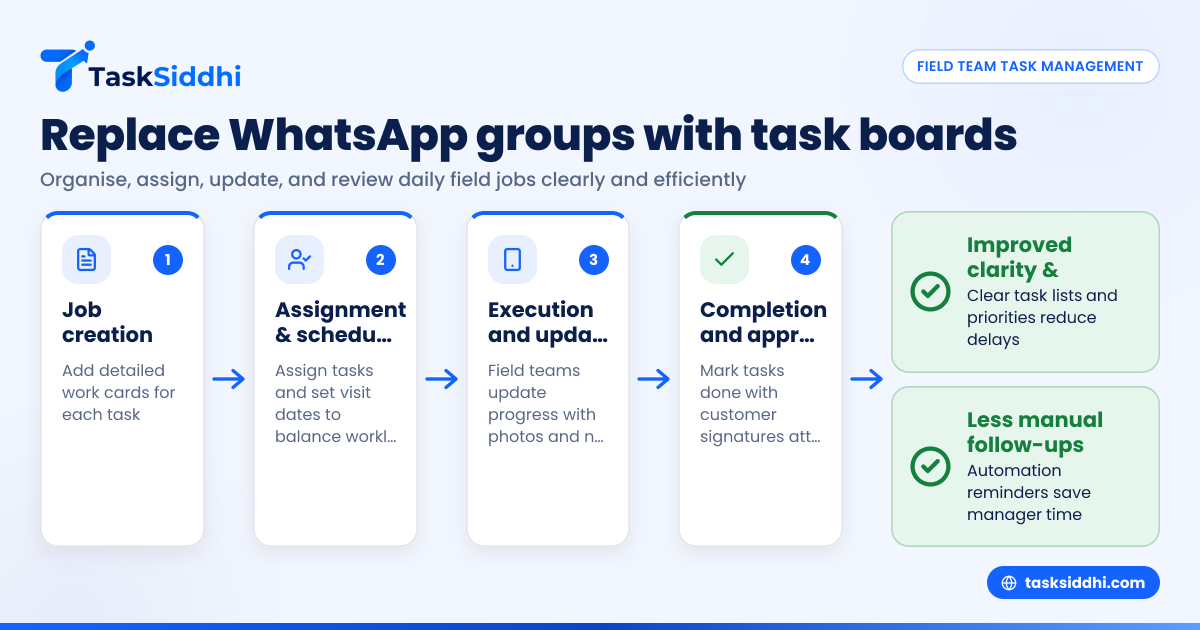
- Job creation: Managers add new service or client work cards with all required details.
- Assignment: Cards are assigned to specific field team members.
- Scheduling: Jobs get dates and times for visits, balanced to avoid workload peaks.
- Execution: Field staff update card progress via mobile app from the site, adding photos or notes.
- Completion: Upon finishing, the card is marked done; customer approval can be attached digitally.
- Review: Managers check reports for job status, time tracking, and billing preparation.
Daily standups or team chats on WhatsApp become focused discussions on specific card issues rather than scattered messages.
What are the essential features to look for in a task board app for Indian service teams?
For Indian small service businesses, look for task boards with:
- Mobile apps with offline support for unreliable network areas.
- Photo upload and GPS tagging on site visits to guard against disputes.
- Time tracking integrated with tasks for accurate billing and payroll.
- Automation workflows to send reminders, update statuses, or escalate delays.
- Simple user interface that works well for teams less familiar with tech.
- Security compliant with India’s DPDP Act 2023 to handle personal data carefully.
- Integration with payment gateways like UPI or Razorpay to streamline collections.
- Support for multiple languages or at least English with Indian date and number formats.
How does the mobile app improve field team task management compared to WhatsApp?
WhatsApp is limited to chat plus simple photo sharing. A mobile app designed for task management provides dedicated fields for job details, status updates, and proof-of-completion attachments. It also works offline to let field agents update jobs even when internet is spotty.
TaskSiddhi’s mobile app, for instance, allows technicians to track time with GPS, upload photos, and fill client feedback onsite. This direct data capture reduces errors from manual notes, paper job cards or relying on memory after visits.
Field managers receive instant notifications of job progress or bottlenecks without sifting through WhatsApp messages. This helps faster decisions and better customer service.
How do automation features reduce manual work in field team task management?
Automation can send automatic reminders before job deadlines, change task status when updates arrive, and escalate overdue jobs to supervisors. This reduces the need for constant manual monitoring.
For an HVAC service company in Pune, using automation can mean fewer last-minute scheduling hassles and less checking-in calls to field teams. TaskSiddhi’s automation enables setting rules that trigger these actions based on task conditions, saving managers hours weekly.
How does digital task board reporting help managers improve business operations?
Reliable data is key for growth. Digital reporting gives managers visibility on task completion times, top performing team members, average delays, and job costs. These insights allow smarter budgeting and planning.
For example, a Mumbai-based pest control firm could identify peak job hours and better allocate teams or negotiate supplier rates from usage data. Reports also help during tax filing and GST compliance by providing accurate job logs and invoices.
How can Indian small businesses get started with field team task management using TaskSiddhi?
Start by listing your common job types and workflows. Then create a simple board for those jobs and invite your team. Gradually move all field task assignments and updates from WhatsApp into the board.
Train your staff on basic use of card creation, updates, and photo attachments with the mobile app. Enable time tracking and automation rules for reminders and reporting.
TaskSiddhi’s flexibility suits teams of 5 to 30 people across India, delivering improvements without heavy upfront costs or complex setups.
See how it works on a product tour or compare pricing and plans at TaskSiddhi pricing.
Frequently asked questions
Can I continue using WhatsApp alongside task boards?
Yes. WhatsApp can still serve for informal discussions and urgent alerts. But for work tracking, all jobs and updates should move to task boards to avoid missed information.
Is the TaskSiddhi app easy for workers with limited smartphone skills?
Absolutely. The interface is simple with minimal clicks and clear fields. Training takes one or two sessions. Offline support means work continues even without full connectivity.
Do I need special devices for photo proof or GPS tracking?
No. Most smartphones used by your team suffice since the app accesses built-in camera and GPS features. No extra hardware needed.
How does task tracking integration improve GST invoicing?
By linking tasks to client records and time logs, GST-compliant bills can be generated faster and with fewer errors in tools like Tally or ERP systems.
What about data privacy with mobile task management in India?
TaskSiddhi complies with the DPDP Act 2023, ensuring personal data is stored and processed securely. You control user access levels within your teams.