














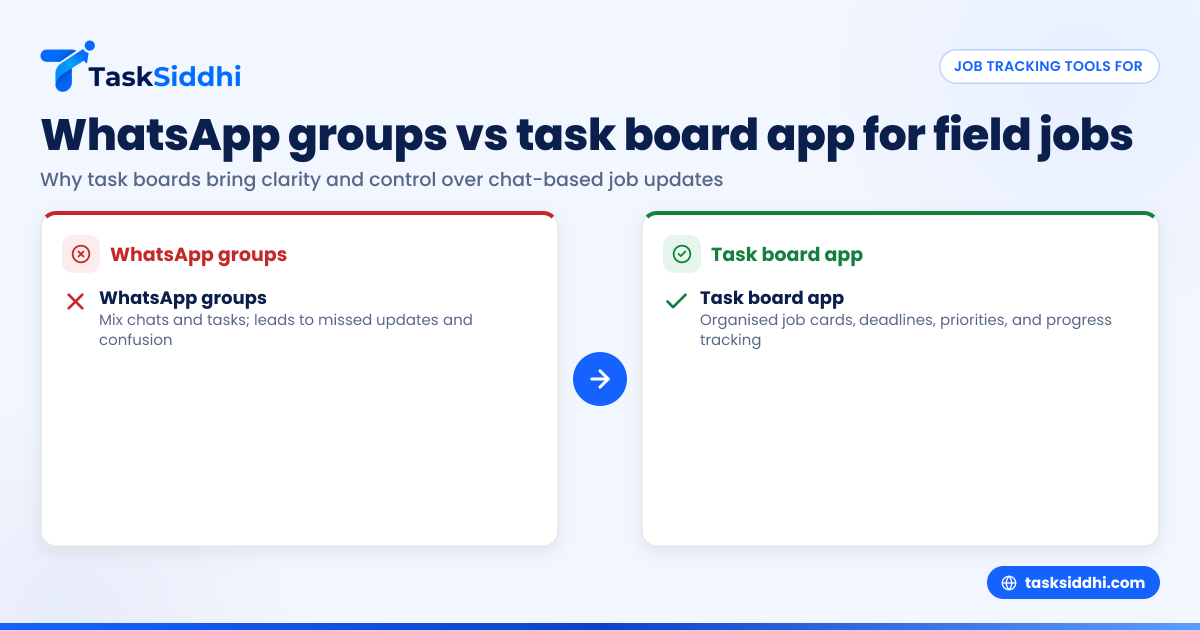
WhatsApp groups are popular for quick team chats, but they fall short as a job-tracking tool for Maharashtra manufacturing field teams. A task board app offers clear job cards, progress tracking, time logs, and proof of site visits, improving accountability, efficiency and reporting.
Key takeaways
- WhatsApp groups mix conversations and tasks, leading to missed job updates and confusion in manufacturing teams.
- Task boards separate work into clear, trackable job cards with deadlines, priorities, and statuses.
- Manufacturing field teams in Maharashtra benefit from mobile task apps that support site visit proof and time tracking.
- Clear job tracking reduces errors, delays, and rework, saving ₹lakhs on daily operations.
- Automation in task boards reduces manual follow-ups compared to chat-based job updates.
- TaskSiddhi’s mobile app supports Indian manufacturers with boards, workflows, and field visit evidence all in one place.
Why are WhatsApp groups used despite their drawbacks?
WhatsApp groups are widespread because they are free, familiar, and easy to set up. Teams share messages, photos, voice notes, and quick status updates. For manufacturers in Pune, Aurangabad, or Nashik, WhatsApp is a low-cost communication tool connecting office and field teams instantly.
However, the same features that make WhatsApp convenient also create problems. Instead of tasks, teams get a jumble of messages. Critical job details are buried or lost in busy chats. There is no way to assign explicit responsibilities or track which jobs are running late or pending approval.
As a result, supervisors spend time replying to repeated questions or chasing updates. Field engineers have no clear view of their daily work priorities. Missing or incomplete job data leads to rework, wasted materials, and unhappy clients.
How does a task board improve job tracking for manufacturing field teams?
A task board is a digital tool that organises and visualises work as individual jobs or tasks. Each job card contains details: description, deadline, assigned person, priority, and status. Instead of searching chats, managers get a clear dashboard showing all jobs by priority or stage.
The benefits for manufacturing teams include:
- Organised job cards with all required info reduce confusion.
- Priority and deadline tracking flags overdue tasks early.
- Assigned responsibilities clarify who owns each job.
- Progress updates keep everyone informed without cluttering a chat with repeated messages.
- Time tracking on jobs allows measuring productivity and optimising resource planning.
- Proof of field visits with photos, GPS or completion notes helps compliance and client trust.
In Maharashtra, manufacturers handling machine servicing, installation, or quality audits spread across Mumbai, Pune, or Nagpur find task boards give direct control over field teams and proper documentation needed for audit or client reports.
What is the difference between “ai whatsapp group” and a task board app?
While AI tools can enhance WhatsApp groups by auto-sorting messages or sending reminders, a chat-based system still lacks a structured task view. AI WhatsApp group features may automate some messaging but do not replace clear, visual job tracking.
Task boards offer integrated workflows designed specifically for work management. TaskSiddhi, for example, helps Indian manufacturing teams organise work with boards and views, set automated alerts with automation, use time tracking for efficiency, and bring field updates directly via the mobile app.
What are the risks of continuing with WhatsApp groups for job tracking?
Relying on WhatsApp groups alone leads to common issues:
- Important job info lost under waves of unrelated chats.
- Confusion over which jobs are pending, completed, or on hold.
- No formal record of work done, causing billing or compliance challenges.
- Difficulty coordinating multiple field teams working across Maharashtra locations.
- Inability to generate reports or analyse team productivity.
- Time wasted chasing colleagues for updates instead of focusing on work.
Such problems cause delays, errors, and operational inefficiency that impact the bottom line. For a manufacturer managing multiple machines, vendors, and clients, WhatsApp group messaging is not enough to ensure reliability or accountability.
How do I switch from WhatsApp group to a task board for my manufacturing team?
Transitioning is simpler with a clear plan. Here are practical steps:
- Choose a task board app suitable for manufacturing field operations and mobile use.
- Set up boards and workflows aligned to your daily operations like site visits, machine servicing, or installation jobs.
- Add your team with roles and responsibilities defined.
- Create job cards inputting required details for each field task.
- Train field staff and supervisors on logging updates, uploading proof, and marking completion on the app.
- Use automation for reminders and status changes reducing manual follow-up calls or messages.
- Monitor work progress via dashboards instead of message threads to promptly identify bottlenecks.
- Leverage reporting for performance insights and client communication.
Make this switch during a lower workload period to allow smooth adoption. Regularly check in with your team to resolve questions. Once they experience the ease of clear job tracking over confusing WhatsApp chats, productivity gains become visible.
How much does migrating to a task board cost compared to WhatsApp groups?
Using WhatsApp groups is free but imposes hidden costs through inefficiency and errors costing ₹lakhs annually in slower turnaround, rework, and lost clients.
Task boards like TaskSiddhi offer scalable pricing aligned to team size. The investment pays off by reducing field visits repeated due to incomplete info, speeding up approvals, and improving data accuracy for GST billing and audits. The cost is reasonable for Maharashtra manufacturers seeking professional task management without investing in complex ERP systems.
Case example: a Pune machine servicing company
In Pune, a manufacturer servicing industrial machines struggled to track jobs via WhatsApp groups for their 25-person field workforce. They faced repeated delays and missing proof of visit documents critical for client billing.
After moving to a task board app, they created boards for site inspections, repair jobs, and client communication. Field staff uploaded photos and completed time logs directly on the app using their phones. Supervisors used dashboards to assign work and approve completion faster.
Within months, average job delays dropped by 30%, client disputes reduced, and staff productivity improved noticeably. The clear work status tracking made supervisor follow-ups effortless compared to chat messages.
How can TaskSiddhi help manufacturing teams replace WhatsApp groups?
TaskSiddhi is designed keeping Indian field and client work teams in mind — especially manufacturers managing multiple jobs daily. It combines:
- Easy job cards with deadlines, priorities, and assignments.
- Proof collection via photos, signatures, and GPS tagging.
- Integrated time tracking for daily productivity.
- Automation to reduce manual reminders.
- Accessible mobile app for field use even in tier-2 and tier-3 cities.
- Comprehensive reporting to monitor team efficiency and client billing.
This makes it a practical upgrade over the unreliable WhatsApp group approach.
If you want to improve work clarity and save costs, visit the product tour to see how TaskSiddhi works or check the pricing plans suitable for Maharashtra manufacturers.
Frequently asked questions
Can a task board replace WhatsApp groups entirely for my team?
Yes. While WhatsApp remains useful for informal chats, a task board centralises work orders, progress updates, and proof in one place. This leads to fewer mistakes and faster completion.
Is a mobile app necessary for field teams?
Absolutely. In Maharashtra’s manufacturing sector, field staff often lack desktops and rely on mobile devices. A mobile-friendly task board app enables real-time updates and quick photo uploads from site visits.
Will switching disrupt my team’s workflow?
There may be a short adjustment period, but with good training and gradual onboarding, teams quickly embrace task boards due to improved clarity and less repeated communication.
How does a task board help with GST compliance?
Accurate job records and time logs aid in preparing GST invoices and e-way bills by ensuring work done is well documented and billed correctly.
Can I integrate leads from IndiaMART or JustDial into task boards?
While direct integration depends on your software tools, many task boards allow manual import or linking of leads and jobs for end-to-end tracking.
What if my team is used to WhatsApp for quick communication?
You can continue using WhatsApp for casual chats but use the task board app exclusively for job tracking and updates. This separation improves accountability and reduces lost information.
Switching from confusing WhatsApp groups to structured task boards transforms how manufacturers in Maharashtra manage field teams. Clear job tracking boosts efficiency, accountability, and business growth. Explore the product tour or compare pricing to see if TaskSiddhi fits your team’s needs.