














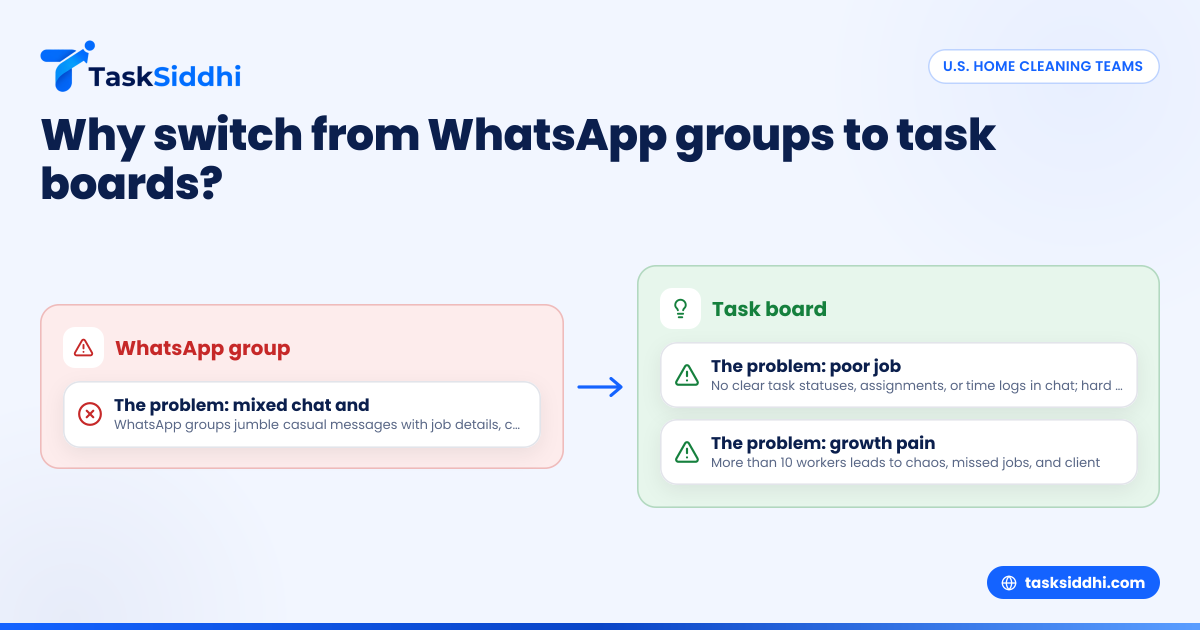
WhatsApp groups are popular for quick team chats but fall short in managing home cleaning service tasks efficiently. A task board organizes jobs, tracks progress, and improves communication — making it easier for U.S. cleaning teams to deliver reliable service without the mess of endless chat threads.
Key takeaways
- WhatsApp groups mix chat and task details, creating confusion for cleaning teams.
- Task boards provide clear job tracking, proof of work, schedules, and time logging in one place.
- When your home cleaning business in Chicago, Houston, or Detroit grows beyond a few workers, a task board improves management and client satisfaction.
- Using AI in WhatsApp groups adds limited automation, but a task board’s structured approach is better for complex workflows.
- TaskSiddhi offers a mobile-friendly task board designed for field and service teams like home cleaning businesses.
- Transitioning helps avoid missed jobs, wasted hours, and frustrating client communication.
Why do U.S. home cleaning teams rely on WhatsApp groups?
WhatsApp groups are widely used by small U.S. teams because they’re free, simple, and almost everyone has the app. In housing markets like Houston or Detroit, home cleaning businesses often start by coordinating jobs, shifts, and quick updates on WhatsApp. You can quickly share addresses, photos, and instructions, and team members respond in real time.
This instant connectivity is helpful for urgent questions and informal coordination. However, WhatsApp groups weren’t built to act as a work management system. Mixing casual chat with job details leads to lost information, overlooked tasks, and duplicated efforts.
What limitations do WhatsApp groups have compared to task boards?
WhatsApp groups combine conversations and job details in one messy feed. This setup causes several problems for managing home cleaning teams in the U.S.:
- No clear job tracking: Once a cleaning request is posted, there’s no easy way to mark it “in progress” or “done.” You must scroll through old messages or ask for updates.
- Lost or buried information: Important instructions and client requests get mixed with casual chat and quickly get buried.
- No work proof or time tracking: Documenting work progress or time spent requires separate apps or manual logging.
- Limited task assignments: It’s hard to assign jobs clearly to individuals without message confusion.
- Scheduling hassles: No simple way to manage shift swaps, upcoming jobs, or route plans.
- Unreliable reporting: No option to view overall performance or job counts in one place.
- Growth pain: As your 10-30 person team expands in a city such as Chicago, WhatsApp chaos increases, making management inefficient.
How can AI WhatsApp group features help, and where do they fall short?
AI WhatsApp group features aim to automate tasks like reminders, basic scheduling, or answering FAQs right inside the chat. This can save some time by reducing repetitive messages and nudging workers on deadlines. But AI automation inside WhatsApp chat remains limited for thorough task management.
While it can make chat more efficient, AI WhatsApp group tools do not replace the need for a structured system. They can’t fully organize job details with statuses, proof of work, or time tracking as a good task board can. For growing U.S. home cleaning businesses, relying solely on AI in WhatsApp misses out on end-to-end workload visibility and systematic management.
Why should U.S. home cleaning businesses switch from WhatsApp groups to task boards?
Switching to a task board keeps all your job information centralized and structured. The benefits for cleaning teams with 5 to 30 people across U.S. cities are significant:
- Clear job statuses: Easily see which cleaning jobs are pending, in progress, or completed.
- Proof of work on-site: Upload photos or notes during site visits to show job completion.
- Easy time tracking: Log hours spent on each cleaning task for payroll accuracy and billing.
- Assigned responsibilities: Assign jobs clearly to team members to avoid confusion.
- Improved scheduling: Manage shifts, route planning, and job calendars.
- Performance reporting: Access stats for tracking efficiency, missed jobs, or site visit times.
- Reduced errors and missed jobs: Structured workflows cut down on loss of information common with chats.
- Better client communication: Quickly update clients with job progress proofs and schedules.
- Mobile access: Enable cleaners on the go to update jobs via smartphones, not just chat.
What is the easiest way to start using a task board for a home cleaning team?
Getting started doesn’t have to be overwhelming. Follow these five steps:
- Choose a task board app designed for service teams with site visits and mobile use.
- Create boards for daily cleaning jobs, scheduling, and client tasks.
- Add team members and assign them tasks via digital job cards.
- Train your crew to upload photos and log time directly through their phones.
- Use reporting features to review team performance weekly.
Tools like TaskSiddhi provide all these essentials tailored for U.S. home cleaning businesses. They simplify managing field visits, proof attachments, and time tracking in one place.
How do task boards integrate with your existing tools like QuickBooks or Stripe?
A good task board often links with common U.S. finance and accounting tools. You can export job data or time logs to QuickBooks for payroll and invoicing or use Stripe for client payments. This integration streamlines your operations from job scheduling to payment collection, reducing manual work and errors.
While WhatsApp groups require manual updating in finance apps, a task board serves as a central source of truth for billable work and hours. This seamless connection boosts financial accuracy in businesses operating in states with different sales tax regulations.
What about data security and privacy for managing U.S. teams?
WhatsApp is encrypted end-to-end, which protects chat content but lacks granular admin controls and audit logs for jobs. Professional task boards offer better user permissions, data backups, and meeting business buyer expectations for workflow visibility and control.
For home cleaning businesses handling sensitive client information in Chicago or Houston, a secure task board platform helps meet basic security standards expected by clients and partners. It also supports compliance with U.S. regulations like CAN-SPAM and TCPA when messaging customers professionally.
When is it time to stop relying on WhatsApp and adopt a task board?
If any of these pain points resonate with your home cleaning business, it’s time to consider a task board:
- Multiple missed or duplicated cleaning jobs.
- Confusion over who is assigned which tasks.
- Difficulty tracking team hours and payroll.
- Client complaints about unclear job updates.
- Excessive scrolling to find job details buried in chat.
- Growing team size beyond 10 members.
- Complex schedules or multiple client locations make WhatsApp inefficient.
Moving to a purpose-built task board will simplify daily management and support future growth.
See how TaskSiddhi’s mobile-friendly task board streamlines cleaning job management for U.S. teams on our product tour. Compare our plans to choose what fits your business at pricing.
Frequently asked questions
Can I still use WhatsApp groups along with a task board?
Yes. Many teams keep WhatsApp for casual chat and quick communication while handling job assignments, proof, and progress tracking through a task board. This hybrid approach reduces chat overload and boosts task clarity.
How does a task board improve client communication?
Task boards let you share job statuses, photos, and time estimates directly with clients. This transparency builds trust and reduces back-and-forth messages from customers about job progress.
What features should I look for in a task board for home cleaning?
Look for clear job assignment, photo attachments for proof, easy time tracking, scheduling tools, mobile app access, and reporting dashboards. Integration with QuickBooks or Stripe is helpful for billing and payroll.
Is switching to a task board expensive or time-consuming?
Many apps offer scalable pricing suitable for small teams and free trials. Initial setup requires some training but pays off quickly through saved hours, fewer errors, and improved team coordination.
How secure are task boards compared to WhatsApp?
Task boards provide role-based access control, data encryption, and backups. These features offer better administrative control over user permissions and job data than WhatsApp groups.
Can automation replace AI WhatsApp group features with task boards?
Yes. Automation inside a task board supports reminders, task dependencies, and workflows beyond simple chat bots, creating more robust process management tailored to your cleaning team’s needs.