














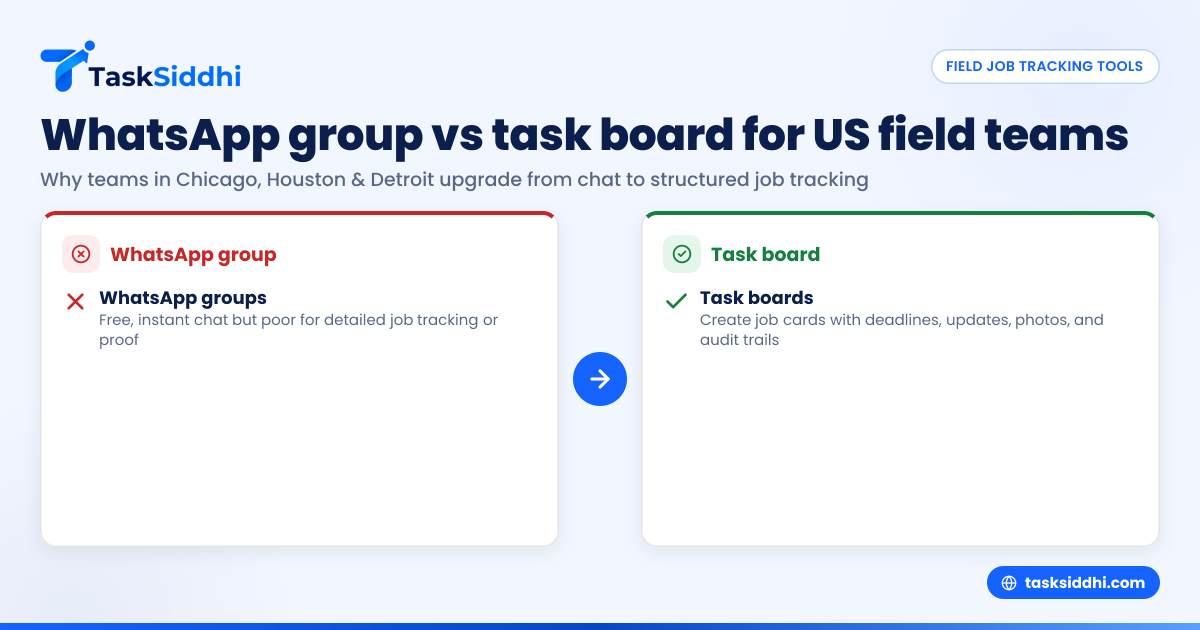
WhatsApp groups are quick for chatting but don’t organize jobs well for US field teams managing service or client work. A task board structures job cards, tracks progress, and stores proof of visits, making field operations clearer and more reliable. Switching improves accountability, reduces errors, and supports compliance.
Key takeaways
- WhatsApp groups lack task management features needed for tracking complex field jobs.
- Task boards create clear job cards with assignments, deadlines, and proof of work.
- Using a task board cuts confusion and errors from chat-based workflows.
- Mobile apps sync updates and time tracking for field workers on the go.
- Task boards help with compliance, billing accuracy, and audit readiness.
- Automation and reporting features simplify recurring jobs and performance analysis.
WhatsApp group vs task board: what’s the fundamental difference?
WhatsApp groups are chat apps good for informal communication but not for tracking or managing jobs. Task boards let you create job cards with customer info, job details, assigned workers, deadlines, and proof like photos or signatures. They show job status clearly from assignment to completion.
US teams in cities like Houston or Chicago often handle many client jobs daily. WhatsApp messages get buried or lost, and important instructions or proof can be missed. Task boards serve as a single source of truth, accessible by managers and workers anytime across the job lifecycle.
Why do US field teams often start with WhatsApp groups?
Many small US field teams start with WhatsApp because it’s free, instant, and everyone knows it. It requires no onboarding and can loosely coordinate small teams under five people with simple tasks.
But as teams grow beyond 10 members, or job complexity increases—as seen in HVAC or pest control companies in Detroit—WhatsApp struggles. Messages get chaotic, updates are missed, and tracking job completion becomes error-prone. This can cause billing mistakes, poor customer service, and compliance risks.
When should you switch from WhatsApp groups to a task board?
Short answer: Switch when job tracking on WhatsApp causes errors, delays, or audit problems.
If you often dig through chat history to find job status or proof, it’s time to move on. Look out for:
- Lost or incomplete job details in chats
- No clear audit trail for work done, necessary for 1099 contractor records
- Time-consuming manual reporting from messages
- Disputes or payment delays due to missing proof of service
- Multiple supervisors causing job assignment confusion
Task boards designed for service jobs or site visits fix these issues with structured boards and views, built-in time tracking, and consolidated proof on job cards.
How does an AI WhatsApp group integrate with task boards?
AI WhatsApp group tools can automate sorting messages and extracting tasks but can’t replace a task board’s clear workflows. AI may highlight deadlines or filter chats but remains limited by the format of messaging apps.
Some US businesses use AI to convert WhatsApp chat input into task board jobs, syncing work instantly and notifying field staff. This approach blends WhatsApp familiarity with professional task tracking, useful in fast-paced sectors like HVAC or pest control where prompt updates matter.
Pairing this with a dedicated mobile app lets workers access job details offline and sync updates securely, avoiding the confusion common in chat-heavy workflows.
How a task board improves job tracking and reduces errors
Task boards turn jobs into digital cards detailing customer info, job scope, location, and assigned team members. Workers can upload photos or signatures during field visits, track time automatically via time tracking, and update status from “Assigned” to “Completed.”
Managers in Chicago or Detroit can quickly review progress on reporting dashboards without searching through chat logs. This cuts unnecessary calls, fixes billing errors, and ensures accurate records for payroll and client invoices.
Built-in automation helps managers set reminders or recurring alerts, ensuring on-time completion and customer updates compliant with TCPA and CAN-SPAM rules.
What are key benefits of multimedia and proof on task boards?
Attaching photos, videos, and signatures to job cards provides solid proof for service verification and dispute resolution. WhatsApp scatters images across chats without clear job links, making retrieval difficult during audits or client inquiries.
Task boards centralize all proof per job, timestamped and geotagged for accuracy. This documentation speeds client approvals, reduces payment delays, and helps field teams comply with local state sales tax and contract rules.
How does task board reporting fit into US business needs?
Task boards generate ready-made reports by client, worker, or job type. This improves billing with tools like QuickBooks or Stripe by confirming hours worked and work done. Transparent reporting reduces payment disputes and boosts cash flow.
For example, a Houston service firm can monitor time per client, identify low productivity, and schedule site visits efficiently—all without manual guesswork. Reports also help prepare accurate 1099 forms by tracking contractor hours and completed jobs.
What does it cost to upgrade to a task board?
Task boards usually require a subscription but yield strong ROI by cutting errors, speeding up reporting, and improving service accuracy. Pricing often depends on features, users, and storage needs.
US businesses weigh free WhatsApp benefits against paid task boards’ gains in time saved, fewer mistakes, and smoother audits. Consider if your chosen board integrates well with QuickBooks, Stripe, or your ERP system.
Explore differences in free vs paid plans to pick what suits your team best.
How to smoothly transition your US field team from WhatsApp to a task board?
Smooth transitions reduce downtime and resistance.
- Clearly explain the benefits and reasons for switching to all team members.
- Train staff on using job cards, updates, and the mobile app.
- Migrate current tasks from chat messages into the task board gradually.
- Run WhatsApp alongside the task board at first for urgent needs.
- Monitor usage and collect feedback for ongoing improvements.
- Keep WhatsApp for informal chats only, and move all job tracking officially to the board.
Conclusion
WhatsApp groups help quick chats but fall short for US field teams handling service or client jobs. Moving to a task board builds clarity, accountability, and operational efficiency. Features like job cards, real-time updates, proof capture, and reporting support better field work in cities such as Chicago, Houston, and Detroit.
Try our product tour to see how it works or compare plans on our pricing page to find what fits your team.
Frequently asked questions
Can WhatsApp groups handle complex field service workflows?
WhatsApp groups do not support detailed job tracking, proof collection, or billing accuracy. Complex workflows require dedicated task boards built for end-to-end job management.
Are task boards expensive compared to using WhatsApp groups?
Task boards usually have subscription fees but save money by reducing errors and speeding reporting. They integrate better with US accounting tools like QuickBooks and Stripe.
How can AI WhatsApp group features help in task tracking?
AI helps by filtering important messages and turning chat tasks into formal job cards, but it cannot replace the structure and accountability offered by task boards.
What role does mobile app access play for field teams?
Mobile apps deliver real-time job updates and capture proof onsite—even offline—reducing reliance on calls or messages and improving accuracy.
Does switching to a task board help with regulatory compliance?
Yes. Task boards keep clear audit trails and proof of work to help meet IRS 1099 contractor rules and reduce risks tied to TCPA and CAN-SPAM regulations.
Can a task board integrate with existing US finance systems?
Many task boards connect with QuickBooks, Stripe, and ERP software common in US businesses, enabling smoother billing and financial reconciliation.