














Switching from WhatsApp groups to task boards offers Indian SMEs a structured, transparent, and efficient way to manage field teams. While WhatsApp is popular for quick chats, task boards provide clearer job tracking, accountability, and easier reporting, helping businesses grow with better organisation and professionalism.
Key takeaways
- WhatsApp groups are informal and lack the structure needed for field or service job management.
- Task boards enable clear task assignments, deadlines, and job status updates for Indian SMEs running mobile teams.
- Using task boards improves accountability, reduces errors, and eases communication beyond chat threads.
- With features like time tracking and proof uploads, task boards help enforce work discipline and GST-related compliance.
- Seamless mobile app access and automation simplify workflows compared to managing multiple WhatsApp conversations.
- Indian SMEs benefit from task boards tailored to local field work realities, like site visits and client jobs.
Why do Indian SMEs use WhatsApp groups for team management?
Indian SMEs use WhatsApp groups because they are free, easy to set up, and widely used across India for instant messaging. Owners and managers often prefer the familiarity and accessibility of WhatsApp to assign tasks and stay connected with teams in cities like Mumbai, Bengaluru, Pune, and beyond.
Despite its convenience, WhatsApp groups mix multiple task updates with casual chatting, causing confusion. Messages lack structure, deadlines, or clear assignments. Important job details often get buried. Handling large or complex jobs through chat leads to inefficiencies and missed information, impacting work quality and customer satisfaction.
What are the limitations of WhatsApp groups compared to task boards?
Task boards solve key pain points WhatsApp groups struggle with:
- No task assignment clarity: WhatsApp messages can be missed. There is no clear status for each job.
- Poor accountability: Without timestamps and checklists, it's impossible to confirm task completion or worker attendance.
- Lack of scalable organisation: As teams grow, managing multiple groups and chats becomes chaotic.
- No built-in reporting: Extracting data like time spent on jobs or proof of work requires manual effort.
- Disrupted communication flow: Important notifications get buried in casual chatting.
- No integration with workflow tools: WhatsApp does not automate reminders, job reassignments, or escalations.
These issues slow down service delivery, harm customer experience, and can affect compliance with invoices and job proof under GST rules. Field managers have to call multiple times to confirm work done. All this slows business growth.
How does a task board improve field team management for Indian SMEs?
A task board offers a centralised digital workspace where every job card is a task. Owners and managers can create boards by project, client, or region, with customizable job cards showing the task, assigned person, deadlines, status, and attachments.
Unlike WhatsApp groups, task boards:
- Provide a clear, visual overview of ongoing, pending, and completed jobs.
- Allow team members to update progress in real time with photos, GPS check-ins, and notes.
- Track time spent on each job using built-in time tracking features.
- Automate reminders and alerts for overdue tasks.
- Support role-based access to sensitive job details, improving data privacy.
- Help generate detailed reports for analysis and GST compliance.
Such structure makes managing a team of mobile workers across Mumbai, Pune, or smaller cities easier, reducing errors and improving accountability.
How does AI Whatsapp group usage affect SMEs?
AI WhatsApp group tools auto-sort messages or highlight key info but lack deep task management features. SMEs using an AI WhatsApp group assistant can partially reduce clutter, but it cannot replace task boards’ job assignment, progress tracking, or reporting benefits.
In other words, AI WhatsApp group enhancements can help communication but don’t meet the formal workflow and accountability needs of field teams. Task boards remain essential for comprehensive work management.
How easy is it for small teams to switch from WhatsApp groups to task boards?
Switching is simple and affordable. SMEs with 5 to 30 field staff can:
- Start a free trial with task board apps customised for Indian business needs.
- Migrate WhatsApp job details as task cards.
- Train teams using the mobile app.
- Use automation for reminders.
- Phase out WhatsApp task instructions gradually.
Mobile-friendly interfaces help field workers update jobs instantly, even in low-bandwidth areas. This approach speeds adoption and improves clarity and control.
What features should Indian SMEs look for in a task board app?
Look for:
- Mobile app with offline capability for site visits.
- Job cards with proof uploads (photos, signatures, checklists).
- Time tracking to monitor labour costs and productivity.
- Automated alerts for deadlines.
- Reporting features for GST compliance.
- Integration with invoicing tools like Tally.
- Data privacy compliance (DPDP Act 2023).
- Collaboration tools replacing WhatsApp chats.
- Support for Indian payment gateways if needed.
TaskSiddhi includes many such features designed for Indian field and service teams.
How does this help with GST and compliance in India?
Task boards keep digital records with timestamps, attachments, and job completion logs, aiding GST audits and e-invoicing compliance. Unlike WhatsApp chats, these records are organised and secure, saving time during tax filing and reducing risks of penalties.
What cost benefits can Indian SMEs expect by switching?
Though WhatsApp is free, managing multiple chats wastes time and causes errors. Task boards reduce rework, follow-ups, and improve productivity. This leads to faster job completion, better cash flow, and fewer mistakes. TaskSiddhi offers free vs paid plans that fit SME budgets.
How does task board use impact internal communication?
Task boards separate chat from work updates. Conversations happen within related job cards, reducing clutter. Managers gain clear visibility without scrolling endless messages. This focused communication improves efficiency and teamwork.
How do mobile apps for task boards enhance field visits?
Mobile apps let field staff update progress, upload photos, signatures, and location proof on the go. Offline features accommodate tier-2 and tier-3 cities with patchy networks. This improves service delivery and reduces delays compared to WhatsApp reliance.
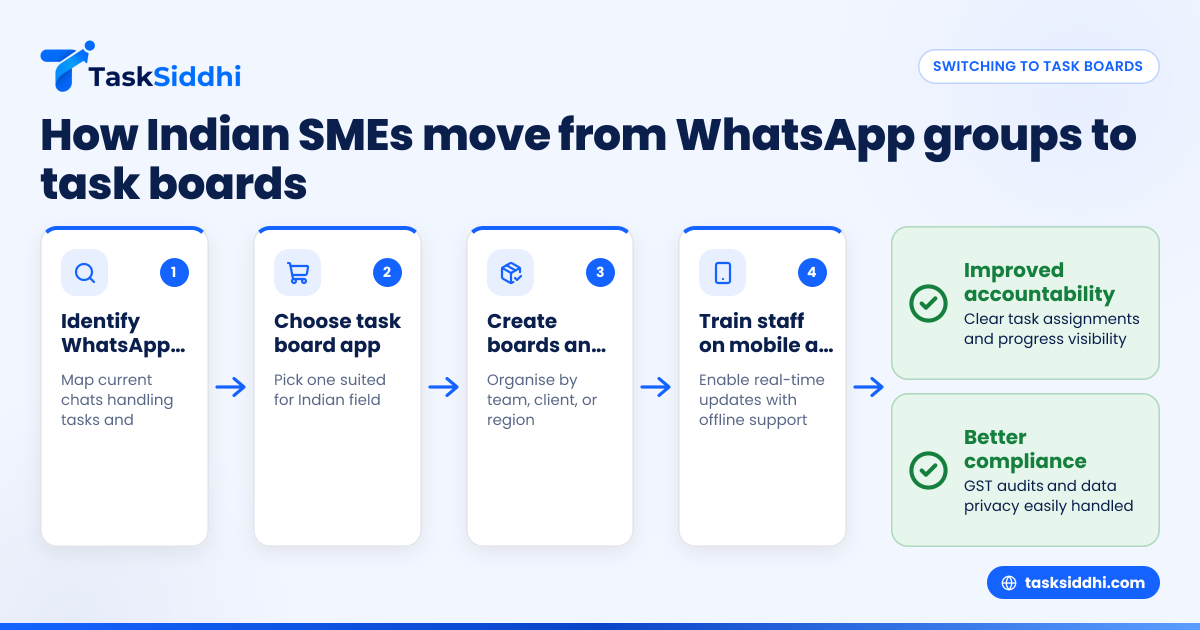
What are the main steps to implement a task board for field teams?
Set up is straightforward:
- Identify workflows currently managed on WhatsApp.
- Select a task board app suitable for Indian field teams.
- Create boards for teams or clients.
- Make job cards with assignee, deadlines, and proof fields.
- Train staff to use the mobile app for real-time updates.
- Start tracking time and enable notifications.
- Use reporting for performance and compliance.
- Gradually replace WhatsApp groups for task instructions.
Following these steps helps Indian SMEs smoothly switch to organised task management.
Ready to switch from WhatsApp to smarter task boards?
Task boards bring order, transparency, and control needed for Indian SMEs managing field teams. They replace chaotic chats with structured workflows, reduce delays, improve accountability, and support GST compliance.
Explore how this works in practice on the product tour or compare plans and features tailored for your team on the pricing page. Upgrade your team management today for business growth and peace of mind.
Frequently asked questions
Can small Indian teams really manage without WhatsApp groups?
Yes. Task boards combine communication and job tracking in one tool. While WhatsApp is good for casual chats, task boards handle official work with clarity and traceability necessary for professional management.
Will my team find it hard to switch from WhatsApp?
No, with proper training. Task boards often have mobile apps that are easy to use. Most teams quickly adapt once they experience fewer missed tasks and better organisation.
How does task board time tracking help SMEs?
It records actual hours worked, helping optimise staffing and calculate labour costs. Time data also supports accurate billing and GST compliance, improving financial control.
Is TaskSiddhi suitable for SMEs in smaller cities?
Yes. Designed for Indian SMEs, it supports offline work and low data usage, making it ideal for tier-2 and tier-3 cities beyond metros.
Does switching impact data privacy under DPDP Act 2023?
Task boards offer role-based access to protect sensitive data. This compliance is a major improvement over informal WhatsApp data storage.
Can task boards integrate with accounting software like Tally?
Many task boards export job data that works alongside Tally, easing reconciliation and audits. Check integration options before selecting a product.